
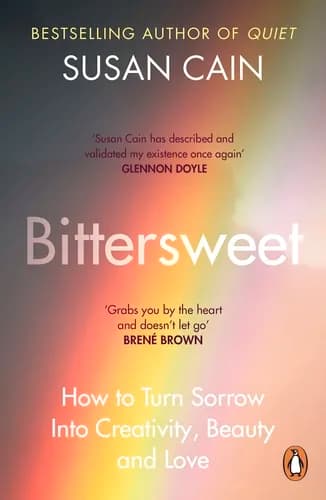
Quotes
We’ve unwittingly taught (children) a delusion—that things are supposed to be whole; that real life is when things are going well; that disappointment, illness, and flies at the picnic are detours from the main road.
p. 184
Our difficulty accepting impermanence is the heart of human suffering.
p. 181
The tragedy of life is linked inescapably with its splendor; you could tear civilization down and rebuild it from scratch, and the same dualities would rise again. Yet to fully inhabit these dualities—the dark as well as the light—is, paradoxically, the only way to transcend them.
The place where you suffer is the same space where you commit yourself to act.
The tyranny of positivity is the cultural message that all of us are sent that no matter what is happening, we should be putting on a happy face, that we should be soldiering through it and whistling cheerfully. I call it the tyranny of positivity and some people call it toxic positivity. What it really is, is a cultural directive that says, Whatever you do, don't tell the truth of what it's like to be alive.
I've concluded that bittersweetness is not, as we tend to think, just a momentary feeling or event. It's also a quiet force, a way of being, a storied tradition—as dramatically overlooked as it is brimming with human potential. It's an authentic and elevating response to the problem of being alive in a deeply flawed yet stubbornly beautiful world.
Longing is the great human state.
"Expressive writing" encourages us to see our misfortunes not as flaws that make us unfit for worldly success (or otherworldly heaven), but as the seeds of our growth.
p. 151
We like art forms that express our longing for union, and for a more perfect and beautiful world.
p. 36
In fact, you could say that what orients a person to the bittersweet is a heightened awareness of finality.
Longing is momentum in disguise: It's active, not passive; touched with the creative, the tender, and the divine.
It doesn’t matter whether we consider ourselves "secular" or "religious": in some fundamental way, we're all reaching for the heavens.
This book is about the melancholic direction, which I call the "bittersweet": a tendency to states of longing, poignancy, and sorrow; an acute awareness of passing time; and a curiously piercing joy at the beauty of the world.
How did a nation founded on so much heartache turn into a culture of normative smiles?
p. 117
There's a reason that so many religions and wisdom traditions counsel meditating on death, and it's because there's almost nothing that delivers you so quickly to the preciousness of life than to think about death.
We think we long for eternal life, but maybe what we're really longing for is perfect and unconditional love; a world in which lions actually do lay down with lambs; a world free of famines and floods, concentration camps and Gulag archipelagos; a world in which we grow up to love others in the same helplessly exuberant way we once loved our parents; a world in which we're forever adored like a precious baby; a world built on an entirely different logic from our own, one in which life needn't eat life in order to survive.
p. 178
The very highest states—of awe and joy, wonder and love, meaning and creativity—emerge from this bittersweet nature of reality. We experience them not because life is perfect—but because it's not.
p. 92
Whatever pain you can't get rid of, make it your creative offering.
p. 56
Living in a bittersweet state, with an intense awareness of life's fragility and the pain of separation, is an underappreciated strength and an unexpected path to wisdom, joy, and especially communion.
p. 183
Being able to exist in a place where light and dark meet is actually not a recipe for unhappiness. It is a recipe for a deeper kind of happiness.
Upbeat tunes make us want to dance around our kitchens and invite friends for dinner. But it's sad music that makes us want to touch the sky.
p. 36
It's not that pain equals art. It's that creativity has the power to look pain in the eye, and to decide to turn it into something better. ... The quest to transform pain into beauty is one of the great catalysts of artistic expression.
p. 61
Seneca suggested that each night we tell ourselves that "You may not wake up tomorrow," and that we greet every morning with the reminder that "You may not sleep again." All of these practices are meant to help us treat our lives, and each other, as the precious gifts they are.
p. 192
When you listen to music, you can transcend your own pain and turn towards another and feel bonded with the whole of humanity because you know that they have felt that grief and love. By expressing it, by communing with that song or picture, you realize you are not alone.
The secret that our poets and philosophers have been trying to tell us for centuries, is that our longing is the great gateway to belonging.
(T)he bittersweet tradition spans centuries—it spans continents. And it teaches us that we are creatures who are born to transform pain into beauty. It also teaches us that our feelings of bittersweetness are some of the greatest gateways that we have to states of creativity and connection and love.
Human beings are a meaning-making species.
We listen to sad music for the same reason we go to church or synagogue or the mosque. We long for the Garden of Eden, we long for Mecca, we long for Zion because we come into this world with the sense that there is a more perfect and beautiful world to which we belong, where we are no longer.


That’s all the quotes.
28 quotes in the collection · come back when we add more