Quotes about meaning of life
20 quotes · 9 authors
Quotes
Human nature simply cannot subsist without a hope and aim of some kind; as the sanity of the Old Testament truly said, where there is no vision the people perisheth. But it is precisely because an ideal is necessary to man that the man without ideals is in permanent danger of fanaticism.
Ultimately a man cannot rejoice in anything except the nature of things. Ultimately a man can enjoy nothing except religion. Once in the world's history men did believe that the stars were dancing to the tune of their temples, and they danced as men have never danced since. With this old pagan eudaemonism the sage of the Rubaiyat has quite as little to do as he has with any Christian variety. He is no more a Bacchanal than he is a saint. Dionysus and his church was grounded on a serious joie-de-vivre like that of Walt Whitman. Dionysus made wine, not a medicine, but a sacrament. Jesus Christ also made wine, not a medicine, but a sacrament. But Omar makes it, not a sacrament, but a medicine. He feasts because life is not joyful; he revels because he is not glad. "Drink," he says, "for you know not whence you come nor why. Drink, for you know not when you go nor where. Drink, because the stars are cruel and the world as idle as a humming-top. Drink, because there is nothing worth trusting, nothing worth fighting for. Drink, because all things are lapsed in a base equality and an evil peace." So he stands offering us the cup in his hand. And at the high altar of Christianity stands another figure, in whose hand also is the cup of the vine. "Drink" he says "for the whole world is as red as this wine, with the crimson of the love and wrath of God. Drink, for the trumpets are blowing for battle and this is the stirrup-cup. Drink, for this my blood of the new testament that is shed for you. Drink, for I know of whence you come and why. Drink, for I know of when you go and where."
At any innocent tea-table we may easily hear a man say, "Life is not worth living." We regard it as we regard the statement that it is a fine day; nobody thinks that it can possibly have any serious effect on the man or on the world. And yet if that utterance were really believed, the world would stand on its head. Murderers would be given medals for saving men from life; firemen would be denounced for keeping men from death; poisons would be used as medicines; doctors would be called in when people were well; the Royal Humane Society would be rooted out like a horde of assassins. Yet we never speculate as to whether the conversational pessimist will strengthen or disorganize society; for we are convinced that theories do not matter.
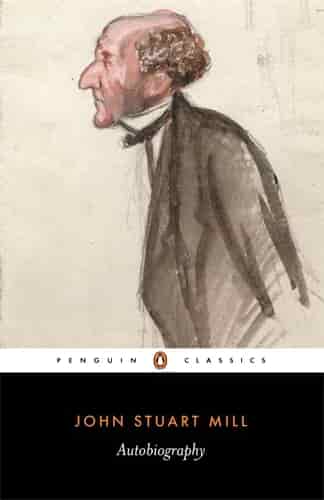
From the winter of 1821, when I first read Bentham, and especially from the commencement of the Westminster Review, I had what might truly be called an object in life; to be a reformer of the world. My conception of my own happiness was entirely identified with this object. The personal sympathies I wished for were those of fellow labourers in this enterprise. I endeavoured to pick up as many flowers as I could by the way; but as a serious and permanent personal satisfaction to rest upon, my whole reliance was placed on this...
p. 132
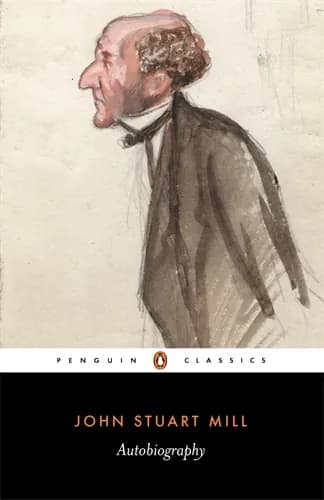 Autobiography
He thought human life a poor thing at best, after the freshness of youth and of unsatisfied curiosity had gone by. This was a topic on which he did not often speak, especially, it may be supposed, in the presence of young persons: but when he did, it was with an air of settled and profound conviction. He would sometimes say, that if life were made what it might be, by good government and good education, it would be worth having: but he never spoke with anything like enthusiasm even of that possibility.
p. 48
AutobiographyIn this frame of mind it occurred to me to put the question directly to myself: "Suppose that all your objects in life were realized; that all the changes in institutions and opinions which you are looking forward to, could be completely effected at this very instant: would this be a great joy and happiness to you?" And an irrepressible self-consciousness distinctly answered, "No!" At this my heart sank within me: the whole foundation on which my life was constructed fell down. All my happiness was to have been found in the continual pursuit of this end. The end had ceased to charm, and how could there ever again be any interest in the means? I seemed to have nothing left to live for.
p. 133
AutobiographyThe enjoyments of life (such was now my theory) are sufficient to make it a pleasant thing, when they are taken en passant, without being made a principal object. Once make them so, and they are immediately felt to be insufficient. They will not bear a scrutinizing examination. Ask yourself whether you are happy, and you cease to be so. The only chance is to treat, not happiness, but some end external to it, as the purpose of life. Let your self-consciousness, your scrutiny, your self-interrogation, exhaust themselves on that; and if otherwise fortunately circumstanced you will inhale happiness with the air you breathe, without dwelling on it or thinking about it, without either forestalling it in imagination, or putting it to flight by fatal questioning. This theory now became the basis of my philosophy of life. And I still hold to it as the best theory for all those who have but a moderate degree of sensibility and of capacity for enjoyment; that is, for the great majority of mankind.
p. 142
AutobiographyOnce when Isaac and I talked about old age, illness, and death, he said it wasn’t so terrible to get sick and old and to die if you’ve been part of life completing itself as a pattern. Even if you don’t make it to old age, it’s still worthwhile, there’s still pleasure in that vision of being part of the pattern of life—especially a pattern expressed in creativity and shared in love.
p. 562
Without the interplay of human against human, the chief interest in life is gone; most of the intellectual values are gone; most of the reason for living is gone.
p. 398
Yet it was the impression that the unknown master has set out to create, Phoenix-like, from the dying embers of a great legend. He had captured, and held for all future ages to see, that beauty whose service is the purpose of life, and it sole justification.
p. 292
Si me preguntáis en dónde he estado
debo decir "Sucede."
Debo de hablar del suelo que oscurecen las piedras,
del río que durando se destruye:
no sé sino las cosas que los pájaros pierden,
el mar dejado atrás, o mi hermana llorando.
¿Por qué tantas regiones, por qué un día
se junta con un día? ¿Por qué una negra noche
se acumula en la boca? ¿Por qué muertos?
Art, at least, teaches us that man cannot be explained by history alone and that he also finds a reason for his existence in the order of nature.