Quotes about change
30 quotes · 18 authors
Quotes
The science of government being, therefore, so practical in itself, and intended for such practical purposes, a matter which requires experience, and even more experience than any person can gain in his whole life, however sagacious and observing he may be, it is with infinite caution that any man ought to venture upon pulling down an edifice which has answered in any tolerable degree for ages the common purposes of society, or on building it up again without having models and patterns of approved utility before his eyes.
 Reflections on the Revolution in France
By the disposition of a stupendous wisdom, moulding together the great mysterious incorporation of the human race, the whole, at one time, is never old, or middle-aged, or young; but, in a condition of unchangeable constancy, moves on through the varied tenor of perpetual decay, fall, renovation, and progression.
Reflections on the Revolution in FranceA state without the means of some change is without the means of its conservation.
Reflections on the Revolution in FranceThe way a crow
Shook down on me
The dust of snow
From a hemlock tree Has given my heart
A change of mood
And saved some part
Of a day I had rued.
The practical reformer has continually to demand that changes be made in things which are supported by powerful and widely-spread feelings, or to question the apparent necessity and indefeasibleness of established facts; and it is often an indispensable part of his argument to show, how these powerful feelings had their origin, and how those facts came to seem necessary and indefeasible. There is therefore a natural hostility between him and a philosophy which discourages the explanation of feelings and moral facts by circumstances and association, and prefers to treat them as ultimate elements of human nature; a philosophy which is addicted to holding up favorite doctrines as intuitive truths, and deems intuition to be the voice of Nature and of God, speaking with an authority higher than that of our reason. In particular, I have long felt that the prevailing tendency to regard all the marked distinctions of human character as innate, and in the main indelible, and to ignore the irresistible proofs that by far the greater part of those differences, whether between individuals, races, or sexes, are such as not only might but naturally would be produced by differences in circumstances, is one of the chief hindrances to the rational treatment of great social questions, and one of the greatest stumbling blocks to human improvement.
p. 273
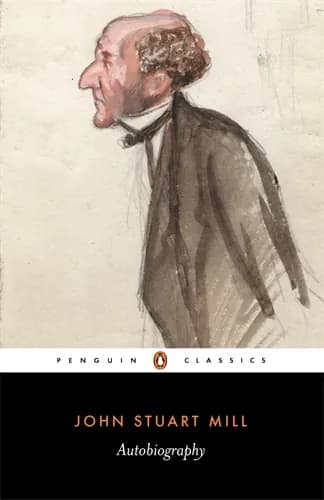 Autobiography
It is the character of the British people, or at least of the higher and middle classes who pass muster for the British people, that to induce them to approve of any change, it is necessary that they should look upon it as a middle course: they think every proposal extreme and violent unless they hear of some other proposal going still farther, upon which their antipathy to extreme views may discharge itself. So it proved in the present instance; my proposal was condemned, but any scheme for Irish Land reform, short of mine, came to be thought moderate by comparison.
p. 294
Autobiography[I]t might even be questioned if the various causes of deterioration which had been at work in the meanwhile, had not more than counterbalanced the tendencies to improvement. I had learnt from experience that many false opinions may be exchanged for true ones, without in the least altering the habits of mind of which false opinions are the result. The English public, for example, are quite as raw and undiscerning on subjects of political economy since the nation has been converted to free-trade, as they were before; and are still further from having acquired better habits of thought and feeling, or being in any way better fortified against error, on subjects of a more elevated character. For, though they have thrown off certain errors, the general discipline of their minds, intellectually and morally, is not altered. I am now convinced, that no great improvements in the lot of mankind are possible, until a great change takes place in the fundamental constitution of their modes of thought.
p. 238
AutobiographyIn this third period (as it may be termed) of my mental progress, which now went hand in hand with hers, my opinions gained equally in breadth and depth, I understood more things, and those which I had understood before, I now understood more thoroughly. I had now completely turned back from what there had been of excess in my reaction against Benthamism. I had, at the height of that reaction, certainly become much more indulgent to the common opinions of society and the world, and more willing to be content with seconding the superficial improvement which had begun to take place in those common opinions, than became one whose convictions on so many points, differed fundamentally from them. I was much more inclined, than I can now approve, to put in abeyance the more decidedly heretical part of my opinions, which I now look upon as almost the only ones, the assertion of which tends in any way to regenerate society.
p. 230
AutobiographyThe experiences of this period had two very marked effects on my opinions and character. In the first place, they led me to adopt a theory of life, very unlike that on which I had before acted, and having much in common with what at that time I certainly had never heard of, the anti-self-consciousness theory of Carlyle.
p. 141
AutobiographyNew technologies create new customs, new laws, new ethics, new crimes.
p. 28
Putting a monkey wrench in machinery is often the only way to force somebody to repair, replace, or redesign the machinery. Especially legal or social machinery.
p. 97
There is social and psychological inertia, as well as physical inertia.
p. 457