


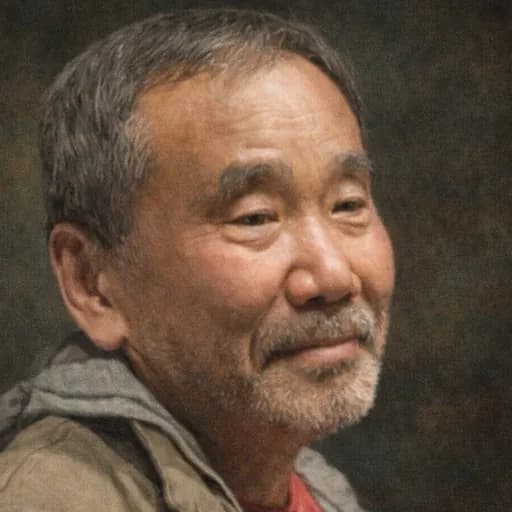
Haruki Murakami
Quotes
“I’d like to wish you luck, but I am afraid a good luck wish from me won’t do any good,” Tamaru said.
“Because you don’t believe in luck.”
“Even if I wanted to, I don’t know what it’s like,” Tamaru said. “I’ve never seen it.”
p. 461
“Fukada was supposedly looking for a utopia in the Takashima system,” the Professor said with a frown. “But utopias don’t exist, of course, anywhere in any world. Like alchemy or perpetual motion. What Takashima is doing, if you ask me, is making mindless robots. They take the circuits out of people’s brains that make it possible for them to think for themselves. Their world is like the one that George Orwell depicted in his novel. I’m sure you realize that there are plenty of people who are looking for exactly that kind of brain death. It makes life a lot easier. You don’t have to think about difficult things, just shut up and do what your superiors tell you to do. You never have to starve. To people who are searching for that kind of environment, the Takashima Academy may well be utopia.”
p. 153
“I barely looked at him, but he seemed kind of creepy.”
Tengo put the card into his wallet. “I suspect that impression wouldn’t change even if you had more time to look at him,” he said.
“I always tell myself not to judge people by their appearance. I’ve been wrong in the past and had some serious regrets. But the minute I saw this man, I got the feeling that he couldn’t be trusted. I still feel that way.”
“You’re not alone,” Tengo said.
p. 423
What we call the present is given shape by an accumulation of the past.
p. 386
I’ve never had the slightest interest in matters of the occult. People have been repeating the same kinds of fraud throughout the world since the beginning of time, using the same old tricks, and still these despicable fakes continue to thrive. That is because most people believe not so much in truth as in things they wish were the truth. Their eyes may be wide open, but they don’t see a thing. Tricking them is as easy as twisting a baby’s arm.
p. 305
A butterfly came fluttering along and landed on the shoulder of her blue work shirt. It was a small, white butterfly with a few crimson spots on its wings. The butterfly seemed to know no fear as it went to sleep on her shoulder.
“I’m sure you’ve never seen this kind of butterfly,” the dowager said, glancing toward her own shoulder. Her voice betrayed a touch of pride. “Even down in Okinawa, you’d have trouble finding one of these. It gets its nourishment from only one type of flower – a special flower that only grows in the mountains of Okinawa. You have to bring the flower here and grow it first if you want to keep this butterfly in Tokyo. It’s a lot of trouble. Not to mention the expense.”
“It seems to be very comfortable with you.”
“This little person thinks of me as a friend.”
“Is it possible to become friends with a butterfly?”
“It is if you first become a part of nature. You suppress your presence as a human being, stay very still, and convince yourself that you are a tree or grass or a flower. It takes time, but once the butterfly lets its guard down, you can become friends quite naturally.”
“Do you give them names?” Aomame asked, curious. “Like dogs or cats?”
The dowager gave her head a little shake. “No, I don’t give them names, but I can tell one from another by their shapes and patterns. And besides, there wouldn’t be much point in giving them names: they die so quickly. These people are your nameless friends for just a little while. I come here every day, say hello to the butterflies, and talk about things with them. When the time comes, though, they just quietly go off and disappear. I’m sure it means they’ve died, but I can never find their bodies. They don’t leave any trace behind. It’s as if they’ve been absorbed by the air. They’re dainty little creatures that hardly exist at all: they come out of nowhere, search quietly for a few, limited things, and disappear into nothingness again, perhaps to some other world.”
p. 101
No matter how passionately or minutely he might attempt to rewrite the past, the present circumstances in which he found himself would remain generally unchanged. Time had the power to cancel all changes wrought by human artifice, overwriting all new revisions with further revisions, returning the flow to its original course. A few minor facts might be changed, but Tengo would still be Tengo.
p. 454
“To give you my honest opinion,” the dowager went on, “the Society of Witnesses is not a proper religion. If you had been badly injured or come down with an illness that required surgery, you might have lost your life then and there. Any religion that would prohibit life-saving surgery simply because it goes against the literal word of the Bible can be nothing other than a cult. This is an abuse of dogma that crosses the line.”
p. 304
I move, therefore I am.
p. 36
But who can possibly save all the people of the world? Tengo thought. You could bring all the gods of the world into one place, and still they couldn’t abolish nuclear weapons or eradicate terrorism. They couldn’t end the drought in Africa or bring John Lennon back to life. Far from it—the gods would just break into factions and start fighting among themselves, and the world would probably become even more chaotic than it is now. Considering the sense of powerlessness that such a state of affairs would bring about, to have people floating in a pool of question marks seems like a minor sin.
p. 475
It was her personal view that people who are overly choosy about the drinks they order in a bar tend to be sexually bland. She had no idea why this should be so.
p. 70
Judging from the spiderwebs clinging to it, the emergency stairway was hardly ever used. To each web clung a small black spider, patiently waiting for its small prey to come along. Not that the spiders had any awareness of being “patient.” A spider had no special skill other than building its web, and no lifestyle choice other than sitting still. It would stay in one place waiting for its prey until, in the natural course of things, it shriveled up and died. This was all genetically predetermined. The spider had no confusion, no despair, no regrets. No metaphysical doubt, no moral complications. Probably. Unlike me.
p. 36

