


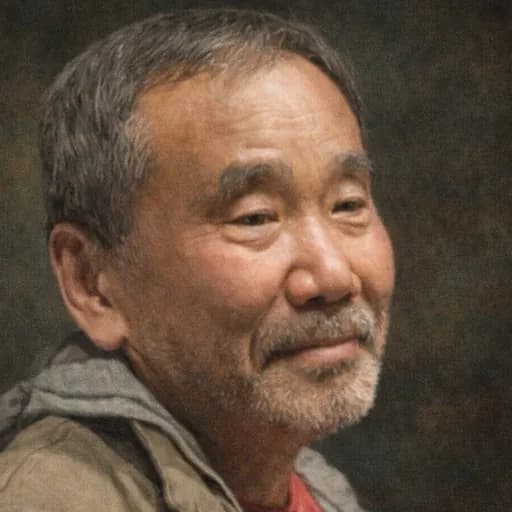
Haruki Murakami
Quotes
The pursuer’s blind spot is that he never thinks he’s being pursued.
p. 1025
So he always kept his mouth shut. He kept his ears open and listened closely to whatever anyone else had to say, aiming to learn something from everything he heard. This habit eventually became a useful tool. Through this, he discovered a number of important realities, including this one: most people in the world don’t really use their brains to think. And people who don’t think are the ones who don’t listen to others.
p. 868
Before he had realized it, these exercises had given him the talent to be skeptical about his own self, and he had come to the recognition that most of what is generally considered the truth is entirely relative. Subject and object are not as distinct as most people think. If the boundary separating the two isn’t clear-cut to begin with, it is not such a difficult task to intentionally shift back and forth from one to the other.
p. 913
It’s no fun growing old, no fun at all. The drawers where you store memories get harder to open.
p. 752
Tengo started to have doubts about the difference between a person being alive and being dead. Maybe there really wasn’t much of a difference to begin with, he thought. Maybe we just decided, for convenience’s sake, to insist on a difference.
p. 772
You said you’re going far away,” Tamaru said. “How far away are we talking about?”
“It’s a distance that can’t be measured.”
“Like the distance that separates one person’s heart from another’s.”
p. 1108
In Ushikawa’s experience, nobody hated paying taxes more than the rich.
p. 787
Aomame’s family—as far as Ushikawa could see it, that is—were narrow-minded in their thinking, narrow-minded in the way they lived. They were people who had no doubt whatsoever that the more narrow-minded they became, the closer they got to heaven.
p. 835
I’m just a machine. A capable, patient, unfeeling machine. A machine that draws in new time through one end, then spits out old time from the other end. It exists in order to exist.
p. 963
“Tell me, Tengo, as a novelist, what is your definition of reality?”
“When you prick a person with a needle, red blood comes out—that’s the real world,” Tengo replied.
p. 996
From Ushikawa’s perspective, they were irretrievably shallow. To him, their minds were dull, their vision narrow and devoid of imagination, and all they cared about was what other people thought. More than anything, they were completely lacking in the sort of healthy skepticism needed to attain any degree of wisdom.
p. 912
Everything ended in silence. The beasts and spirits heaved a deep breath, broke up their encirclement, and returned to the depths of a forest that had lost its heart.
p. 591

