Quotes about doubt
16 quotes · 14 authors
Quotes
That was doublethink. He had a feeling of deadly helplessness. If he could have been certain that O'Brien was lying, it would not have seemed to matter. But it was perfectly possible that O'Brien had really forgotten the photograph. And if so, then already he would have forgotten his denial of remembering it, and forgotten the act of forgetting. How could one be sure that it was simple trickery? Perhaps that lunatic dislocation in the mind could really happen: that was the thought that defeated him.
He wondered, as he had many times wondered before, whether he himself was a lunatic. Perhaps a lunatic was simply a minority of one. At one time it had been a sign of madness to believe that the earth goes round the sun; today, to believe that the past is unalterable. He might be ALONE in holding that belief, and if alone, then a lunatic. But the thought of being a lunatic did not greatly trouble him: the horror was that he might also be wrong.
Alas! the fearful Unbelief is unbelief in yourself.
Scepticism is not irrefutable, but obviously nonsensical, when it tries to raise doubts where no questions can be asked.
For doubt can exist only where a question exists, a question only where an answer exists, and an answer only where something can be said.
We've looked and looked, but after all where are we?
Do we know any better where we are,
And how it stands between the night tonight
And a man with a smoky lantern chimney?
How different from the way it ever stood?
Truths turn into dogmas the instant that they are disputed. Thus every man who utters a doubt defines a religion. And the scepticism of our time does not really destroy the beliefs, rather it creates them; gives them their limits and their plain and defiant shape. We who are Liberals once held Liberalism lightly as a truism. Now it has been disputed, and we hold it fiercely as a faith. We who believe in patriotism once thought patriotism to be reasonable, and thought little more about it. Now we know it to be unreasonable, and know it to be right. We who are Christians never knew the great philosophic common sense which inheres in that mystery until the anti-Christian writers pointed it out to us. The great march of mental destruction will go on. Everything will be denied. Everything will become a creed. It is a reasonable position to deny the stones in the street; it will be a religious dogma to assert them. It is a rational thesis that we are all in a dream; it will be a mystical sanity to say that we are all awake. Fires will be kindled to testify that two and two make four. Swords will be drawn to prove that leaves are green in summer. We shall be left defending, not only the incredible virtues and sanities of human life, but something more incredible still, this huge impossible universe which stares us in the face. We shall fight for visible prodigies as if they were invisible. We shall look on the impossible grass and the skies with a strange courage. We shall be of those who have seen and yet have believed.
The world would be astonished if it knew how great a proportion of its brightest ornaments—of those most distinguished even in popular estimation for wisdom and virtue—are complete sceptics in religion...
p. 45
It was a horrible feeling to find things in your head and not know how they fitted.
Now the plan was threatend by something more serious than the Mule had ever been. It was to be diverted from a renewal of Empire to something utterly different from anything in history - Galaxia. And he himself had agreed to that. But why? Was there a flaw in the plan? a basic flaw? For one flashing moment, it seemed to Trevize that this flaw did indeed exist and that he knew what it was, that he had known what it was when he made his decision - but the knowledge...if that were what it was...vanished as fast as it came, and left him with nothing.
p. 59
In order to seek truth, it is necessary once in the course of our life, to doubt, as far as possible, of all things.
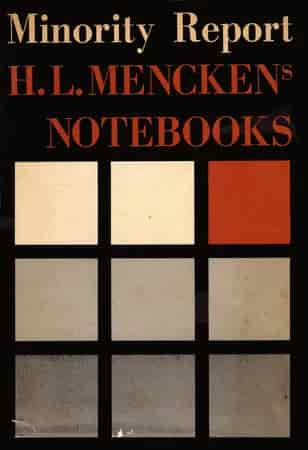
Moral certainty is always a sign of cultural inferiority. The more uncivilized the man, the surer he is that he knows precisely what is right and what is wrong. All human progress, even in morals, has been the work of men who have doubted the current moral values, not of men who have whooped them up and tried to enforce them. The truly civilized man is always skeptical and tolerant, in this field as in all others. His culture is based on "I am not too sure."
We are here and it is now: further than that, all human knowledge is moonshine.