


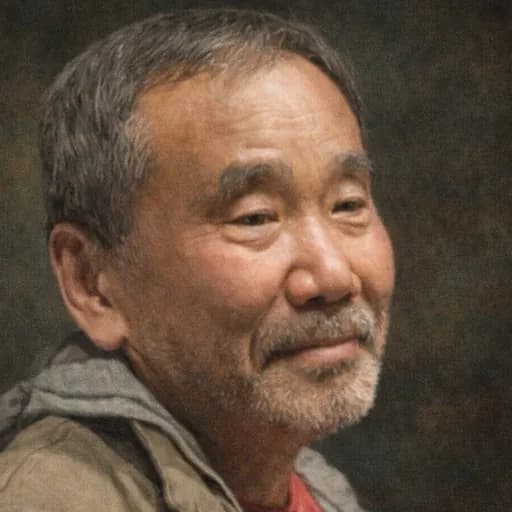
Haruki Murakami
Quotes
“Not very heartwarming facts, are they.”
“Well, with facts what’s important is their weight and accuracy. Warmth is secondary.”
p. 844
“There is always just a thin line separating deep faith from intolerance,” Ushikawa said. “And it’s very hard for people to do anything about it.”
p. 879
Tengo gazed at the moons, not paying much attention to the sound of the wind, sitting there until his whole body was chilled to the bone. It must have been around fifteen minutes. No, maybe more. His sense of time had left him. His body, initially warmed by the whiskey, now felt hard and cold, like a lonely boulder at the bottom of the sea.
The clouds continued to scud off toward the south. No matter how many were blown away, others appeared to take their place. There was an inexhaustible source of clouds in some land far to the north. Decisive people, minds fixed on the task, clothed in thick, gray uniforms, working silently from morning to night to make clouds, like bees make honey, spiders make webs, and war makes widows.
p. 937
“It’s very difficult to logically explain the illogical.”
“Exactly. As difficult as finding a real pearl in a Roppongi oyster bar.”
p. 1104
Air Chrysalis had long since disappeared from the bestseller lists. Number one on the list now was a diet book entitled Eat as Much as You Want of the Food You Love and Still Lose Weight. What a great title. The whole book could be blank inside and it would still sell.
p. 776
The total amount of time available is especially limited. The clock is ticking as we speak. Time rushes past. Opportunities are lost right and left. If you have money, you can buy time. You can even buy freedom if you want. Time and freedom: those are the most important things that people can buy with money.
p. 416
“Feelings like that don’t give you any choice, do they?” Aomame said. “They come at you whenever they want to. It’s not like choosing food from a menu.”
“It is in one way: you have regrets after you make a mistake.”
They shared a laugh.
Aomame said, “It’s the same with menus and men and just about anything else: we think we’re choosing things for ourselves, but in fact we may not be choosing anything. It could be that everything’s decided in advance and we pretend we’re making choices. Free will may be an illusion. I often think that.”
“If that’s true, life is pretty dark.”
“Maybe so.”
“But if you can love someone with your whole heart—even if he’s a terrible person and even if he doesn’t love you back—life is not a hell, at least, though it might be kind of dark. Is that what you’re saying?” Ayumi asked.
“Exactly.”
“But still,” Ayumi said, “it seems to me that this world has a serious shortage of both logic and kindness.”
“You may be right,” Aomame said. “But it’s too late to traded in for another one.”
“The exchange window expired a long time ago,” Ayumi said.
“And the receipt’s been thrown away.”
“You said it.”
“Oh, well, no problem,” Aomame said. “The world’s going to end before we know it.”
p. 241
You’re still young and healthy. Maybe that’s why you don’t understand what I am saying. Let me give you an example. Once you pass a certain age, life becomes nothing more than a process of continual loss. Things that are important to your life begin to slip out of your grasp, one after another, like a comb losing teeth. And the only things that come to take their place are worthless imitations. Your physical strength, your hopes, your dreams, your ideals, your convictions, all meaning, or, then again, the people you love: one by one, they fade away. Some announce their departure before they leave, while others just disappear all of a sudden without warning one day. And once you lose them you can never get them back. Your search for replacements never goes well. It’s all very painful—as painful as actually being cut with a knife. You will be turning thirty soon, Mr. Kawana, which means that, from now on, you will gradually enter that twilight portion of life—you will be getting older. You are probably beginning to grasp that painful sense that you are losing something, are you not?
p. 482
Most people are not looking for provable truths. As you said, truth is often accompanied by intense pain, and almost no one is looking for painful truths. What people need is beautiful, comforting stories that make them feel as if their lives have some meaning. Which is where religion comes from.
p. 550
Drawing distinctions between religions and cults has always been a delicate business. There’s no hard and fast definition. Interpretation is everything. And where there is room for interpretation, there is always room for political persuasion.
p. 184
This may be the most important proposition revealed by history: “At the time, no one knew what was coming.”
p. 3
The dowager smiled. “What an interesting person you are!”
Aomame said, “I’m a very ordinary human being. I just happen to like reading books. Especially history books.”
“I like history books too. They teach us that we are basically the same, whether now or in the old days. There may be a few differences in clothing and lifestyle, but there’s not that much difference in what we think and do. Human beings are ultimately nothing but carriers—passageways—for genes. They ride us into the ground like racehorses from generation to generation. Genes don’t think about what constitutes good or evil. They don’t care whether we are happy or unhappy. We’re just a means to an end for them. The only thing they think about is what is most efficient for them.”
“In spite of that, we can’t help but think about what is good and what is evil. Is that what you’re saying?”
The dowager nodded. “Exactly. People have to think about those things. But genes are what control the basis for how we live. Naturally, a contradiction arises,” she said with a smile.
p. 268

