


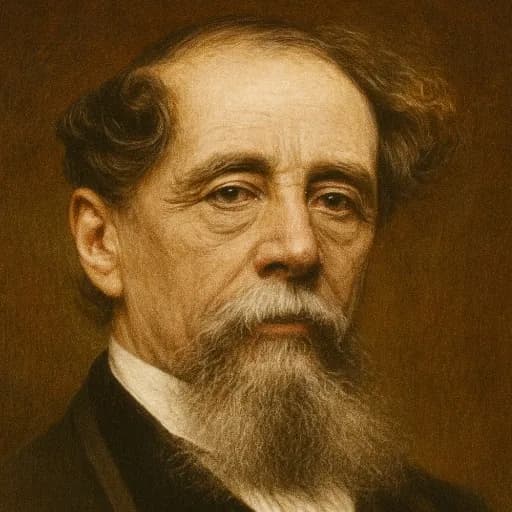
Charles Dickens
Quotes
Whether they were right or wrong in this conjecture, certain it is that minds, like bodies, will often fall into a pimpled ill-conditioned state from mere excess of comfort, and like them, are often successfully cured by remedies in themselves very nauseous and unpalatable.
Finding that his look was not returned, or indeed observed by the person to whom it was addressed, John gradually concentrated the whole power of his eyes into one focus, and brought it to bear upon the man in the flapped hat, at whom he came to stare in course of time with an intensity so remarkable, that it affected his fireside cronies, who all, as with one accord, took their pipes from their lips, and stared with open mouths at the stranger likewise.
Whether these, and many other stories of the like nature, were true or untrue, the Maypole was really an old house, a very old house, perhaps as old as it claimed to be, and perhaps older, which will sometimes happen with houses of an uncertain, as with ladies of a certain age.
"My dear boy," returned his father, "confide in me, I beg. But you know my constitution—don’t be prosy, Ned." "I will be plain, and brief," said Edward. "Don’t say you will, my good fellow," returned his father, crossing his legs, "or you certainly will not."
The flip had had no flavor till now. The tobacco had been of mere English growth, compared with its present taste. A duel in that great old rambling room upstairs, and the best bed ordered already for the wounded man!
Sim as he was called in the locksmith's family, or Mr. Simon Tappertit, as he called himself, and required all men to style him out of doors, on holidays, and Sundays out,—was an old-fashioned, thin-faced, sleek-haired, sharp-nosed, small-eyed little fellow, very little more than five feet high, and thoroughly convinced in his own mind that he was above the middle size; rather tall, in fact, than otherwise. ...It may be inferred from these premises, that in the small body of Mr. Tappertit there was locked up an ambitious and aspiring soul. As certain liquors, confined in casks too cramped in their dimensions, will ferment, and fret, and chafe in their imprisonment, so the spiritual essence or soul of Mr. Tappertit would sometimes fume within that precious cask, his body, until, with great foam and froth and splutter, it would force a vent, and carry all before it. It was his custom to remark, in reference to any one of these occasions, that his soul had got into his head; and in this novel kind of intoxication many scraps and mishaps befel him, which he had frequently concealed with no small difficulty from his worthy master.
Your cold and sullen temper, which chills every breast about you, which turns affection into fear, and changes duty into dread, has forced us on this secret course, repugnant to our nature and our wish, and far more foreign, sir, to us than you. I am not a false, a hollow, or a heartless man; the character is yours, who poorly venture on these injurious terms, against the truth, and under the shelter whereof I reminded you just now. You shall not cancel the bond between us. I will not abandon this pursuit.
"Call him down, Barnaby my man." "Call him!" echoed Barnaby, sitting upright upon the floor, and staring vacantly at Gabriel, as he thrust his hair back from his face. "But who can make him come! He calls me, and makes me go where he will. He goes on before, and I follow. He's the master, and I'm the man. Is that the truth, Grip?" The raven gave a short, comfortable, confidential kind of croak;—a most expressive croak, which seemed to say "You needn't let these fellows into our secrets. We understand each other. It's all right."
There are, still, worse places than the Temple, on a sultry day, for basking in the sun, or resting idly in the shade. There is yet a drowsiness in its courts, and a dreamy dulness in its trees and gardens; those who pace its lanes and squares may yet hear the echoes of their footsteps on the sounding stones, and read upon its gates, in passing from the tumult of the Strand or Fleet Street, "Who enters here leaves noise behind." There is still the plash of falling water in fair Fountain Court, and there are yet nooks and corners where dun-haunted students may look down from their dusty garrets, on a vagrant ray of sunlight patching the shade of the tall houses, and seldom troubled to reflect a passing stranger’s form. There is yet, in the Temple, something of a clerkly monkish atmosphere, which public offices of law have not disturbed, and even legal firms have failed to scare away. In summer time, its pumps suggest to thirsty idlers, springs cooler, and more sparkling, and deeper than other wells; and as they trace the spillings of full pitchers on the heated ground, they snuff the freshness, and, sighing, cast sad looks towards the Thames, and think of baths and boats, and saunter on, despondent.
"He’s not often in the house, you know. He’s more at his ease among horses than men. I look upon him as a animal himself." Following up this opinion with a shrug that seemed meant to say, "we can’t expect everybody to be like us," John put his pipe into his mouth again, and smoked like one who felt his superiority over the general run of mankind.
And you'd find your father rather a tough customer in argeyment, Joe, if anybody was to try and tackle him.
A shade passed over Mr Willet’s face as he thought of broken windows and disabled furniture, but bethinking himself that one of the parties would probably be left alive to pay the damage, he brightened up again.

