


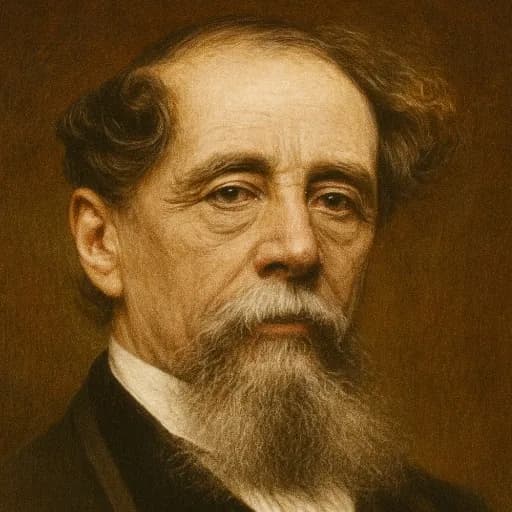
Charles Dickens
Quotes
"For his manner of doing so, I give you my honor, Ned, I am not accountable," said his father. "That you must excuse. He is a mere boor, a log, a brute, with no address in life.—Positively a fly in the jug. The first I have seen this year."
It was no longer a home; children were never born and bred there; the fireside had become mercenary—a something to be bought and sold—a very courtesan: let who would die, or sit beside, or leave it, it was still the same—it missed nobody, cared for nobody, had equal warmth and smiles for all. God help the man whose heart ever changes with the world, as an old mansion when it becomes an inn!
I believe you know how very much I dislike what are called family affairs, which are only fit for plebeian Christmas days, and have no manner of business with people of our condition.
It was on one of those mornings, common in early spring, when the year, fickle and changeable in its youth like all other created things, is undecided whether to step backward into winter or forward into summer, and in its uncertainty inclines now to the one and now to the other, and now to both at once—wooing summer in the sunshine, and lingering still with winter in the shade—it was, in short, on one of those mornings, when it is hot and cold, wet and dry, bright and lowering, sad and cheerful, withering and genial, in the compass of one short hour, that old John Willet, who was dropping asleep over the copper boiler, was roused...
Let us be moral, Ned, or we are nothing. ...The very idea of marrying a girl whose father was killed, like meat! Good God, Ned, how disagreeable!
"Hush!" said Barnaby, laying his fingers on his lips. "He went out today a wooing. I wouldn't for a light guinea that he should never go a wooing again, for if he did some eyes would grow dim that are now as bright as—see, when I talk of eyes, the stars come out. Whose eyes are they? If they are angels' eyes why do they look down here and see good men hurt, and only wink and sparkle all the night?"
A message arrived from Mrs. Varden, making known to all whom it might concern, that she felt too much indisposed to rise after her great agitation and anxiety of the previous night; and therefore desired to be immediately accommodated with the little black tea-pot of strong mixed tea, a couple of rounds of buttered toast, a middling-sized dish of beef and ham cut thin, and the Protestant Manual in two volumes post octavo. Like some other ladies who in remote ages flourished upon this globe, Mrs. Varden was most devout when most ill-tempered. Whenever she and her husband were at unusual variance, then the Protestant Manual was in high feather.
"That," returned the landlord, a little brought down from his dignity by the stranger's surliness, "is a Maypole story, and has been any time these four-and-twenty years. That story is Solomon Daisy's story. It belongs to the house; and nobody but Solomon Daisy has ever told it under this roof, or ever shall—that's more."
"Good night! Barnaby, my good fellow, you say some prayers before you go to bed, I hope?" Barnaby nodded. "He has some nonsense that he calls his prayers, sir," returned old John, officiously. "I’m afraid there an’t much good in em." "And Hugh?" said Mr Chester, turning to him. "Not I," he answered. "I know his"—pointing to Barnaby—"they’re well enough. He sings ’em sometimes in the straw. I listen." "He’s quite a animal, sir," John whispered in his ear with dignity. "You’ll excuse him, I’m sure. If he has any soul at all, sir, it must be such a very small one, that it don’t signify what he does or doesn’t in that way. Good night, sir!"
I have been taught to look upon those means, by which men raise themselves to riches and distinction, as being beyond my heeding, and beneath my care. I have been, as the phrase is, liberally educated, and am fit for nothing.
It was John Willet's ordinary boast in his more placid moods that if he was slow he was sure; which assertion could in one sense at least be by no means gainsaid, seeing that he was in everything unquestionably the reverse of fast, and withal one of the most dogged and positive fellows in existence—always sure that what he thought or said or did was right, and holding it as a thing quite settled and ordained by the laws of nature and Providence, that anybody who said or did or thought otherwise must be inevitably and of necessity wrong.
"Sure enough it's Barnaby—how did you guess?" "By your shadow," said the locksmith. "Oho!" cried Barnaby, glancing over his shoulder, "He's a merry fellow, that shadow, and keeps close to me, though I am silly. We have such pranks, such walks, such runs, such gambols on the grass. Sometimes he'll be half as tall as a church steeple, and sometimes no bigger than a dwarf. Now he goes on before, and now behind, and anon he'll be stealing slyly on, on this side, or on that, stopping whenever I stop, and thinking I can't see him, though I have my eye on him sharp enough. Oh! he's a merry fellow. Tell me—is he silly too! I think he is. ...where's his shadow? ...He has changed shadows with a woman... Her shadow's always with him and his with her. That's sport I think, eh?"

