


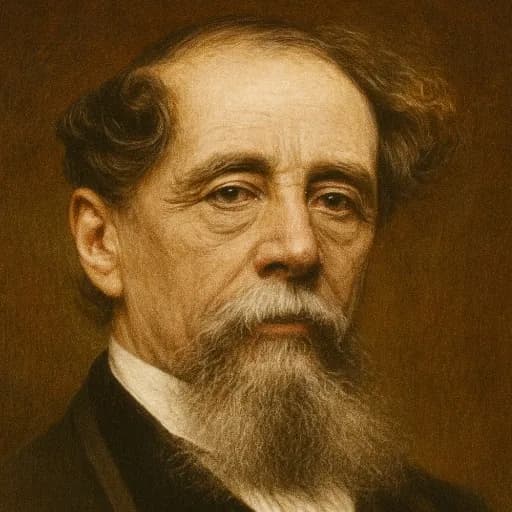
Charles Dickens
Quotes
"Do you observe what a philosophical mind our friend has?" "Why hasn’t he?" said John, gently striking the table with his open hand. "Because they was never drawed out of him when he was a boy. That’s why. What would any of us have been, if our fathers hadn’t drawed our faculties out of us?.."
"What have I done?" reasoned poor Joe. "Silence sir!" returned his father, "what do you mean by talking, when you see people that are more than two or three times your age, sitting still and silent and not dreaming of saying a word?" "Why that's the proper time for me to talk, isn't it?" said Joe rebelliously. "The proper time sir!" retorted his father, "the proper time's no time. ...The proper time's no time sir," repeated John Willet; "when I was your age I never talked, I never wanted to talk, I listened and improved myself, that's what I did."
"Will you hear me gravely for a moment?" "My dear Ned," said his father, "I will hear you with the patience of an anchorite. Oblige me with the milk."
It was a substantial meal; for over and above the ordinary tea equipage, the board creaked beneath the weight of a jolly round of beef, a ham of the first magnitude, and sundry towers of buttered Yorkshire cake, piled slice upon slice in most alluring order. There was also a goodly jug of well-browned clay, fashioned into the form of an old gentleman, not by any means unlike the locksmith, atop of whose bald head was a fine white froth answering to his wig, indicative, beyond dispute, of sparkling home-brewed ale. But better far than fair home-brewed, or Yorkshire cake, or ham, or beef, or anything to eat or drink that earth or air or water can supply, there sat, presiding over all, the locksmith's rosy daughter, before whose dark eyes even beef grew insignificant and malt became as nothing.
As the locksmith stood upon the step, it was chained and locked behind him, and the raven, in furtherance of these precautions, barked like a lusty house-dog. "In league with that ill-looking figure that might have fallen from a gibbet--he listening and hiding here--Barnaby first upon the spot last night--can she who has always borne so fair a name be guilty of such crimes in secret!" said the locksmith, musing. "Heaven forgive me if I am wrong, and send me just thoughts; but she is poor, the temptation may be great, and we daily hear of things as strange.--Ay, bark away, my friend. If there's any wickedness going on, that raven's in it, I'll be sworn."
...every man put down his sixpence for a can of flip, which grateful beverage was brewed with all dispatch, and set down in the midst of them on the brick floor; both that it might simmer and stew before the fire, and that its fragrant steam, rising up among them, and mixing with the wreaths of vapour from their pipes, might shroud them in a delicious atmosphere of their own, and shut out all the world. The very furniture of the room seemed to mellow and deepen in its tone; the ceiling and walls looked blacker and more highly polished, the curtains of a ruddier red; the fire burnt clear and high, and the crickets in the hearthstone chirped with a more than wonted satisfaction.
"Look at him!" said Varden, divided between admiration of the bird and a kind of fear of him. "Was there ever such a knowing imp as that! Oh he's a dreadful fellow!" The raven, with his head very much on one side, and his bright eye shining like a diamond, preserved a thoughtful silence for a few seconds, and then replied in a voice so hoarse and distant, that it seemed to come through his thick feathers rather than out of his mouth. "Halloa, halloa, halloa! What's the matter here! Keep up your spirits. Never say die. Bow wow wow. I'm a devil, I'm a devil, I'm a devil. Hurrah!"—And then, as if exulting in his infernal character, he began to whistle. "I more than half believe he speaks the truth. Upon my word I do," said Varden. "Do you see how he looks at me, as if he knew what I was saying? To which the bird, balancing himself on tiptoe, as it were, and moving his body up and down in a sort of grave dance, rejoined, "I'm a devil, I'm a devil, I'm a devil," and flapped his wings against his sides as if he were bursting with laughter. Barnaby clapped his hands, and fairly rolled upon the ground in an ecstasy of delight. "Strange companions, sir," said the locksmith, shaking his head and looking from one to the other. "The bird has all the wit."
He melts, I think. He goes like a drop of froth. You look at him, and there he is. You look at him again, and—there he isn’t.
Mrs Varden was a lady of what is commonly called an uncertain temper — a phrase which being interpreted signifies a temper tolerably certain to make everybody more or less uncomfortable.
"A mere fortune-hunter!" cried the son, indignantly. "What in the devil’s name, Ned, would you be!" returned the father. "All men are fortune-hunters, are they not? The law, the church, the court, the camp—see how they are all crowded with fortune-hunters, jostling each other in the pursuit. The stock-exchange, the pulpit, the counting-house, the royal drawing-room, the senate,—what but fortune-hunters are they filled with? A fortune-hunter! Yes. You are one; and you would be nothing else, my dear Ned, if you were the greatest courtier, lawyer, legislator, prelate, or merchant, in existence. If you are squeamish and moral, Ned, console yourself with the reflection that at the very worst your fortune-hunting can make but one person miserable or unhappy. How many people do you suppose these other kinds of huntsmen crush in following their sport—hundreds at a step? Or thousands?"
"Miss Haredale is Mr. Geoffrey Haredale's niece." "Is her father alive?" said the man carelessly. "No," rejoined the landlord, "he is not alive, and he is not dead—" "Not dead!" cried the other. "Not dead in a common sort of way," said the landlord. ..."What do you mean?" "More than you think for, friend." returned John Willet. "Perhaps there's more meaning in them words than you suspect." "Perhaps there is," said the strange man, gruffly; "but what the devil do you speak in such mysteries for? You tell me first that a man is not alive, nor yet dead—then that he's not dead in a common sort of way—then, that you mean a great deal more than I think for. To tell you the truth, you may do that easily; for so far as I can make out, you mean nothing. What do you mean, I ask again."
And now he approached the great city, which lay outstretched before him like a dark shadow on the ground, reddening the sluggish air with a deep dull light, that told of labyrinths of public ways and shops, and swarms of busy people. Approaching nearer and nearer yet, this halo began to fade, and the causes which produced it slowly to develop themselves. Long lines of poorly lighted streets might be faintly traced, with here and there a lighter spot, where lamps were clustered about a square or market, or round some great building; after a time these grew more distinct, and the lamps themselves were visible; slight yellow specks, that seemed to be rapidly snuffed out one by one as intervening obstacles hid them from the sight. Then sounds arose—the striking of church clocks, the distant bark of dogs, the hum of traffic in the streets; then outlines might be traced—tall steeples looming in the air, and piles of unequal roofs oppressed by chimneys: then the noise swelled into a louder sound, and forms grew more distinct and numerous still, and London—visible in the darkness by its own faint light, and not by that of Heaven—was at hand.

