
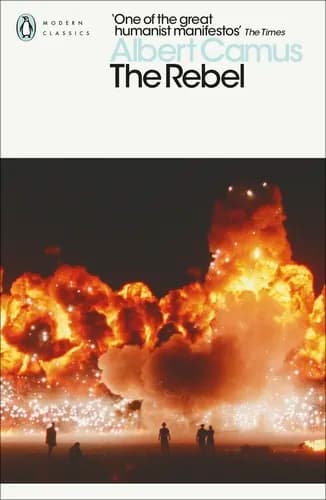
Quotes
In the end, man is not entirely guilty — he did not start history. Nor is he wholly innocent — he continues it.
Real generosity toward the future consists in giving all to the present.
p. 313
With rebellion, awareness is born.
When the throne of God is overturned, the rebel realizes that it is now his own responsibility to create the justice, order, and unity that he sought in vain within his own condition, and in this way to justify the fall of God. Then begins the desperate effort to create, at the price of crime and murder if necessary, the dominion of man.
Man is the only creature who refuses to be what he is.
For those of us who have been thrown into hell, mysterious melodies and the torturing images of a vanished beauty will always bring us, in the midst of crime and folly, the echo of that harmonious insurrection which bears witness, throughout the centuries, to the greatness of humanity.
Art, at least, teaches us that man cannot be explained by history alone and that he also finds a reason for his existence in the order of nature.
The words that reverberate for us at the confines of this long adventure of rebellion are not formulas for optimism, for which we have no possible use in the extremities of our unhappiness, but words of courage and intelligence which, on the shores of the eternal seas, even have the qualities of virtue.
"Then we understand that rebellion cannot exist without a strange form of love. Those who find no rest in God or in history are condemned to live for those who, like themselves, cannot live; in fact, for the humiliated."
A character is never the author who created him. It is quite likely, however, that an author may be all his characters simultaneously.
p. 86
Artistic creation is a demand for unity and a rejection of the world.
Nothing can discourage the appetite for divinity in the heart of man.
A nihilist is not one who believes in nothing, but one who does not believe in what exists.
The most elementary form of rebellion, paradoxically, expresses an aspiration for order.
Whatever we may do, excess will always keep its place in the heart of man, in the place where solitude is found. We all carry within us our places of exile, our crimes and our ravages. But our task is not to unleash them on the world; it is to fight them in ourselves and in others.
The artist reconstructs the world to his plan.
"In the light, the earth remains our first and our last love. Our brothers are breathing under the same sky as we; justice is a living thing. Now is born that strange joy which helps one live and die, and which we shall never again postpone to a later time."
"The real saint", Baudelaire pretends to think, "is he who flogs and kills people for their own good." His argument will be heard. A race of real saints is beginning to spread over the earth for the purposes of confirming these curious conclusions about rebellion.
In every rebellion is to be found the metaphysical demand for unity, the impossibility of capturing it, and the construction of a substitute universe.
Alyosha can, in fact, treat Ivan with compassion as a "real simpleton." The latter only made an attempt at self-control and failed. Others will appear, with more serious intentions, who, on the basis of the same despairing nihilism, will insist on ruling the world. These are the Grand Inquisitors who imprison Christ and come to tell Him that His method is not correct, that universal happiness cannot be achieved by the immediate freedom of choosing between good and evil, but by the domination and unification of the world. The first step is to conquer and rule. The kingdom of heaven will, in fact, appear on earth, but it will be ruled over by men — a mere handful to begin with, who will be the Caesars, because they were the first to understand — and later, with time, by all men. The unity of all creation will be achieved by every possible means, since everything is permitted. The Grand Inquisitor is old and tired, for the knowledge he possesses is bitter. He knows that men are lazy rather than cowardly and that they prefer peace and death to the liberty of discerning between good and evil. He has pity, a cold pity, for the silent prisoner whom history endlessly deceives. He urges him to speak, to recognize his misdeeds, and, in one sense, to approve the actions of the Inquisitors and of the Caesars. But the prisoner does not speak.
Metaphysical rebellion is a claim, motivated by the concept of a complete unity, against the suffering of life and death and a protest against the human condition both for its incompleteness, thanks to death, and its wastefulness, thanks to evil.
No human being, even the most passionately loved and passionately loving, is ever in our possession.
Real fulfillment, for the man who allows absolutely free rein to his desires, and who much dominate everything, lies in hatred.
The ancients, even though they believed in destiny, believed primarily in nature, in which they participated wholeheartedly. To rebel against nature amounted to rebelling against oneself. It was butting one's head against a wall.
If Nietzsche and Hegel serve as alibis to the masters of Dachau and Karaganda, that does not condemn their entire philosophy. But it does lead to the suspicion that one aspect of their thought, or of their logic, can lead to these appalling conclusions.
Art is the activity that exalts and denies simultaneously. "No artist tolerates reality," says Nietzsche.
The contradiction is this: man rejects the world as it is, without accepting the necessity of escaping it. In fact, men cling to the world and by far the majority do not want to abandon it.
Every revolutionary ends as an oppressor or a heretic.
One might think that a period which, in a space of fifty years, uproots, enslaves, or kills seventy million human beings should be condemned out of hand. But its culpability must still be understood... In more ingenuous times, when the tyrant razed cities for his own greater glory, when the slave chained to the conqueror's chariot was dragged through the rejoicing streets, when enemies were thrown to the wild beasts in front of the assembled people, the mind did not reel before such unabashed crimes, and the judgment remained unclouded. But slave camps under the flag of freedom, massacres justified by philanthropy or by a taste for the superhuman, in one sense cripple judgment. On the day when crime dons the apparel of innocence — through a curious transposition peculiar to our times — it is innocence that is called upon to justify itself.
Every rebellion implies some kind of unity.
Every ideology is contrary to human psychology.
I rebel — therefore we exist.
Absolute freedom mocks at justice. Absolute justice denies freedom. To be fruitful, the two ideas must find their limits in each other.
The slave begins by demanding justice and ends by wanting to wear a crown. He must dominate in his turn.
What is a rebel? A man who says no.
The absurd ... is an experience to be lived through, a point of departure, the equivalent, in existence of Descartes' methodical doubt. Absurdism, like methodical doubt, has wiped the slate clean. It leaves us in a blind alley. But, like methodical doubt, it can, by returning upon itself, open up a new field of investigation, and in the process of reasoning then pursues the same course. I proclaim that I believe in nothing and that everything is absurd, but I cannot doubt the validity of my proclamation and I must at least believe in my protest. The first and only evidence that is supplied me, within the terms of the absurdist experience, is rebellion ... Rebellion is born of the spectacle of irrationality, confronted with an unjust and incomprehensible condition.
p. 8
That’s all the quotes.
36 quotes in the collection · come back when we add more