
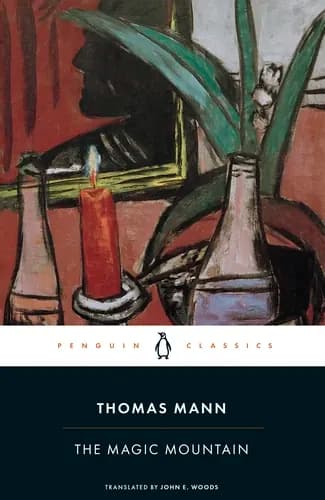
Quotes
Asia surrounds us — wherever one's glance rests, a Tartar physiognomy.
Rough translation of this passage written in French: The body, love, death, these three are just one. For the body, this is the disease and exquisite delight, and this that does die, yes, they are carnal both of them, love and death, and thus their terror and their great magic!
Translation: What we call mourning for our dead is perhaps not so much grief at not being able to call them back as it is grief at not being able to want to do so.
Love for him, for the human body, was extremely humanitarian an interest and had more educational power than the whole teaching skills of the world!
Passionate — that means to live for the sake of living. But one knows that you all live for the sake of experience. Passion, that is self-forgetfulness. But what you all want is self-enrichment. C'est ça. You don't realize what revolting egoism it is, and that one day it will make you the enemies of the human race.
A man's dying is more the survivors' affair than his own.
'''The purifying, healing influence of literature, the dissipating of passions by knowledge and the written word, literature as the path to understanding, forgiveness and love, the redeeming might of the word, the literary spirit as the noblest manifestation of the spirit of man, the writer as perfected type, as saint.
We, when we sow the seeds of doubt deeper than the most up-to-date and modish free-thought has ever dreamed of doing, we well know what we are about. Only out of radical skepsis, out of moral chaos, can the Absolute spring, the anointed Terror of which the time has need.
Time cools, time clarifies, no mood can be maintained quite unaltered through the course of hours. In the early dawn, standing weapon in hand, neither of the combatants would be the same man as on the evening of the quarrel. They would be going through it, if at all, mechanically, in obedience to the demands of honour, not, as they would have at first, of their own free will, desire, and conviction; and such a denial of their actual selves in favour of their past ones, it must somehow be possible to prevent.
Absolutely everything beloved and cherished of the bourgeoisie, the conservative, the cowardly, and the impotent — the State, family life, secular art and science — was consciously or unconsciously hostile to the religious idea, to the Church, whose innate tendency and permanent aim was the dissolution of all existing worldly orders, and the reconstitution of society after the model of the ideal, the communistic City of God.
It is a cruel atmosphere down there, cruel and ruthless.
My aversion from music rests on political grounds.
Everything is politics.
"Love as a force contributory to disease."
This conflict between the powers of love and chastity ... it ended apparently in the triumph of chastity. Love was suppressed, held in darkness and chains, by fear, conventionality, aversion, or a tremulous yearning to be pure.... But this triumph of chastity was only an apparent, a pyrrhic victory. It would break through the ban of chastity, it would emerge — if in a form so altered as to be unrecognizable.
Our air up here is good for the disease — I mean good against the disease,... but it is also good for the disease.
I will keep faith with death in my heart, yet will remember that faith with death and the dead is only wickedness and dark voluptuousness and enmity against humankind, if it is given power over our thought and contemplation. For the sake of goodness and love, man shall let death have no sovereignty over his thoughts. And with that, I wake up.
Order and simplification are the first steps toward the mastery of a subject — the actual enemy is the unknown.
Paradox is the poisonous flower of quietism, the iridescent surface of the rotting mind, the greatest depravity of all.
A man lives not only his personal life, as an individual, but also, consciously or unconsciously, the life of his epoch and his contemporaries.
“Beer, tobacco, and music,” he went on. “Behold the Fatherland.”
The only religious way to think of death is as part and parcel of life; to regard it, with the understanding and the emotions, as the inviolable condition of life.
Disease makes men more physical, it leaves them nothing but body.
Two principles, according to the Settembrinian cosmogony, were in perpetual conflict for possession of the world: force and justice, tyranny and freedom, superstition and knowledge; the law of permanence and the law of change, of ceaseless fermentation issuing in progress.
In effect it seemed to him that, though honor might possess certain advantages, yet shame had others, and not inferior: advantages, even, that were well-nigh boundless in their scope.
Love stands opposed to death. It is love, not reason, that is stronger than death. Only love, not reason, gives sweet thoughts. And from love and sweetness alone can form come: form and civilization, friendly, enlightened, beautiful human intercourse — always in silent recognition of the blood sacrifice.
Six months at most after they get here, these young people — and they are mostly young who come — have lost every idea they had, except flirtation and temperature.
Analysis as an instrument of enlightenment and civilization is good, in so far as it shatters absurd convictions, acts as a solvent upon natural prejudices, and undermines authority; good, in other words, in that it sets free, refines, humanizes, makes slaves ripe for freedom. But it is bad, very bad, in so far as it stands in the way of action, cannot shape the vital forces, maims life at its roots. Analysis can be a very unappetizing affair, as much so as death.
There is something suspicious about music, gentlemen. I insist that she is, by her nature, equivocal. I shall not be going too far in saying at once that she is politically suspect.
Disease was a perverse, a dissolute form of life.
Human reason needs only to will more strongly than fate, and she is fate.
Speech is civilization itself. The word, even the most contradictory word, preserves contact — it is silence which isolates.
Writing well was almost the same as thinking well, and thinking well was the next thing to acting well. All moral discipline, all moral perfection derived from the soul of literature, from the soul of human dignity, which was the moving spirit of both humanity and politics. Yes, they were all one, one and the same force, one and the same idea, and all of them could be comprehended in one single word... The word was — civilization!
The ancients adorned their sarcophagi with the emblems of life and procreation, and even with obscene symbols; in the religions of antiquity the sacred and the obscene often lay very close together. These men knew how to pay homage to death. For death is worthy of homage as the cradle of life, as the womb of palingenesis.
Opinions cannot survive if one has no chance to fight for them.
All interest in disease and death is only another expression of interest in life.
Tolerance becomes a crime when applied to evil.
p. 506
I love and reverence the Word, the bearer of the spirit, the tool and gleaming ploughshare of progress.
Frau Stöhr ... began to talk about how fascinating it was to cough.... Sneezing was much the same thing. You kept on wanting to sneeze until you simply couldn't stand it any longer; you looked as if you were tipsy; you drew a couple of breaths, then out it came, and you forgot everything else in the bliss of the sensation. Sometimes the explosion repeated itself two or three times. That was the sort of pleasure life gave you free of charge.
Time has no divisions to mark its passage, there is never a thunderstorm or blare of trumpets to announce the beginning of a new month or year. Even when a new century begins it is only we mortals who ring bells and fire off pistols.
A black pall, you know, with a silver cross on it, or R.I.P. — requiescat in pace — you know. That seems to me the most beautiful expression — I like it much better than ‘He is a jolly good fellow,’ which is simply rowdy.
What was life? It was warmth, the warmth generated by a form-preserving instability, a fever of matter, which accompanied the process of ceaseless decay and repair of protein molecules that were too impossibly ingenious in structure.
One always has the idea of a stupid man as perfectly healthy and ordinary, and of illness as making one refined and clever and unusual.
Irony, forsooth! Guard yourself, Engineer, from the sort of irony that thrives up here; guard yourself altogether from taking on their mental attitude! Where irony is not a direct and classic device of oratory, not for a moment equivocal to a healthy mind, it makes for depravity, it becomes a drawback to civilization, an unclean traffic with the forces of reaction, vice and materialism.
It seemed that at the end of the lecture Dr. Krokowski was making propaganda for psycho-analysis; with open arms he summoned all and sundry to come unto him. "Come unto me," he was saying, though not in those words, " come unto me, all ye who are weary and heavy-laden." And he left no doubt of his conviction that all those present were weary and heavy-laden. He spoke of secret suffering, of shame and sorrow, of the redeeming power of the analytic. He advocated the bringing of light into the unconscious mind and explained how the abnormality was metamorphosed into the conscious emotion; he urged them to have confidence; he promised relief.
Hans Castorp loved music from his heart; it worked upon him much the same way as did his breakfast porter, with deeply soothing, narcotic effect, tempting him to doze.
There is both rhyme and reason in what I say, I have made a dream poem of humanity. I will cling to it. I will be good. I will let death have no mastery over my thoughts. For therein lies goodness and love of humankind, and in nothing else.
I, for one, have never in my life come across a perfectly healthy human being.
I never can understand how anyone can not smoke — it deprives a man of the best part of life … with a good cigar in his mouth a man is perfectly safe, nothing can touch him — literally.
The invention of printing and the Reformation are and remain the two outstanding services of central Europe to the cause of humanity.
The beautiful word begets the beautiful deed.
Psycho-analyses — how disgusting.
Space, like time, engenders forgetfulness; but it does so by setting us bodily free from our surroundings and giving us back our primitive, unattached state. Yes, it can even, in the twinkling of an eye, make something like a vagabond of the pedant and Philistine. Time, we say, is Lethe; but change of air is a similar draught, and, if it works less thoroughly, does so more quickly.
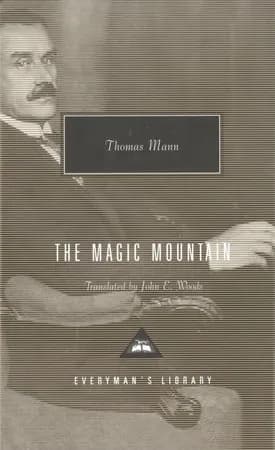
That’s all the quotes.
53 quotes in the collection · come back when we add more