

Quotes
And just as the internal contradictions of capitalism must become increasingly apparent, so must the internal contradictions of empirical science – as in the development of pure knowledge to the point where it assumes a life of its own, e.g., the atomic bomb. As long as man is still engaged only in the means – the charting of the ways of nature, the gathering of ‘pure’ knowledge – to his final realization, mastery of nature, his knowledge, because it is not complete, is dangerous. So dangerous that many scientists are wondering whether they shouldn’t put a lid on certain types of research. But this solution is hopelessly inadequate. The machine of empiricism has its own momentum, and is, for such purposes, completely out of control. Could one actually decide what to discover or not discover? That is, by definition, antithetical to the whole empirical process that Bacon set in motion.
p. 181
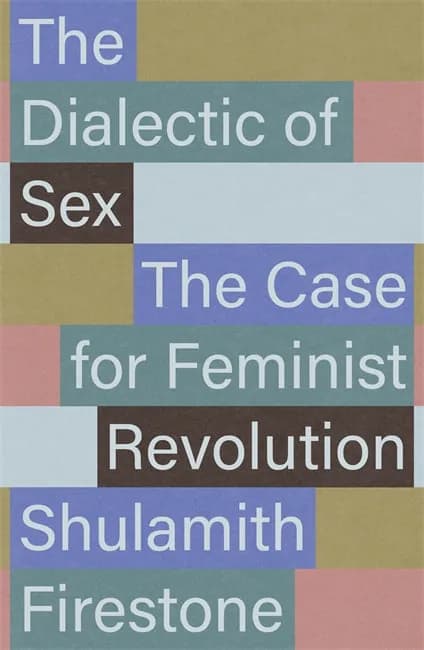 The Dialectic of Sex: The Case for Feminist Revolution
The first attempts to confront the modern world have been for the most part misguided. The , a famous example, failed at its objective of replacing an irrelevant easel art (only a few optical illusions and designy chairs mark the grave), ending up with a hybrid, neither art nor science, and certainly not the sum of the two. They failed because they didn’t understand science on its own terms: to them, seeing in the old aesthetic way, it was simply a rich new subject matter to be digested whole into the traditional aesthetic system. It is as if one were to see a computer as only a beautifully ordered set of lights and sounds, missing completely the function itself. The scientific experiment is not only beautiful, an elegant structure, another piece of an abstract puzzle, something to be used in the next collage – but scientists, too, in their own way, see science as this abstraction divorced from life – it has a real intrinsic meaning of its own, similar to, but not the same as, the ‘presence’, the ‘en-soi’, of modern painting. Many artists have made the mistake of thus trying to annex science, to incorporate it into their own artistic framework, rather than using it to expand that framework.
p. 187
The Dialectic of Sex: The Case for Feminist RevolutionSex objects are beautiful. An attack on them can be confused with an attack on beauty itself. Feminists need not get so pious in their efforts that they feel they must flatly deny the beauty of the face on the cover of Vogue. For this is not the point. The real question is: is the face beautiful in a human way – does it allow for growth and flux and decay, does it express negative as well as positive emotions, does it fall apart without artificial props – or does it falsely imitate the very different beauty of an inanimate object, like wood trying to be metal? To attack eroticism creates similar problems. Eroticism is exciting. No one wants to get rid of it. Life would be a drab and routine affair without at least that spark. That's just the point. Why has all joy and excitement been concentrated, driven into one narrow, difficult-to-find alley of human experience, and all the rest laid waste? When we demand the elimination of eroticism, we mean not the elimination of sexual joy and excitement but its diffusion over - there's plenty to go around , it increases with use - the spectrum of our lives.
p. 155
The Dialectic of Sex: The Case for Feminist RevolutionNew theories and new movements do not develop in a vacuum, they arise to spearhead the necessary social solutions to contradictions in the environment.
p. 192
The Dialectic of Sex: The Case for Feminist RevolutionThere is some irony in the fact that children imagine that parents can do what they want, and parents imagine that children do. "When I grow up..." parallels "Oh to be a child again..."
p. 102
The Dialectic of Sex: The Case for Feminist RevolutionEvery person in his first trip to a foreign country, where he knows neither the people nor the language, experiences childhood.
p. 103
The Dialectic of Sex: The Case for Feminist RevolutionLet me then say it bluntly: Pregnancy is barbaric. I do not believe, as many women are now saying, that the reason pregnancy is viewed as not beautiful is due strictly to cultural perversion. The child’s first response, ‘What’s wrong with that Fat Lady?’; the husband’s guilty waning of sexual desire; the woman’s tears in front of the mirror at eight months – are all gut reactions, not to be dismissed as cultural habits. Pregnancy is the temporary deformation of the body of the individual for the sake of the species. Moreover, childbirth hurts. And it isn’t good for you. Three thousand years ago, women giving birth ‘naturally’ had no need to pretend that pregnancy was a real trip, some mystical orgasm (that far-away look). The Bible said it: pain and travail. The glamour was unnecessary: women had no choice. They didn’t dare squawk. But at least they could scream as loudly as they wanted during their labour pains. And after it was over, even during it, they were admired in a limited way for their bravery; their valour was measured by how many children (sons) they could endure bringing into the world.
p. 198
The Dialectic of Sex: The Case for Feminist RevolutionContrary to popular opinion, love is not altruistic. [...] Love is the height of selfishness: the self attempts to enrich itself through the absorption of another being. Love is being psychically wide-open to another. It is a situation of total emotional vulnerability. Therefore it must be not only the incorporation of the other, but an exchange of selves. Anything short of a mutual exchange will hurt one or the other party. There is nothing inherently destructive about this process. A little healthy selfishness would be a refreshing change. Love between two equals would be an enrichment, each enlarging himself through the other: instead of being one, locked in the cell of himself with only his own experience and view, he could participate in the existence of another – an extra window on the world. This accounts for the bliss that successful lovers experience: lovers are temporarily freed from the burden of isolation that every individual bears.
p. 128
The Dialectic of Sex: The Case for Feminist RevolutionChildren, then, are not freer than adults. They are burdened by a wish fantasy in direct proportion to the restraints of their narrow lives; with an unpleasant sense of their own physical inadequacy and ridiculousness; with constant shame about their dependence, economic and otherwise (‘Mother, may I?’); and humiliation concerning their natural ignorance of practical affairs. Children are repressed at every waking minute. Childhood is hell.
p. 103
The Dialectic of Sex: The Case for Feminist RevolutionLove has never been understood, though it may have been fully experienced, and that experience communicated.
p. 126
The Dialectic of Sex: The Case for Feminist RevolutionThe family is neither private nor a refuge, but is directly connected to – is even the cause of – the ills of the larger society which the individual is no longer able to confront.
p. 224
The Dialectic of Sex: The Case for Feminist RevolutionIn the second type of cultural response the contingencies of reality are overcome, not through the creation of an alternate reality, but through the mastery of reality’s own workings: the laws of nature are exposed, then turned against it, to shape it in accordance with man’s conception. If there is a poison, man assumes there is an antidote; if there is a disease, he searches for the cure: every fact of nature that is understood can be used to alter it. But to achieve the ideal through such a procedure takes much longer, and is infinitely more painful, especially in the early stages of knowledge. For the vast and intricate machine of nature must be entirely understood – and there are always fresh and unexpected layers of complexity – before it can be thoroughly controlled. Thus before any solution can be found to the deepest contingencies of the human condition, e.g., death, natural processes of growth and decay must be catalogued, smaller laws related to larger ones. This scientific method (also attempted by Marx and Engels in their materialist approach to history) is the attempt by man to master nature through the complete understanding of its mechanics. The coaxing of reality to conform with man’s conceptual ideal, through the application of information extrapolated from itself, we shall call the Technological Mode.
p. 174
The Dialectic of Sex: The Case for Feminist RevolutionThe myth of childhood has an even greater parallel in the myth of Femininity. Both women and children were considered asexual and thus"purer" than man. Their inferior status was ill-concealed under an elaborate "respect." One didn't discuss serious matters nor did one curse in from of women and children; one didn't openly degrade them, one did it behind their backs.
p. 88
The Dialectic of Sex: The Case for Feminist RevolutionMarriage is in the same state as the Church: both are becoming functionally defunct, as their preachers go about heralding a revival, eagerly chalking up converts in the day of dread. And just as God has been pronounced dead quite often but has this sneaky way of resurrecting himself, so everyone debunks marriage, yet ends up married.
p. 222
The Dialectic of Sex: The Case for Feminist RevolutionThe fact remains: childbirth is at best necessary and tolerable. It is not fun.
p. 199
The Dialectic of Sex: The Case for Feminist RevolutionThere are no precedents in history for feminist revolution – there have been women revolutionaries, certainly, but they have been used by male revolutionaries, who seldom gave even lip service to equality for women, let alone to a radical feminist restructuring of society.
p. 226
The Dialectic of Sex: The Case for Feminist RevolutionA book on radical feminism that did not deal with love would be a political failure. For love, perhaps even more than childbearing, is the pivot of women's oppression today.
The Dialectic of Sex: The Case for Feminist RevolutionCulture then is the sum of, and the dynamic between, the two modes through which the mind attempts to transcend the limitations and contingencies of reality. These two types of cultural responses entail different methods to achieve the same end, the realization of the conceivable in the possible. In the first, the individual denies the limitations of the given reality by escaping from it altogether, to define, create, his own possible. In the provinces of the imagination, objectified in some way – whether through the development of a visual image within some artificial boundary, say four square feet of canvas, through visual images projected through verbal symbols (poetry), with sound ordered into a sequence (music), or with verbal ideas ordered into a progression (theology, philosophy) – he creates an ideal world governed by his own artificially imposed order and harmony, a structure in which he consciously relates each part to the whole, a static (and therefore ‘timeless’) construction. The degree to which he abstracts his creation from reality is unimportant, for even when he most appears to imitate, he has created an illusion governed by its own – perhaps hidden – set of artificial laws. (Degas said that the artist had to lie in order to tell the truth.) This search for the ideal, realized by means of an artificial medium, we shall call the Aesthetic Mode.
p. 173
The Dialectic of Sex: The Case for Feminist RevolutionIn the Middle Ages there was no such thing as childhood. The medieval view of children was profoundly different from ours.
p. 76
The Dialectic of Sex: The Case for Feminist RevolutionRevolutionary feminism is the only radical programme that immediately cracks through to the emotional strata underlying ‘serious’ politics, thus reintegrating the personal with the public, the subjective with the objective, the emotional with the rational – the female principle with the male.
p. 210
The Dialectic of Sex: The Case for Feminist RevolutionAs was demonstrated in the case of the development of atomic energy, radicals, rather than breast-beating about the immorality of scientific research, could be much more effective by concentrating their full energies on demands for control of scientific discoveries by and for the people. For, like atomic energy, fertility control, artificial reproduction, cybernation, in themselves, are liberating – unless they are improperly used.
p. 196
The Dialectic of Sex: The Case for Feminist RevolutionThe beauty ideal. Every society has promoted a certain ideal of beauty over all others. What that ideal is is unimportant, for any ideal leaves the majority out; ideals, by definition, are modelled on rare qualities.
p. 151
The Dialectic of Sex: The Case for Feminist RevolutionTo live without love in the end proves intolerable to men just as it does to women.
p. 137
The Dialectic of Sex: The Case for Feminist RevolutionRadical goals must be kept in sight at all times.
p. 206
The Dialectic of Sex: The Case for Feminist RevolutionThese two different responses, the idealistic and the scientific, do not merely exist simultaneously: there is a dialogue between the two. The imaginative construction precedes the technological though often it does not develop until the technological know-how is ‘in the air’. For example, the art of science fiction developed, in the main, only a half-century in advance of, and now co-exists with, the scientific revolution that is transforming it into a reality – for example (an innocuous one), the moon flight. The phrases ‘way out’, ‘far out’, ‘spaced’, the observation ‘it’s like something out of science fiction’ are common language.
p. 173
The Dialectic of Sex: The Case for Feminist RevolutionI submit that love is essentially a much simpler phenomenon – it becomes complicated, corrupted, or obstructed by an unequal balance of power. We have seen that love demands a mutual vulnerability or it turns destructive: the destructive effects of love occur only in a context of inequality. But because sexual inequality has remained a constant – however its degree may have varied – the corruption 'romantic' love became characteristic of love between the sexes.
p. 130
The Dialectic of Sex: The Case for Feminist RevolutionAn artist can never know in advance just how his vision might be articulated in reality.
p. 173
The Dialectic of Sex: The Case for Feminist RevolutionAnother scientific development that we find difficult to absorb into our traditional value system is the new science of cybernetics: machines that may soon equal or surpass man in original thinking and problem-solving. [...] In the hands of the present establishment there is no doubt that the machine could be used – is being used – to intensify the apparatus of repression and to increase established power. But again, as in the issue of population control, misuse of science has often obscured the value of science itself. In this case, though perhaps the response may not be quite so hysterical and evasive, we still often have the same unimaginative concentration on the evils of the machine itself, rather than a recognition of its revolutionary significance.
p. 200
The Dialectic of Sex: The Case for Feminist RevolutionEmpiricism itself is only the means, a quicker and more effective technique, for achieving technology’s ultimate cultural goal: the building of the ideal in the real world. One of its own basic dictates is that a certain amount of material must be collected and arranged into categories before any decisive comparison, analysis, or discovery can be made. In this light centuries of empirical science have been little more than the building of foundations for the breakthroughs of our own time and the future. The amassing of information and understanding of the laws and mechanical processes of nature (‘pure research’) is but a means to a larger end: total understanding of Nature in order, ultimately, to achieve transcendence.
p. 180
The Dialectic of Sex: The Case for Feminist RevolutionCulture is the attempt by man to realize the conceivable in the possible. Man’s consciousness of himself within his environment distinguishes him from the lower animals, and turns him into the only animal capable of culture. This consciousness, his highest faculty, allows him to project mentally states of being that do not exist at the moment. Able to construct a past and future, he becomes a creature of time – a historian and a prophet. More than this, he can imagine objects and states of being that have never existed and may never exist in the real world – he becomes a maker of art. Thus, for example, though the ancient Greeks did not know how to fly, still they could imagine it. The myth of Icarus was the formulation in fantasy of their conception of the state ‘flying’. But man was not only able to project the conceivable into fantasy. He also learned to impose it on reality: by accumulating knowledge, learning experience, about that reality and how to handle it, he could shape it to his liking. This accumulation of skills for controlling the environment, technology, is another means to reaching the same end, the realization of the conceivable in the possible.
p. 172
The Dialectic of Sex: The Case for Feminist RevolutionWe can also see the class basis of the emerging concept of child hood in the system of child education that came in along with it. If childhood was only an abstract concept, then the modern school was the institution that built it into reality.
p. 81
The Dialectic of Sex: The Case for Feminist RevolutionThe most important characteristic to be maintained in any revolution is flexibility.
p. 227
The Dialectic of Sex: The Case for Feminist RevolutionWomen and love are underpinnings. Examine them and you threaten the very structure of culture.
p. 126
The Dialectic of Sex: The Case for Feminist RevolutionAnother internal contradiction in empirical science: the mechanistic, deterministic, ‘soulless’ scientific world-view, which is the result of the means to, rather than the (inherently noble and often forgotten) ultimate purpose of, Empiricism: the actualization of the ideal in reality.
p. 182
The Dialectic of Sex: The Case for Feminist RevolutionThe economic independence and self-determination of all. Under a cybernetic communism, even during the socialist transition, work would be divorced from wages, the ownership of the means of production in the hands of all the people, and wealth distributed on the basis of need, independent of the social value of the individual’s contribution to society. We would aim to eliminate the dependence of women and children on the labour of men, as well as all other types of labour exploitation. Each person could choose his life style freely, changing it to suit his tastes without seriously inconveniencing anyone else; no one would be bound into any social structure against his will, for each person would be totally self-governing as soon as she was physically able.
p. 239
The Dialectic of Sex: The Case for Feminist RevolutionBeing unable to love is hell.
p. 136
The Dialectic of Sex: The Case for Feminist RevolutionThe ideology of school was the ideology of childhood. It operated on the assumption that children needed"discipline," that they were special creatures who had to be handled in a special way (child psych., child ed., etc.) and that to facilitate this they should be corralled in a special place with tie own kind, and with an age group as restricted to their own as possible.
p. 87
The Dialectic of Sex: The Case for Feminist RevolutionNow, in 1970, we are experiencing a major scientific breakthrough. The new physics, relativity, and the astrophysical theories of contemporary science had already been realized by the first part of this century. Now, in the latter part, we are arriving, with the help of the electron microscope and other new tools, at similar achievements in biology, biochemistry, and all the life sciences. Important discoveries are made yearly by small, scattered work teams all over the United States, and in other countries as well – of the magnitude of DNA in genetics, or of Urey and Miller’s work in the early fifties on the origins of life. Full mastery of the reproductive process is in sight, and there has been significant advance in understanding the basic life and death process. The nature of ageing and growth, sleep and hibernation, the chemical functioning of the brain and the development of consciousness and memory are all beginning to be understood in their entirety. This acceleration promises to continue for another century, or however long it takes to achieve the goal of Empiricism: total understanding of the laws of nature.
p. 179
The Dialectic of Sex: The Case for Feminist RevolutionThe classic trap for any revolutionary is always, ‘What’s your alternative?’ But even if you could provide the interrogator with a blueprint, this does not mean he would use it: in most cases he is not sincere in wanting to know. In fact this is a common offensive, a technique to deflect revolutionary anger and turn it against itself. Moreover, the oppressed have no job to convince all people. All they need know is that the present system is destroying them.
p. 226
The Dialectic of Sex: The Case for Feminist RevolutionSelf-regulation is the basis of freedom, and dependence the origin of inequality.
p. 97
The Dialectic of Sex: The Case for Feminist RevolutionBliss in love is seldom the case: for every successful contemporary love experience, for every short period of enrichment, there are ten destructive love experiences, post-love ‘downs’ of much longer duration – often resulting in the destruction of the individual, or at least an emotional cynicism that makes it difficult or impossible ever to love again.
p. 128
The Dialectic of Sex: The Case for Feminist RevolutionMost revolutionary movements are unable to practise among themselves what they preach. Strong leadership cults, factionalism, ‘ego-tripping’, backbiting are the rule rather than the exception.
p. 39
The Dialectic of Sex: The Case for Feminist RevolutionMatriarchy is a stage on the way to patriarchy, to man’s fullest realization of himself; he goes from worshipping Nature through women to conquering it. Though it’s true that woman’s lot worsened considerably under patriarchy, she never had it good; for despite all the nostalgia it is not hard to prove that matriarchy was never an answer to women’s fundamental oppression. Basically it was no more than a different means of counting lineage and inheritance, one which, though it might have held more advantages for women than the later patriarchy, did not allow women into the society as equals. To be worshipped is not freedom. For worship still takes place in someone else’s head, and that head belongs to Man. Thus throughout history, in all stages and types of culture, women have been oppressed due to their biological functions.
p. 74
The Dialectic of Sex: The Case for Feminist RevolutionThe fifties was the bleakest decade of all, perhaps the bleakest in some centuries for women.
p. 27
The Dialectic of Sex: The Case for Feminist RevolutionI submit that the only way that the can make full sense is in terms of power. We must keep in mind that Freud observed this complex as common to every normal individual who grows up in the of a patriarchal society, a form of social organization that intensifies the worst effects of the inequalities inherent in the biological family itself. There is some evidence to prove that the effects of the Oedipus Complex decrease in societies where males hold less power, and that the weakening of patriarchalism produces many cultural changes that perhaps can be traced to this relaxation.
p. 47
The Dialectic of Sex: The Case for Feminist RevolutionWomen and children are always mentioned in the same breath ("Women and children to the forts!"). The special tie women have with children is recognized by everyone. I submit, however, that the nature of this bond is no more than shared oppression. And that moreover this oppression i intertwined and mutually reinforcing in such complex ways that we will be an able to speak of the liberation of women without also discussing the liberation of children, and since versa. The heart of woman's oppressing is her childbearing and childrearing roles. And in turn children are defined in relation to this role and are psychologically formed by it; what they become as adults and the sorts of relationships they are able to form determine the society they will ultimately built.
p. 72
The Dialectic of Sex: The Case for Feminist RevolutionThe feminist movement is the first to combine effectively the ‘personal’ with the ‘political’. It is developing a new way of relating, a new political style, one that will eventually reconcile the personal – always the feminine prerogative – with the public, with the ‘world outside’, to restore that world to its emotions, and literally to its senses.
p. 38
The Dialectic of Sex: The Case for Feminist RevolutionI believe Freud was talking about something real, though perhaps his ideas, taken literally, lead to absurdity – for his genius was poetic rather than scientific; his ideas are more valuable as metaphors than as literal truths.
p. 46
The Dialectic of Sex: The Case for Feminist RevolutionFreud captured the imagination of a whole continent and civilization for a good reason. Though on the surface inconsistent, illogical or "way out," his followers, with their cautious logic, their experiments and revisions have nothing comparable to say. Freudianism is so charted so impossible to repudiate because Freud grasped the crucial problem of modern life: Sexuality.
p. 43
The Dialectic of Sex: The Case for Feminist RevolutionThe goals of feminism can never be achieved through evolution, but only through revolution. Power, however it has evolved, whatever its origins, will not be given up without a struggle.
p. 31
The Dialectic of Sex: The Case for Feminist RevolutionRadical feminist movement has many political assets that no other movement can claim, a revolutionary potential far higher, as well as qualitatively different, from any in the past.
p. 38
The Dialectic of Sex: The Case for Feminist RevolutionIn the radical feminist view, the new feminism is not just the revival of a serious for . It is the second wave of the most important revolution in history. Its aim: overthrow of the oldest, most rigid class/caste system in existence, the class system based on sex – a system consolidated over thousands of years, lending the archetypal male and female roles an undeserved legitimacy and seeming permanence. In this perspective, the pioneer Western was only the first onslaught, the fifty-year ridicule that followed it only a first counter-offensive – the dawn of a long struggle to break free from the oppressive power structures set up by nature and reinforced by man.
p. 15
The Dialectic of Sex: The Case for Feminist RevolutionBy and large, feminist theory has been as inadequate as were the early feminist attempts to correct sexism. This was to be expected. The problem is so immense that, at first try, only the surface could be skimmed, the most blatant inequalities described. Simone de Beauvoir was the only one who came close to – who perhaps has done – the definitive analysis. Her profound work – which appeared as recently as the early fifties to a world convinced that feminism was dead – for the first time attempted to ground feminism in its historical base. Of all feminist theorists De Beauvoir is the most comprehensive and far-reaching, relating feminism to the best ideas in our culture.
p. 7
The Dialectic of Sex: The Case for Feminist RevolutionWomen have been allowed to achieve individuality only though their appearance.
The Dialectic of Sex: The Case for Feminist RevolutionFeminism, in truth, has a cyclical momentum all its own. In the historical interpretation we have espoused, feminism is the inevitable female response to the development of a technology capable of freeing women from the tyranny of their sexual-reproductive roles – both the fundamental biological condition itself, and the sexual class system built upon, and reinforcing, this biological condition.
p. 31
The Dialectic of Sex: The Case for Feminist RevolutionBecause class oppression of women and children couched in the phraseology of "cute" it is much harder to fight than open oppression
The Dialectic of Sex: The Case for Feminist RevolutionConstant erotic stimulation of male sexuality coupled with its forbidden release through most normal channels are designed to encourage men to look at women as only things whose resistance to entrance must be overcome.
The Dialectic of Sex: The Case for Feminist RevolutionThe contemporary radical feminist position is the direct descendant of the radical feminist line in the old movement, notably that championed by Stanton and Anthony, and later by the militant Congressional Union subsequently known as the Woman’s Party. It sees feminist issues not only as women’s first priority, but as central to any larger revolutionary analysis. It refuses to accept the existing leftist analysis not because it is too radical, but because it is not radical enough: it sees the current leftist analysis as outdated and superficial, because this analysis does not relate the structure of the economic class system to its origins in the sexual class system, the model for all other exploitative systems, and thus the tapeworm that must be eliminated first by any true revolution.
p. 37
The Dialectic of Sex: The Case for Feminist RevolutionWomen throughout history before the advent of birth control were at the continual mercy of their biology - menstruation, menopause, and "female ills," constant painful childbirth, wetnursing and care of infants, all of which made them dependent on males (whether brother, father, husband, lover, or clan, government, community-at-large) for physical survival.
p. 8
The Dialectic of Sex: The Case for Feminist RevolutionTo grant that the sexual imbalance of power is biologically based is not to lose our case. We are no longer just animals. And the Kingdom of Nature does not reign absolute.
p. 9
The Dialectic of Sex: The Case for Feminist RevolutionIf any revolutionary movement can succeed at establishing an egalitarian structure, radical feminism will.
p. 39
The Dialectic of Sex: The Case for Feminist RevolutionWhether or not we can blame Freud personally, his failure to question society itself was responsible for massive confusion in the disciplines that grew up around this theory. Beset with the insurmountable problems that resulted from trying to put into practice a basic contradiction – the resolution of a problem within the environment that created it – his followers began to attack one component after another of his theory, until they had thrown the baby out with the bath.
p. 46
The Dialectic of Sex: The Case for Feminist RevolutionFreudianism and Feminism grew from the same soil. It is no accident that Freud began his work at the height of the early feminist movement. We underestimate today how important feminist ideas were at the time. [...] The culture reflected prevailing attitudes and concerns: feminism was an important literary theme because it was then a vital problem. For writers wrote about what they saw: they described the cultural milieu around them. And in this milieu there was concern for the issues of feminism. The question of the emancipation of women affected every woman, whether she developed through the new ideas or fought them desperately. Old films of the time show the growing solidarity of women, reflecting their unpredictable behaviour, their terrifying and often disastrous testing of sex roles. No one remained untouched by the upheaval. And this was not only in the West: Russia at this time was experimenting at doing away with the family. At the turn of the century, then, in social and political thinking, in literary and artistic culture, there was a tremendous ferment of ideas regarding sexuality, marriage and family, and women’s role. Freudianism was only one of the cultural products of this ferment. Both Freudianism and feminism came as reactions to one of the smuggest periods in Western civilization, the Victorian Era, characterized by its family-centredness, and thus its exaggerated sexual oppression and repression. Both movements signified awakening: but Freud was merely a diagnostician for what feminism purports to cure.
p. 43
The Dialectic of Sex: The Case for Feminist RevolutionIf we had to name the one cultural current that most characterizes America in the twentieth century, it might be the work of Freud and the disciplines that grew out of it.
The Dialectic of Sex: The Case for Feminist RevolutionIt is everywhere. The division yin and yang pervades all culture, history, economics, nature itself: modern Western versions of sex discrimination are only the most recent layer. To so heighten one's sensitivity to sexism presents problems far worse than the black militant's new awareness of racism: Feminists have to question, not just all of Western culture, but the organization of culture itself, and further, even the very organization of nature. Many women give up in despair: if that's how deep it goes they don't want to know. Others continue strengthening and enlarging the movement, their painful sensitivity to female oppression existing for a purpose: eventually to eliminate it.
p. 2
The Dialectic of Sex: The Case for Feminist RevolutionContemporary slang reflects this animal state: children are "mice," "rabbits," "kittens," women are called "chicks," (in England( "birds," "hens," "dumb clucks," "silly geese," "old mares," "bitches." Similar terminology is used about males as a defamation of character, or more broadly only about pressed males males: stud, wold, cat, stag, jack - and then it is used much more rarely, and often with a specifically sexual connotation.
The Dialectic of Sex: The Case for Feminist RevolutionThe assumption that, beneath economics, reality is psychosexual is often rejected as ahistorical by those who accept a view of history because it seems to land us back where Marx began: groping through a fog of utopian hypotheses, philosophical systems that might be right, that might be wrong (there is no way to tell); systems that explain concrete historical developments by a priori categories of thought; historical materialism, however, attempted to explain 'knowing' by 'being' and not vice versa.
The Dialectic of Sex: The Case for Feminist RevolutionA revolutionary in every bedroom cannot fail to shake up the status quo. And if it’s your wife who is revolting, you can’t just split to the suburbs.
p. 38
The Dialectic of Sex: The Case for Feminist RevolutionSex class is so deep as to be invisible. Or it may appear as a superficial inequality, one that can be solved by merely a few reforms, or perhaps by the full integration of women into the labour force. But the reaction of the common man, woman, and child - 'That? Why you can't change that! You must be out of your mind!' - is the closest to the truth. ]
p. 1
The Dialectic of Sex: The Case for Feminist RevolutionRadical Feminism. The two positions we have described usually generate a third, the radical feminist position: The women in its ranks range from disillusioned moderate feminists from NOW to disillusioned leftists from the women's liberation movement. , and include others who had been waiting for just such an alternative, women for whom neither conservative bureaucratic feminism nor warmed-over leftist dogma had much appeal.
p. 37
The Dialectic of Sex: The Case for Feminist RevolutionThough the sex class system may have originated in fundamental biological conditions, this does not guarantee once the biological basis of their oppression has been swept away that women and children will be freed.
p. 10
The Dialectic of Sex: The Case for Feminist RevolutionFreudianism has become, with its confessionals and penance, its proselytes and converts, with the millions spent on its upkeep, our modern Church. We attack only uneasily, for you never know, on the day of final judgement, whether might be right. Who can be sure that he is as healthy as he can get? Who is functioning at his highest capacity? And who not scared out of his wis? Who doesn't hate his mother and father? Who doesn't compete with his brother? What girl at some time did not wish she were a boy? And for those hardy souls who persist in their skepticism, there is always that dreadful persist in their skepticism, there is always that dreadful word resistance. They are the one who are sickest: it's obvious, they fight it so much.
p. 42
The Dialectic of Sex: The Case for Feminist Revolution


That’s all the quotes.
72 quotes in the collection · come back when we add more