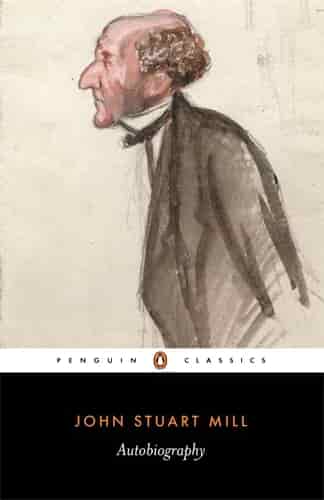
John Stuart Mill
Quotes
When, however, not more than half that duration of time had elapsed, a small ray of light broke in upon my gloom. I was reading, accidentally, Marmontel's "Mémoires," and came to the passage which relates his father's death, the distressed position of the family, and the sudden inspiration by which he, then a mere boy, felt and made them feel that he would be everything to them—would supply the place of all that they had lost. A vivid conception of the scene and its feelings came over me, and I was moved to tears. From this moment my been grew lighter. The oppression of the thought that all feeling was dead within me, was gone. I was no longer hopeless: I was not a stock or a stone. I had still, it seemed, some of the material out of which all worth of character, and all capacity for happiness, are made. ...Thus the cloud gradually drew off, and I again enjoyed life: and though I had several relapses, some of which lasted many months, I never again was as miserable as I had been.
p. 140
 Autobiography
It was the period of my mental progress which I have now reached that I formed the friendship which has been the honour and chief blessing of my existence, as well as the source of a great part of all that I have attempted to do, or hope to effect hereafter, for human improvement. My first introduction to the lady who, after a friendship of twenty years, consented to become my wife, was in 1830, when I was in my twenty-fifth and she in her twenty-third year.
p. 184
Autobiography[My father] impressed upon me from the first, that the manner in which the world came into existence was a subject on which nothing was known: that the question, "Who made me?" cannot be answered, because we have no experience or authentic information from which to answer it; and that any answer only throws the difficulty a step further back, since the question immediately presents itself, "Who made God?"
p. 42
AutobiographyMy father's moral inculcations were at all times mainly those of the "Socratici viri;" justice, temperance (to which he gave a very extended application), veracity, perseverance, readiness to encounter pain and especially labour; regard for the public good; estimation of persons according to their merits, and of things according to their intrinsic usefulness; a life of exertion in contradiction to one of self-indulgent sloth. These and other moralities he conveyed in brief sentences, uttered as occasion arose, of grave exhortation, or stern reprobation and contempt.
But though direct moral teaching does much, indirect does more; and the effect my father produced on my character, did not depend solely on what he said or did with that direct object, but also, and still more, on what manner of man he was.
p. 47
AutobiographyI believe that the early success and reputation of Carlyle's French Revolution, were considerably accelerated by what I wrote about it in the Review. Immediately on its publication, and before the commonplace critics, all whose rules and modes of judgment it set at defiance, had time to preoccupy the public with their disapproval of it, I wrote and published a review of the book, hailing it as one of those productions of genius which are above all rules, and are a law to themselves.
p. 217
AutobiographyThe world would be astonished if it knew how great a proportion of its brightest ornaments—of those most distinguished even in popular estimation for wisdom and virtue—are complete sceptics in religion...
p. 45
AutobiographyIn vain I sought relief from my favourite books; those memorials of past nobleness and greatness from which I had always hitherto drawn strength and animation. I read them now without feeling, or with the accustomed feeling minus all its charm; and I became persuaded, that my love of mankind, and of excellence for its own sake, had worn itself out. I sought no comfort by speaking to others of what I felt. If I had loved any one sufficiently to make confiding my griefs a necessity, I should not have been in the condition.
p. 134
AutobiographyI frequently asked myself, if I could, or if I was bound to go on living, when life must be passed in this manner. I generally answered to myself, that I did not think I could possibly bear it beyond a year.
p. 140
AutobiographyAll those to whom I looked up, were of opinion that the pleasure of sympathy with human beings, and the feelings which made the good of others, and especially of mankind on a large scale, the object of existence, were the greatest and surest sources of happiness. Of the truth of this I was convinced, but to know that a feeling would make me happy if I had it, did not give me the feeling.
p. 138
AutobiographyBut Bentham's subject was Legislation, of which Jurisprudence is only the formal part: and at every page he seemed to open a clearer and broader conception of what human opinions and institutions ought to be, how they might be made what they ought to be, and how far removed from it they now are. When I laid down the last volume of the Traité, I had become a different being. The "principle of utility" understood as Bentham understood it, and applied in the manner in which he applied it through these three volumes, fell exactly into its place as the keystone which held together the detached and fragmentary component parts of my knowledge and beliefs. It gave unity to my conceptions of things. I now had opinions; a creed, a doctrine, a philosophy; in one among the best senses of the word, a religion; the inculcation and diffusion of which could be made the principal outward purpose of a life. And I had a grand conception laid before me of changes to be effected in the condition of mankind through that doctrine. The Traité de Législation wound up with what was to me a most impressive picture of human life as it would be made by such opinions and such laws as were recommended in the treatise.
p. 66
AutobiographyIn this frame of mind it occurred to me to put the question directly to myself: "Suppose that all your objects in life were realized; that all the changes in institutions and opinions which you are looking forward to, could be completely effected at this very instant: would this be a great joy and happiness to you?" And an irrepressible self-consciousness distinctly answered, "No!" At this my heart sank within me: the whole foundation on which my life was constructed fell down. All my happiness was to have been found in the continual pursuit of this end. The end had ceased to charm, and how could there ever again be any interest in the means? I seemed to have nothing left to live for.
p. 133
Autobiography[T]he question was, whether, if the reformers of society and government could succeed in their objects, and every person in the community were free and in a state of physical comfort, the pleasures of life, being no longer kept up by struggle and privation, would cease to be pleasures.
p. 145
Autobiography