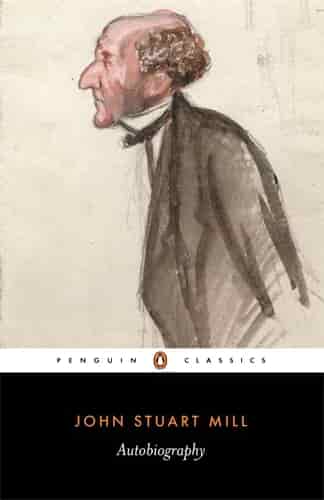
John Stuart Mill
Quotes
I needed to be made to feel that there was real, permanent happiness in tranquil contemplation. Wordsworth taught me this, not only without turning away from, but with a greatly increased interest in the common feelings and common destiny of human beings.
p. 148
 Autobiography
Compared with the greatest poets, he may be said to be the poet of unpoetical natures, possessed of quiet and contemplative tastes. But unpoetical natures are precisely those which require poetic cultivation. This cultivation Wordsworth is much more fitted to give, than poets who are intrinsically far more poets than he.
p. 149
AutobiographyI never turned recreant to intellectual culture, or ceased to consider the power and practice of analysis as an essential condition both of individual and of social improvement. But I thought that it had consequences which required to be corrected, by joining other kinds of cultivation with it. The maintenance of a due balance among the faculties, now seemed to me of primary importance. The cultivation of the feelings became one of the cardinal points in my ethical and philosophical creed.
p. 143
AutobiographyFor I now saw, or thought I saw, what I had always before received with incredulity—that the habit of analysis has a tendency to wear away the feelings: as indeed it has, when no other mental habit is cultivated, and the analysing spirit remains without its natural complements and correctives.
p. 137
AutobiographyMere newspaper articles on the occurrences or questions of the moment, gave no opportunity for the development of any general mode of thought; but I attempted, in the beginning of 1831, to embody in a series of articles, headed "The Spirit of the Age," some of my new opinions, and especially to point out in the character of the present age, the anomalies and evils characteristic of the transition from a system of opinions which had worn out, to another only in process of being formed. These articles were, I fancy, lumbering in style, and not lively or striking enough to be at any time, acceptable to newspaper readers; but had they been far more attractive, still, at that particular moment, when great political changes were impending, and engrossing all minds, these discussions were ill-timed, and missed fire altogether. The only effect which I know to have been produced by them, was that Carlyle, then living in a secluded part of Scotland, read them in his solitude, and saying to himself (as he afterwards told me) "here is a new Mystic," inquired on coming to London that autumn respecting their authorship; an inquiry which was the immediate cause of our becoming personally acquainted.
p. 173
AutobiographyI thought the predominance of the aristocratic classes, the noble and the rich, in the English Constitution, an evil worth any struggle to get rid of; not on account of taxes, or any such comparatively small inconvenience, but as the great demoralizing agency in the country. Demoralizing, first, because it made the conduct of the government an example of gross public immorality, through the predominance of private over public interests in the State, and the abuse of the powers of legislation for the advantage of classes. Secondly, and in a still greater degree, because the respect of the multitude always attaching itself principally to that which, in the existing state of society, is the chief passport to power; and under English institutions, riches, hereditary or acquired, being the almost exclusive source of political importance; riches, and the signs of riches, were almost the only things really respected, and the life of the people was mainly devoted to the pursuit of them. I thought, that while the higher and richer classes held the power of government, the instruction and improvement of the mass of the people were contrary to the self-interest of those classes, because tending to render the people more powerful for throwing off the yoke: but if the democracy obtained a large, and perhaps the principal, share in the governing power, it would become the interest of the opulent classes to promote their education, in order to ward off really mischievous errors, and especially those which would lead to unjust violations of property. On these grounds I was not only as ardent as ever for democratic institutions, but earnestly hoped that Owenite, St. Simonian, and all other anti-property doctrines might spread widely among the poorer classes; not that I thought those doctrines true, or desired that they should be acted on, but in order that the higher classes might be made to see that they had more to fear from the poor when uneducated, than when educated.
p. 171
AutobiographyBut, in my state of mind, this appearance of superiority to illusion added to the effect which Bentham's doctrines produced on me, by heightening the impression of mental power, and the vista of improvement which he did open was sufficiently large and brilliant to light up my life, as well as to give a definite shape to my aspirations.
p. 67
AutobiographyThough they may think the proof incomplete that the universe is a work of design, and though they assuredly disbelieve that it can have an Author and Governor who is absolute in power as well as perfect in goodness, they have that which constitutes the principal worth of all religions whatever, an ideal conception of a Perfect Being, to which they habitually refer as the guide of their conscience; and this ideal of Good is usually far nearer to perfection than the objective Deity of those, who think themselves obliged to find absolute goodness in the author of a world so crowded with suffering and so deformed by injustice as ours.
p. 46
AutobiographyAll this is merely saying that he, in a degree once common, but now very unusual, threw his feelings into his opinions; which truly it is difficult to understand how any one who possesses much of both, can fail to do. None but those who do not care about opinions, will confound it with intolerance. Those, who having opinions which they hold to be immensely important, and their contraries to be prodigiously hurtful, have any deep regard for the general good, will necessarily dislike, as a class and in the abstract, those who think wrong what they think right, and right what they think wrong: though they need not therefore be, nor was my father, insensible to good qualities in an opponent, nor governed in their estimation of individuals by one general presumption, instead of by the whole of their character.
p. 50
AutobiographyI am thus one of the very few examples, in this country, of one who has, not thrown off religious belief, but never had it...
p. 43
AutobiographyI had obtained some distinction, and felt myself of some importance, before the desire of distinction and of importance had grown into a passion: and little as it was which I had attained, yet having been attained too early, like all pleasures enjoyed too soon, it had made me blasé and indifferent to the pursuit. Thus neither selfish nor unselfish pleasures were pleasures to me. And there seemed no power in nature sufficient to begin the formation of my character anew, and create in a mind now irretrievably analytic, fresh associations of pleasure with any of the objects of human desire.
p. 139
AutobiographyScott does this still better than Wordsworth, and a very second-rate landscape does it more effectually than any poet. What made Wordsworth's poems a medicine for my state of mind, was that they expressed, not mere outward beauty, but states of feeling, and of thought coloured by feeling, under the excitement of beauty. They seemed to be the very culture of the feelings, which I was in quest of. In them I seemed to draw from a Source of inward joy, of sympathetic and imaginative pleasure, which could be shared in by all human beings; which had no connexion with struggle or imperfection, but would be made richer by every improvement in the physical or social condition of mankind. From them I seemed to learn what would be the perennial sources of happiness, when all the greater evils of life shall have been removed. And I felt myself at once better and happier as I came under their influence.
p. 147
Autobiography