
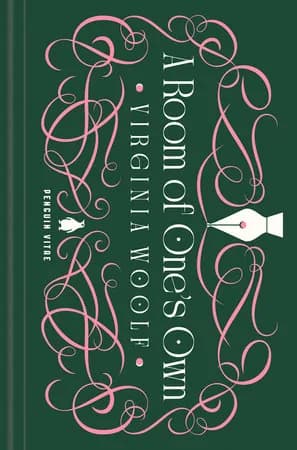
Quotes
The beauty of the world which is so soon to perish, has two edges, one of laughter, one of anguish, cutting the heart asunder.
p. 17
For it needs little skill in psychology to be sure that a highly gifted girl who had tried to use her gift for poetry would have been so thwarted and hindered by other people, so tortured and pulled asunder by her own contrary instincts, that she must have lost her health and sanity to a certainty.
p. 51
Women have served all these centuries as looking-glasses possessing the magic and delicious power of reflecting the figure of man at twice its natural size.
p. 35
A woman must have money and a room of her own if she is to write fiction.
p. 4
If truth is not to be found on the shelves of the British Museum, where, I asked myself, picking up a notebook and a pencil, is truth?
p. 25
Have you any notion how many books are written about women in the course of one year? Have you any notion how many are written by men? Are you aware that you are, perhaps, the most discussed animal in the universe?
p. 26
Literature is strewn with the wreckage of men who have minded beyond reason the opinions of others.
p. 58
[Women] Are they capable of education or incapable? Napoleon thought them incapable. Dr. Johnson thought the opposite. Have they souls or have they not souls? Some savages say they have none. Others, on the contrary, maintain that women are half divine and worship them on that account. Some sages hold that they are shallower in the brain; others that they are deeper in the consciousness. Goethe honoured them; Mussolini despises them. Wherever one looked men thought about women and thought differently. It was impossible to make head or tail of it all, I decided, glancing with envy at the reader next door who was making the neatest abstracts, headed often with an A or a B or a C, while my own notebook rioted with the wildest scribble of contradictory jottings. It was distressing, it was bewildering, it was humiliating. Truth had run through my fingers. Every drop had escaped.
The history of men's opposition to women's emancipation is more interesting perhaps than the story of that emancipation itself.
p. 72
When a subject is highly controversial — and any question about sex is that — one cannot hope to tell the truth. One can only show how one came to hold whatever opinion one does hold. One can only give one's audience the chance of drawing their own conclusions as they observe the limitations, the prejudices, the idiosyncrasies of the speaker.
p. 4
Fiction is like a spider's web, attached ever so lightly perhaps, but still attached to life at all four corners. Often the attachment is scarcely perceptible; Shakespeare's plays, for instance, seem to hang there complete by themselves. But when the web is pulled askew, hooked up at the edge, torn in the middle, one remembers that these webs are not spun in midair by incorporeal creatures, but are the work of suffering human beings, and are attached to the grossly material things, like health and money and the houses we live in.
p. 43
Life for both sexes — and I looked at them, shouldering their way along the pavement — is arduous, difficult, a perpetual struggle. It calls for gigantic courage and strength. More than anything, perhaps, creatures of illusion as we are, it calls for confidence in oneself. Without self-confidence we are as babes in the cradle. And how can we generate this imponderable quality, which is yet so invaluable, most quickly? By thinking that other people are inferior to one self. By feeling that one has some innate superiority — it may be wealth, or rank, a straight nose, or the portrait of a grandfather by Romney — for there is no end to the pathetic devices of the human imagination — over other people.
p. 35
I told you in the course of this paper that Shakespeare had a sister; but do not look for her in Sir Sidney Lee's life of the poet. She died young — alas, she never wrote a word... Now my belief is that this poet who never wrote a word and was buried at the cross-roads still lives. She lives in you and in me, and in many other women who are not here to-night, for they are washing up the dishes and putting the children to bed. But she lives; for great poets do not die; they are continuing presences; they need only the opportunity to walk among us in the flesh.
p. 117
I would venture to guess that Anon, who wrote so many poems without signing them, was often a woman.
p. 51
The human frame being what it is, heart, body and brain all mixed together, and not contained in separate compartments as they will be no doubt in another million years, a good dinner is of great importance to good talk. One cannot think well, love well, sleep well, if one has not dined well.
p. 18
Lock up your libraries if you like; but there is no gate, no lock, no bolt that you can set upon the freedom of my mind.
p. 90
My belief is that if we live another century or so — I am talking of the common life which is the real life and not of the little separate lives which we live as individuals — and have five hundred a year each of us and rooms of our own; if we have the habit of freedom and the courage to write exactly what we think; if we escape a little from the common sitting-room and see human beings not always in their relation to each other but in relation to reality; and the sky, too, and the trees or whatever it may be in themselves; if we look past Milton's bogey, for no human being should shut out the view; if we face the fact, for it is a fact, that there is no arm to cling to, but that we go alone and that our relation is to the world of reality and not only to the world of men and women, then the opportunity will come and the dead poet who was Shakespeare's sister will put on the body which she has so often laid down. Drawing her life from the lives of the unknown who were her forerunners, as her brother did before her, she will be born. As for her coming without that preparation, without that effort on our part, without that determination that when she is born again she shall find it possible to live and write her poetry, that we cannot expect, for that would be impossible. But I maintain that she would come if we worked for her, and that so to work, even in poverty and obscurity, is worth while.
p. 117
No need to hurry. No need to sparkle. No need to be anybody but oneself.
p. 17
That’s all the quotes.
18 quotes in the collection · come back when we add more