


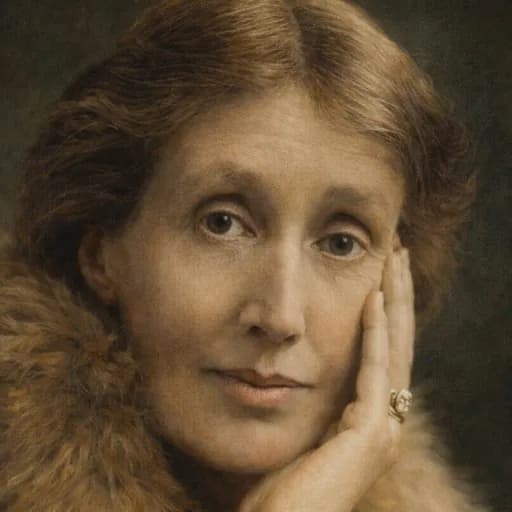
Virginia Woolf
Quotes
Mrs Swithin took her knitting from the table. 'Did you feel,' she asked, 'what he said: we act different parts but are the same?'
'That was the burden,' she mused, 'laid on me in the cradle; murmured by waves; breathed by restless elm trees; crooned by singing women; what we must rememeber; what we would forget.'
Words rose above the intolerably laden dumb oxen plodding through the mud. Words without meaning - wonderful words.
Books are the mirrors of the soul.
The flowers flashed before they faded. She watched them flash.
They never pulled the curtains till it was too dark to see, nor shut the windows till it was too cold. Why shut out the day before it was over? The flowers were still bright; the birds chirped. You could see more in the evening often when nothing interrupted, when there was no fish to order, no telephone to answer.
Something, perhaps, we must believe in, and as Orlando, we have said, had no belief in the usual divinities she bestowed her credulity upon great men — yet with a distinction. Admirals, soldiers, statesmen, moved her not at all. But the very thought of a great writer stirred her to such a pitch of belief that she almost believed him to be invisible. Her instinct was a sound one. One can only believe entirely, perhaps, in what one cannot see.
I like the copious, shapeless, warm, not so very clever, but extremely easy and rather coarse aspect of things; the talk of men in clubs and public-houses; of miners half naked in drawers — the forthright, perfectly unassuming, and without end in view except dinner, love, money and getting along tolerably; that which is without great hopes, ideals, or anything of that kind; what is unassuming except to make a tolerably, good job of it. I like all that.
p. 246
Old Madame du Deffand and her friends talked for fifty years without stopping. And of it all, what remains? Perhaps three witty sayings.
‘The flower,’ said Bernard, ‘the red carnation that stood in the vase on the table of the restaurant when we dined together with Percival, is become a six-sided flower; made of six lives.’
Our friends, how seldom visited, how little known — it is true; and yet, when I meet an unknown person, and try to break off, here at this table, what I call “my life”, it is not one life that I look back upon; I am not one person; I am many people; I do not altogether know who I am — Jinny, Susan, Neville, Rhoda, or Louis; or how to distinguish my life from theirs.
Green in nature is one thing, green in in literature another. Nature and letters seem to have a natural antipathy; bring them together and they tear each other to pieces.


