
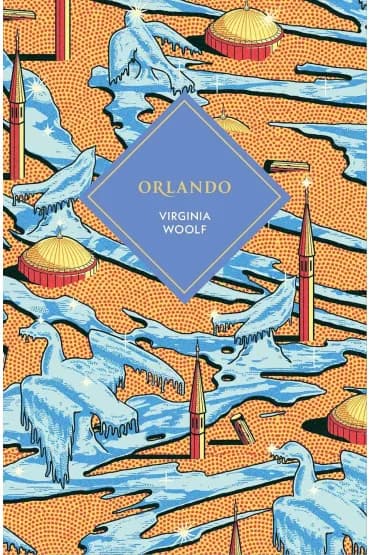
Quotes
Something, perhaps, we must believe in, and as Orlando, we have said, had no belief in the usual divinities she bestowed her credulity upon great men — yet with a distinction. Admirals, soldiers, statesmen, moved her not at all. But the very thought of a great writer stirred her to such a pitch of belief that she almost believed him to be invisible. Her instinct was a sound one. One can only believe entirely, perhaps, in what one cannot see.
Old Madame du Deffand and her friends talked for fifty years without stopping. And of it all, what remains? Perhaps three witty sayings.
Green in nature is one thing, green in in literature another. Nature and letters seem to have a natural antipathy; bring them together and they tear each other to pieces.
Thus, there is much to support the view that it is clothes that wear us and not we them; we may make them take the mould of arm or breast, but they mould our hearts, our brains, our tongues to their liking.
Only those who have little need of the truth, and no respect for it — the poets and novelists — can be trusted to do it, for this is one of the cases where the truth does no exist. Nothing exists. The whole thing is a miasma — a mirage.
For the Philosopher is right who says that nothing thicker than a knife's blade separates happiness from melancholy; and he goes on to opine that one is twin fellow to the other; and draws from this the conclusion that all extremes of feeling are allied to madness; and so bids us take refuge in the true Church (in his view the Anabaptists), which is the only harbor, port, anchorage, etc., he said, for those tossed on this sea.
The hostess is our modern Sibyl. She is a witch who lays her guests under a spell. In this house they think themselves happy; in that witty; in a third profound. It is all an illusion (which is nothing against it, for illusions are the most valuable and necessary of all things, and she who can create one is among the world's greatest benefactors), but as it is notorious that illusions are shattered by conflict with reality, so no real happiness, no real wit, no real profundity are tolerated where the illusion prevails.
As long as she thinks of a man, nobody objects to a woman thinking.
No passion is stronger in the breast of man than the desire to make others believe as he believes. Nothing so cuts at the root of his happiness and fills him with rage as the sense that another rates low what he prizes high. Whigs and Tories, Liberal party and Labour party — for what do they battle except their own prestige?
Society is the most powerful conception in the world and society has no existence whatsoever.
The chief charges against her were (1) that she was dead, and therefore could not hold any property; (2) that she was a woman which amounts to much the same thing ...
Better was it to go unknown and leave behind you an arch, a potting shed, a wall where peaches ripen, than to burn like meteor and leave no dust.
While fame impedes and constricts, obscurity wraps about a man like a mist; obscurity is dark, ample, and free; obscurity lets the mind take its way unimpeded. Over the obscure man is poured the merciful suffusion of darkness. None knows where he goes or comes. He may seek the truth and speak it; he alone is free; he alone is truthful, he alone is at peace.
Time, unfortunately, though it makes animals and vegetables bloom and fade with amazing punctuality, has no such simple effect upon the mind of man. The mind of man, moreover, works with equal strangeness upon the body of time. An hour, once it lodges in the queer element of the human spirit, may be stretched to fifty or a hundred times its clock length; on the other hand, an hour may be accurately represented on the timepiece of the mind by one second. This extraordinary discrepancy between time on the clock and time in the mind is less known than it should be and deserves fuller investigation.
At the age of thirty, or thereabouts, this young Nobleman had not only had every experience that life has to offer, but had seen the worthlessness of them all. Love and ambition, women and poets were all equally vain. Literature was a farce. The night after reading Greene's Visit to a Nobleman in the Country, he burnt in a great conflagration fifty-seven poetical works, only retaining 'The Oak Tree', which was his boyish dream and very short. Two things alone remained to him in which he now put any trust: dogs and nature; an elk-hound and a rose bush. The world, in all its variety, life in all its complexity, had shrunk to that. Dogs and a bush were the whole of it.



That’s all the quotes.
15 quotes in the collection · come back when we add more