

Quotes
Ignorance produces rashness, reflection timidity
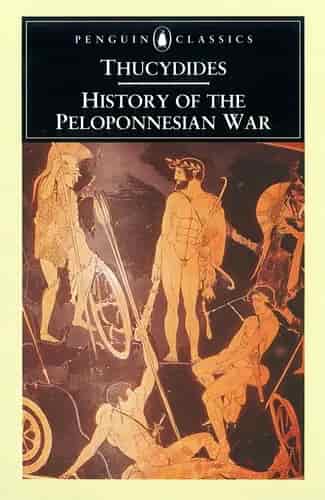
 History of the Peloponnesian War
By day certainly the combatants have a clearer notion, though even then by no means of all that takes place, no one knowing much of anything that does not does not go on in his own immediate neighborhood; but in a night engagement (and this was the only one that occurred between great armies during the war) how could anyone know anything for certain?
History of the Peloponnesian WarThe dead lay unburied, and each man as he recognized a friend among them shuddered with grief and horror; while the living whom they were leaving behind, wounded or sick, were to the living far more shocking than the dead, and more to be pitied than those who had perished.
History of the Peloponnesian WarThe wide difference between the two characters, the slowness and want of energy of the Spartans as contrasted with the dash and enterprise of their opponents, proved of the greatest service, especially to a maritime empire like Athens. Indeed this was shown by the Syracusans, who were most like the Athenians in character, and also most successful in combating them.
History of the Peloponnesian War[T]heir swaying bodies reflected the agitation of their minds, and they suffered the worst agony of all, ever just within the reach of safety or just on the point of destruction.
History of the Peloponnesian WarAnd the rarest dangers are those in which failure brings little loss and success the greatest advantage.
History of the Peloponnesian WarWhen men are once checked in what they consider their special excellence, their whole opinion of themselves suffers more than if they had not at first believed in their superiority, the unexpected shock to their pride causing them to give way more than their real strength warrants; and that is probably now the case with the Athenians.
History of the Peloponnesian WarRight or community of blood was not the bond of union between them, so much as interest or compulsion as the case may be.
History of the Peloponnesian WarIn a democracy ...someone who fails to get elected to office can always console himself with the thought that there was something not quite fair about it.
p. 298
History of the Peloponnesian WarHatred also is short lived; but that which makes the splendor of the present and the glory of the future remains forever unforgotten
History of the Peloponnesian WarYou can now, if you choose, employ your present success to advantage, so as to keep what you have got and gain honour and reputation besides, and you can avoid the mistake of those who meet with an extraordinary piece of good fortune, and are led on by hope to grasp continually at something further, through having already succeeded without expecting it.
History of the Peloponnesian WarThe bravest are surely those who have the clearest vision of what is before them, glory and danger alike, and yet notwithstanding, go out to meet it.
History of the Peloponnesian War[W]e must make up our minds to look for our protection not to legal terrors but to careful administration.
History of the Peloponnesian War[T]he Thracian people, like the bloodiest of the barbarians, being ever most murderous when it has nothing to fear.
History of the Peloponnesian WarMen do not rest content with parrying the attacks of a superior, but often strike the first blow to prevent the attack being made.
History of the Peloponnesian War" we know that there can never be any solid friendship between individuals, or union between communities that is worth the name, unless the parties be persuaded of each others honesty,"
History of the Peloponnesian WarAgain, in our enterprises we present the singular spectacle of daring and deliberation, each carried to its highest point, and both united in the same persons; although usually decision is the fruit of ignorance, hesitation of reflection. But the palm of courage will surely be adjudged most justly to those, who best know the difference between hardship and pleasure and yet are never tempted to shrink from danger. In generosity we are equally singular, acquiring our friends by conferring, not by receiving, favours.
History of the Peloponnesian WarContempt for an assailant is best shown by bravery in action.
History of the Peloponnesian WarBut what most oppressed them was that they had two wars at once, and has thus reached a pitch of frenzy which no one would have believed possible if he had heard of it before it had come to pass.
History of the Peloponnesian WarNow the only sure basis of an alliance is for each party to be equally afraid of the other...
History of the Peloponnesian War[H]ere we bless your simplicity but do not envy your folly.
History of the Peloponnesian WarWe must not disguise from ourselves that we go to found a city among strangers and enemies, and he who undertakes such an enterprise should be prepared to become master of the country the first day he lands, or failing in this find everything hostile to him.
History of the Peloponnesian WarIf you give way, you will instantly have to meet some greater demand, as having been frightened into obedience in the first instance; while a firm refusal will make them clearly understand that they must treat you more as equals.
History of the Peloponnesian WarI think the two things most opposed to good counsel are haste and passion; haste usually goes hand in hand with folly, passion with coarseness and narrowness of mind.
History of the Peloponnesian WarThey stood where they stood by the power of the sword.
History of the Peloponnesian WarIt must be thoroughly understood that war is a necessity, and that the more readily we accept it, the less will be the ardor of our opponents, and that out of the greatest dangers communities and individuals acquire the greatest glory.
History of the Peloponnesian WarBut the prize for courage will surely be awarded most justly to those who best know the difference between hardship and pleasure and yet are never tempted to shrink from danger.
History of the Peloponnesian WarI could have wished that the reputations of many brave men were not to be imperilled in the mouth of a single individual, to stand or fall according as he spoke well or ill. For it is hard to speak properly upon a subject where it is even difficult to convince your hearers that you are speaking the truth. On the one hand, the friend who is familiar with every fact of the story may think that some point has not been set forth with that fullness which he wishes and knows it to deserve; on the other, he who is a stranger to the matter may be led by envy to suspect exaggeration if he hears anything above his own nature. For men can endure to hear others praised only so long as they can severally persuade themselves of their own ability to equal the actions recounted: when this point is passed, envy comes in and with it incredulity.
History of the Peloponnesian WarDisdain is the privilege of those who, like us, have been assured by reflection of their superiority to their adversary. And where the chances are the same, knowledge fortifies courage by the contempt which is its consequence, its trust being placed, not in hope, which is the prop of the desperate, but in a judgment grounded upon existing resources, whose anticipations are more to be depended upon.
History of the Peloponnesian WarFire signals of an attack were also raised toward Thebes, but the Plataeans in the city at once displayed a number of others, prepared beforehand for this very purpose, in order to render the enemy's signals unintelligible, and to prevent his friends from getting a true idea of what was happening and coming to his aid before their comrades who had gone out should have made good their escape and be in safety.
History of the Peloponnesian WarThe Spartans meanwhile, man to man, and with their war songs in the ranks, exhorted each brave comrade to remember what he had learned before; well aware that the long training of action was of more use for saving lives than any brief verbal exhortation, though ever so well delivered.
History of the Peloponnesian WarAnd it is certain that those who do not yield to their equals, who keep terms with their superiors, and are moderate towards their inferiors, on the whole succeed best.
History of the Peloponnesian WarAs for democracy, the men of sense among us knew what it was, and I perhaps as well as any, as I have more cause to complain of it; but there is nothing new to be said of a patent absurdity-meanwhile we did not think it safe to alter it under the pressure of your hostility.
History of the Peloponnesian War[H]e who voluntarily confronts tremendous odds must have very great internal resources to draw upon.
History of the Peloponnesian War[S]till hope leads men to venture; and no one ever yet put himself in peril without the inward conviction that he would succeed in his design.
History of the Peloponnesian WarThere is, however, no advantage in reflections on the past further than may be of service to the present. For the future we must provide by maintaining what the present gives us and redoubling our efforts; it is hereditary to us to win virtue as the fruit of labour, and you must not change the habit, even though you should have a slight advantage in wealth and resources; for it is not right that what was won in want should be lost in plenty.
History of the Peloponnesian WarThe fate of those of their neighbours who had already rebelled and had been subdued was no lesson to them; their own prosperity could not dissuade them from affronting danger; but blindly confident in the future, and full of hopes beyond their power though not beyond their ambition, they declared war and made their decision to prefer might to right, their attack being determined not by provocation but by the moment which seemed propitious. The truth is that great good fortune coming suddenly and unexpectedly tends to make a people insolent; in most cases it is safer for mankind to have success in reason than out of reason; and it is easier for them, one may say, to stave off adversity than to preserve prosperity.
History of the Peloponnesian Warspeculation is carried on in safety, but, when it comes to action, fear causes failure.
History of the Peloponnesian WarThey have discovered that the length of time we have now been in commission has rotted our ships and wasted our crews, and that with the completeness of our crews and the soundness of the pristine efficiency of our navy has departed. For it is impossible for us to haul our ships ashore and dry them out because the enemy's vessels being as many or more than our own, we are constantly anticipating an attack.
History of the Peloponnesian WarHope, danger's comforter...
History of the Peloponnesian War[A]nd their judgment was based more upon blind wishing than upon any sound prediction; for it is a habit of mankind to entrust to careless hope what they long for, and to use sovereign reason to thrust aside what they do not desire.
History of the Peloponnesian WarWe hope that you, instead of thinking to influence us by saying that you did not join the Lacedaemonians, although their colonists, or that you have done us no wrong, will aim at what is feasible, holding in view the real sentiments of us both; since you know as well as we do that right, as the world goes, is only in question between equals in power, while the strong do what they can and the weak suffer what they must.
History of the Peloponnesian WarThat war is an evil is a proposition so familiar to every one that it would be tedious to develop it. No one is forced to engage in it by ignorance, or kept out of it by fear, if he fancies there is anything to be gained by it.
History of the Peloponnesian WarWe must march against the enemy, and teach him that he must go and get what he wants by attacking someone who will not resist him, but that men whose glory it is to be always ready to give battle for the liberty of their own country, and never unjustly to enslave that of others, will not let him go without a struggle.
History of the Peloponnesian War[T]hey possess most gold and silver, by which war, like everything else, flourishes.
History of the Peloponnesian WarOf the gods we believe, and of men we know, that by a necessary law of their nature they rule wherever they can.
History of the Peloponnesian WarI think, therefore, that we ought to take great numbers of hoplites, both from Athens and from our allies, and not merely from our subjects, but also any we may be able to get for love or money in the Peloponnesus, and great numbers also of archers and slingers, to oppose the Sicilian horse.
History of the Peloponnesian War[W]hen night came on, the Macedonians and the barbarian crowd suddenly took fright in one of those mysterious panics to which great armies are liable...
History of the Peloponnesian WarLet him remember that many before now have tried to chastise a wrongdoer, and failing to punish their enemy have not even saved themselves; while many who have trusted in force to gain an advantage, instead of gaining anything more, have been doomed to lose what they had. Vengeance is not necessarily successful because wrong has been done, or strength sure because it is confident; but the incalculable element in the future exercises the widest influence, and is the most treacherous, and yet in fact the most useful of all things, as it frightens us all equally, and thus makes us consider before attacking each other.
History of the Peloponnesian WarThe country on the sea coast, now called Macedonia, was first acquired by Alexander, the father of Perdiccas, and his ancestors, originally Temenids from Argos...The whole is now called Macedonia, and at the time of the invasion of Sitalces, Perdiccas, Alexander's son, was the reigning king.
History of the Peloponnesian WarThe secret of happiness is freedom and the secret of freedom is courage.
History of the Peloponnesian WarIn practice we always base our preparations against an enemy on the assumption that his plans are good; indeed, it is right to rest our hopes not on a belief in his blunders, but on the soundness of our provisions. Nor ought we to believe that there is much difference between man and man, but to think that the superiority lies with him who is reared in the severest school.
History of the Peloponnesian WarWords had to change their ordinary meaning and to take that which was now given them. Reckless audacity came to be considered the courage of a loyal ally; prudent hesitation, specious cowardice; moderation was held to be a cloak for unmanliness; ability to see all sides of a question, inaptness to act on any. Frantic violence became the attribute of manliness; cautious plotting, a justifiable means of self-defence. The advocate of extreme measures was always trustworthy; his opponent a man to be suspected. To succeed in a plot was to have a shrewd head, to divine a plot a still shrewder; but to try to provide against having to do either was to break up your party and to be afraid of your adversaries.
History of the Peloponnesian WarI am more afraid of our own blunders than of the enemy's devices.
History of the Peloponnesian WarI have often before now been convinced that a democracy is incapable of empire...
History of the Peloponnesian WarOn the whole, however, the conclusions I have drawn from the proofs quoted may, I believe, safely be relied on. Assuredly they will not be disturbed either by the lays of a poet displaying the exaggeration of his craft, or by the compositions of the chroniclers that are attractive at truth's expense; the subjects they treat of being out of the reach of evidence, and time having robbed most of them of historical value by enthroning them in the region of legend.
History of the Peloponnesian War" war is a matter not so much of arms as of money,"
History of the Peloponnesian WarAbstinence from all injustice to other first-rate powers is a greater tower of strength than anything that can be gained by the sacrifice of permanent tranquillity for an apparent temporary advantage.
History of the Peloponnesian WarIt is a common mistake in going to war to begin at the wrong end, to act first, and wait for disaster to discuss the matter.
History of the Peloponnesian WarFor the true author of the subjugation of a people is not so much the immediate agent, as the power which permits it having the means to prevent it.
History of the Peloponnesian WarThe real cause I consider to be the one which was formerly most kept out of sight. The growth of the power of Athens, and the alarm which this inspired the Lacedaemon, made war inevitable.
History of the Peloponnesian WarIn fine, I have written my work, not as an essay which is to win the applause of the moment, but as a possession for all time.
History of the Peloponnesian WarBut as the power of Hellas grew, and the acquisition of wealth became more an objective, the revenues of the states increasing, tyrannies were established almost everywhere...
p. 7
History of the Peloponnesian WarFor the love of gain would reconcile the weaker to the dominion of the stronger, and the possession of capital enabled the more powerful to reduce the smaller cities to subjection.
History of the Peloponnesian War[C]oncessions to adversaries only end in self reproach, and the more strictly they are avoided the greater will be the chance of security.
History of the Peloponnesian WarThus they toil on in trouble and danger all the days of their life, with little opportunity for enjoying, being ever engaged in getting: their only idea of a holiday is to do what the occasion demands, and to them laborious occupation is less of a misfortune than the peace of a quiet life. To describe their character in a word, one might truly say that they were born into the world to take no rest themselves and to give none to others.
History of the Peloponnesian Warself-control contains honour as a chief constituent, and honour bravery.
History of the Peloponnesian War[T]he freaks of chance are not determinable by calculation.
History of the Peloponnesian WarSo little pains do the vulgar take in the investigation of truth, accepting readily the first story that comes to hand.
History of the Peloponnesian WarTo come to this war: despite the known disposition of the actors in a struggle to overrate its importance, and when it is over to return to their admiration of earlier events, yet an examination of the facts will show that it was much greater than the wars which preceded it.
History of the Peloponnesian War

That’s all the quotes.
70 quotes in the collection · come back when we add more