
Quotes
In general we look for a new law by the following process. First we guess it. Then we compute the consequences of the guess to see what would be implied if this law that we guessed is right. Then we compare the result of the computation to nature, with experiment or experience, compare it directly with observation, to see if it works. If it disagrees with experiment it is wrong. In that simple statement is the key to science. It does not make any difference how beautiful your guess is. It does not make any difference how smart you are, who made the guess, or what his name is – if it disagrees with experiment it is wrong. That is all there is to it.
p. 156
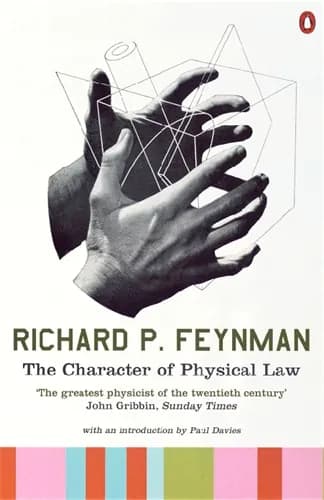
 The Character of Physical Law
It is not unscientific to make a guess, although many people who are not in science think it is. Some years ago I had a conversation with a layman about flying saucers — because I am scientific I know all about flying saucers! I said “I don’t think there are flying saucers”. So my antagonist said, “Is it impossible that there are flying saucers? Can you prove that it’s impossible?” “No”, I said, “I can’t prove it’s impossible. It’s just very unlikely”. At that he said, “You are very unscientific. If you can’t prove it impossible then how can you say that it’s unlikely?” But that is the way that is scientific. It is scientific only to say what is more likely and what less likely, and not to be proving all the time the possible and impossible. To define what I mean, I might have said to him, "Listen, I mean that from my knowledge of the world that I see around me, I think that it is much more likely that the reports of flying saucers are the results of the known irrational characteristics of terrestrial intelligence than of the unknown rational efforts of extra-terrestrial intelligence." It is just more likely. That is all.
p. 165
The Character of Physical LawIn general, we look for a new law by the following process: First we guess it. Then we – now don't laugh, that's really true. Then we compute the consequences of the guess to see what, if this is right, if this law that we guessed is right, to see what it would imply. And then we compare the computation results to nature, or we say compare to experiment or experience, compare it directly with observations to see if it works. If it disagrees with experiment, it's wrong. In that simple statement is the key to science. It doesn't make any difference how beautiful your guess is, it doesn't make any difference how smart you are, who made the guess, or what his name is. If it disagrees with experiment, it's wrong. That's all there is to it.
The Character of Physical Lawchapter 2, “The Relation of Mathematics to Physics,” p. 58; video
The Character of Physical LawMathematics is not just a language. Mathematics is a language plus reasoning. It's like a language plus logic. Mathematics is a tool for reasoning. It's, in fact, a big collection of the results of some person's careful thought and reasoning. By mathematics, it is possible to connect one statement to another.
The Character of Physical LawThe next question was — what makes planets go around the sun? At the time of Kepler some people answered this problem by saying that there were angels behind them beating their wings and pushing the planets around an orbit. As you will see, the answer is not very far from the truth. The only difference is that the angels sit in a different direction and their wings push inward.
p. 18
The Character of Physical LawIt is impossible, by the way, when picking one example of anything, to avoid picking one which is atypical in some sense.
p. 27
The Character of Physical Law...Dirac discovered the correct laws for relativity quantum mechanics simply by guessing the equation. The method of guessing the equation seems to be a pretty effective way of guessing new laws. This shows again that mathematics is a deep way of expressing nature, and any attempt to express nature in philosophical principles, or in seat-of-the-pants mechanical feelings, is not an efficient way.
...It always bothers me that, according to the laws as we understand them today, it takes a computing machine an infinite number of logical operations to figure out what goes on in no matter how tiny a region of space, and no matter how tiny a region of time. How can all that be going on in that tiny space? Why should it take an infinite amount of logic to figure out what one tiny piece of space/time is going to do? So I have often made the hypotheses that ultimately physics will not require a mathematical statement, that in the end the machinery will be revealed, and the laws will turn out to be simple, like the chequer board with all its apparent complexities.
The Character of Physical LawTherefore psychologically we must keep all the theories in our heads, and every theoretical physicist who is any good knows six or seven different theoretical representations for exactly the same physics.
p. 168
The Character of Physical LawNature's imagination far surpasses our own.
p. 162
The Character of Physical LawTo those who do not know mathematics it is difficult to get across a real feeling as to the beauty, the deepest beauty, of nature. ... If you want to learn about nature, to appreciate nature, it is necessary to understand the language that she speaks in.
p. 58
The Character of Physical LawNature uses only the longest threads to weave her patterns, so each small piece of her fabric reveals the organization of the entire tapestry.
p. 34
The Character of Physical LawSo we have these wide principles which sweep across all the different laws, and if one takes too seriously its derivations, and feels that this is only valid because this [assumed more fundamental principle] is valid, you cannot understand the interconnections of the different branches of physics. Some day, when physics is complete, then maybe with this kind of argument we'll know all the laws, then we can start with some axioms (and no doubt somebody will figure out a particular way of doing it) and then all the deductions will be made. But while we don't know all the laws, we can use some to make guesses at theorems which extend beyond the proof.
The Character of Physical LawOur imagination is stretched to the utmost, not, as in fiction, to imagine things which are not really there, but just to comprehend those things which are there.
p. 127
The Character of Physical LawNow we have a problem. We can deduce, often, from one part of physics like the law of gravitation, a principle which turns out to be much more valid than the derivation. This doesn't happen in mathematics, that the theorems come out in places where they're not supposed to be!
The Character of Physical LawThis is the key of modern science and is the beginning of the true understanding of nature. This idea. That to look at the things, to record the details, and to hope that in the information thus obtained, may lie a clue to one or another of a possible theoretical interpretation.
p. 15
The Character of Physical LawOne of the most important things in this 'guess — compute consequences — compare with experiment' business is to know when you are right. It is possible to know when you are right way ahead of checking all the consequences. You can recognize truth by its beauty and simplicity. It is always easy when you have made a guess, and done two or three little calculations to make sure that it is not obviously wrong, to know that it is right. When you get it right, it is obvious that it is right — at least if you have any experience — because usually what happens is that more comes out than goes in. Your guess is, in fact, that something is very simple. If you cannot see immediately that it is wrong, and it is simpler than it was before, then it is right. The inexperienced, the crackpots, and people like that, make guesses that are simple, but you can immediately see that they are wrong, so that does not count. Others, the inexperienced students, make guesses that are very complicated, and it sort of looks as if it is all right, but I know it is not true because the truth always turns out to be simpler than you thought.
p. 171
The Character of Physical LawI think I can safely say that nobody understands quantum mechanics.
p. 129
The Character of Physical Law[T]he total amount that a physicist knows is very little. He has only to remember the rules to get him from one place to another...
p. 45
The Character of Physical LawSo in order to understand the physics one must always have a neat balance and contain in his head all of the various propositions and their interelationships because the laws often extend beyond the range of their deductions. This will only have no importance when all the laws are known.
The Character of Physical LawFor those who want some proof that physicists are human, the proof is in the idiocy of all the different units which they use for measuring energy.
p. 75
The Character of Physical LawOn the infrequent occasions when I have been called upon in a formal place to play the bongo drums, the introducer never seems to find it necessary to mention that I also do theoretical physics.
p. 13
The Character of Physical LawDo not keep saying to yourself, if you can possibly avoid it, "But how can it be like that?" because you will get "down the drain", into a blind alley from which nobody has yet escaped. Nobody knows how it can be like that.
p. 129
The Character of Physical LawIf we have confidence in a law, then if something appears to be wrong it can suggest to us another phenomenon.
p. 23
The Character of Physical LawA person talks in such generalities that everyone can understand him and it's considered to be some deep philosophy. However, I would like to be very rather more special and I would like to be understood in an honest way, rather than in a vague way.
p. 13
The Character of Physical Law
That’s all the quotes.
25 quotes in the collection · come back when we add more