


Richard P. Feynman
Quotes
The third aspect of my subject is that of science as a method of finding things out. This method is based on the principle that observation is the judge of whether something is so or not. All other aspects and characteristics of science can be understood directly when we understand that observation is the ultimate and final judge of the truth of an idea. But "prove" used in this way really means "test," in the same way that a hundred-proof alcohol is a test of the alcohol, and for people today the idea really should be translated as, "The exception tests the rule." Or, put another way, "The exception proves that the rule is wrong." That is the principle of science. If there is an exception to any rule, and if it can be proved by observation, that rule is wrong.
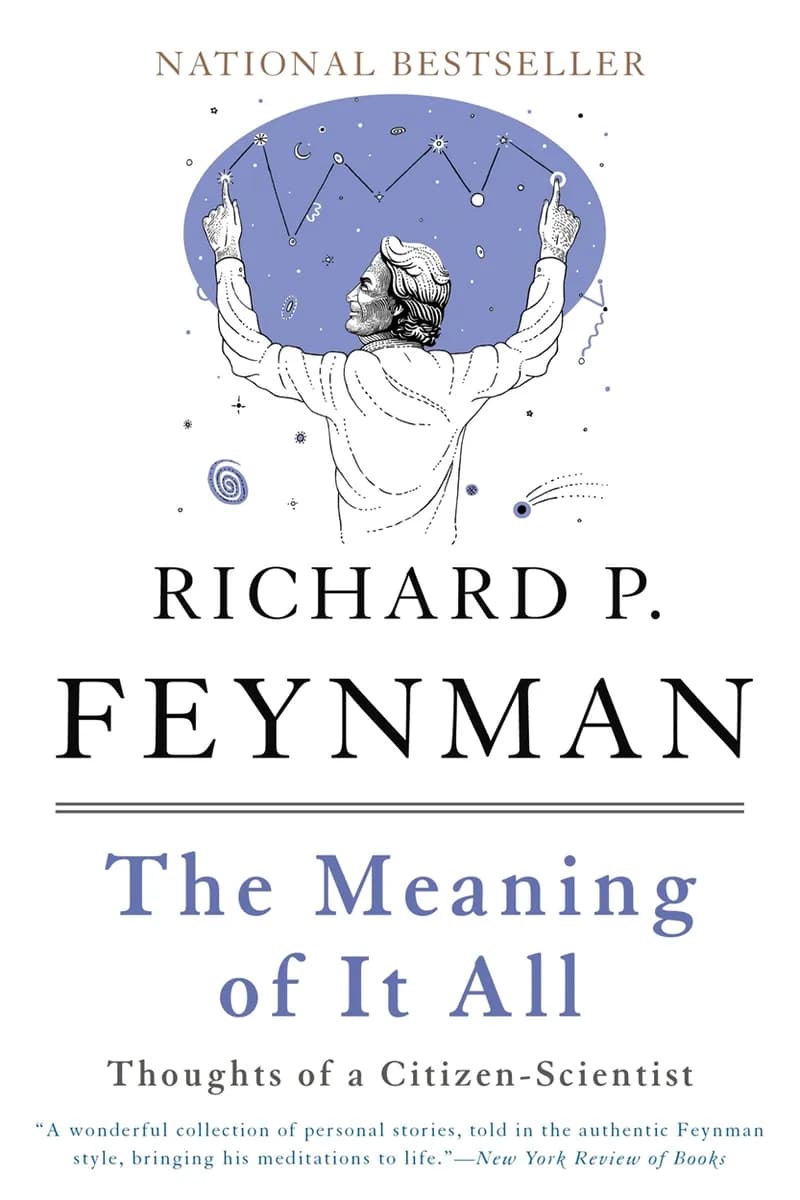 The Meaning of It All
It is a great adventure to contemplate the universe, beyond man, to contemplate what it would be like without man, as it was in a great part of its long history and as it is in a great majority of places. When this objective view is finally attained, and the mystery and majesty of matter are fully appreciated, to then turn the objective eye back on man viewed as matter, to view life as part of this universal mystery of greatest depth, is to sense an experience which is very rare, and very exciting. It usually ends in laughter and a delight in the futility of trying to understand what this atom in the universe is, this thing — atoms with curiosity — that looks at itself and wonders why it wonders. Well, these scientific views end in awe and mystery, lost at the edge in uncertainty, but they appear to be so deep and so impressive that the theory that it is all arranged as a stage for God to watch man's struggle for good and evil seems inadequate.
The Meaning of It All...I don't believe in the idea that there are a few peculiar people capable of understanding math and the rest of the world is normal. Math is a human discovery, and it's no more complicated than humans can understand. I had a calculus book once that said, "What one fool can do, another fool can." What we've been able to work out about nature may look abstract and threatening to someone who hasn't studied it, but it was fools who did it, and in the next generation, all the fools will understand it. There's a tendency to pomposity in all this, to make it all deep and profound...
p. 194
 The Pleasure of Finding Things Out
Suppose two politicians are running for president, and one goes through the farm section and is asked, "What are you going to do about the farm question?" And he knows right away - bang, bang, bang. Now he goes to the next campaigner who comes through. "What are you going to do on the farm problem?" "Well, I don't know. I used to be a general, and I don't know anything about farming. But it seems to me it must be a very difficult problem, because for twelve, fifteen, twenty years people have been struggling with it, and people say that they know how to solve the farm problem. And it must be a hard problem. So the way I intend to solve the farm problem is to gather around me a lot of people who know something about it, to look at all the experience that we have had with this problem before, to take a certain amount of time at it, and then to come to some conclusion in a reasonable way about it. Now, I can't tell you ahead of time what solution, but I can give you some of the principles I'll try to use - not to make things difficult for individual farmers, if there are any special problems we will have to have some way to take care of them," etc., etc., etc.
Now such a man would never get anywhere in this country, I think. It's never been tried, anyway. This is in the attitude of mind of the populace, that they have to have an answer and that a man who gives an answer is better than a man who gives no answer, when the real fact of the matter is, in most cases, it is the other way around. And the result of this of course is that the politician must give an answer. And the result of this is that political promises can never be kept. It is a mechanical fact; it is impossible. The result of that is that nobody believes campaign promises. And the result of that is a general disparaging of politics, a general lack of respect for the people who are trying to solve problems, and so forth. It's all generated from the very beginning (maybe - this is a simple analysis). It's all generated, maybe, by the fact that the attitude of the populace is to try to find the answer instead of trying to find a man who has a way of getting at the answer.
The Meaning of It AllIf the professors of English will complain to me that the students who come to the universities, after all those years of study, still cannot spell "friend," I say to them that something's the matter with the way you spell friend.
The Meaning of It AllI don't know anything, but I do know that everything is interesting if you go into it deeply enough.
p. 203
The Pleasure of Finding Things Out...In that same period there was Newton, there was Harvey studying the circulation of the blood, there were people with methods of analysis by which progress was being made! You can take every one of Spinoza's propositions and take the contrary propositions and look at the world--and you can't tell which is right. Sure, people were awed because he had the courage to take on these great questions, but it doesn't do any good to have the courage if you can't get anywhere with the question...
p. 195
The Pleasure of Finding Things OutSome people say, "How can you live without knowing?" I do not know what they mean. I always live without knowing. That is easy. How you get to know is what I want to know.
The Meaning of It AllThe remark which I read somewhere, that science is all right as long as it doesn't attack religion, was the clue I needed to understand the problem. As long as it doesn't attack religion it need not be paid attention to and nobody has to learn anything. So it can be cut off from society except for its applications, and thus be isolated. And then we have this terrible struggle to try to explain things to people who have no reason to want to know. But if they want to defend their own point of view, they will have to learn what yours is a little bit. So I suggest, maybe correctly and perhaps wrongly, that we are too polite.
The Pleasure of Finding Things OutThe first principle is that you must not fool yourself, and you are the easiest person to fool.
The Pleasure of Finding Things OutLooking back at the worst times, it always seems that they were times in which there were people who believed with absolute faith and absolute dogmatism in something. And they were so serious in this matter that they insisted that the rest of the world agree with them. And then they would do things that were directly inconsistent with their own beliefs in order to maintain that what they said was true.
The Meaning of It AllIt is in the admission of ignorance and the admission of uncertainty that there is a hope for the continuous motion of human beings in some direction that doesn't get confined, permanently blocked, as it has so many times before in various periods in the history of man.
The Meaning of It All

