Leafy Quotes
Recently added
The newest book quotes in the Leafy Quotes collection — passages readers have just added, each with its author, book and the page it came from.
Death and disaster are at our shoulders every second of our lives, trying to get at us. Missing, a lot of the time. A lot of miles on the motorway without a front wheel blow-out. A lot of viruses that slither through our bodies without snagging. A lot of pianos that fall a minute after we've passed. Or a month, it makes no difference.
So unless were going to get down on our knees and give thanks every time disaster misses, it makes no sense to moan when it strikes.
We should bow deeply before the orchid and the snail and join our palms reverently before the monarch butterfly and the magnolia tree. The feeling of respect for all species will help us recognize the noblest nature in ourselves.
The first item was fighting under the name ‘Crostini of Mealed Tarroce, with Benatore Potatoes’ and weighed in at an impressive twelve pounds sixty-five. The Ralph Lauren blonde came over and asked me if I needed any help with the menu, and I asked her to explain what potatoes were. She didn’t laugh.
Birds' songs express joy, beauty, and purity, and evoke in us vitality and love. So many beings in the universe love us unconditionally. The trees, the water, and the air don't ask anything of us; they just love us. Even though we need this kind of love, we continue to destroy them. By destroying the animals, the air, and the trees, we are destroying ourselves. We must learn to practice unconditional love for all beings so that the animals, the air, the trees, and the minerals can continue to be themselves.
Our ecology should be a deep ecology—not only deep, but universal. There is pollution in our consciousness. Television, films, and newspapers are forms of pollution for us and our children. They sow seeds of violence and anxiety in us and pollute our consciousness, just as we destroy our environment by farming with chemicals, clear-cutting the trees, and polluting the water. We need to protect the ecology of the Earth and the ecology of the mind, or this kind of violence and recklessness will spill over into even more areas of life.
All life is impermanent. We are all children of the Earth, and, at some time, she will take us back to herself again. We are continually arising from Mother Earth, being nurtured by her, and then returning to her. Like us, plants are born, live for a period of time, and then return to the Earth. When they decompose, they fertilize our gardens. Living vegetables and decomposing vegetables are part of the same reality. Without one, the other cannot be. After six months, compost becomes fresh vegetables again. Plants and the Earth rely on each other. Whether the Earth is fresh, beautiful, and green, or arid and parched depends on the plants.
It also depends on us. Our way of walking on the Earth has a great influence on animals and plants. We have killed so many animals and plants and destroyed their environments. Many are now extinct. In turn, our environment is now harming us. We are like sleepwalkers, not knowing what we are doing or where we are heading. Whether we can wake up or not depends on whether we can walk mindfully on our Mother Earth. The future of all life, including our own, depends on our mindful steps.
p. 3
There’s an undeniable pleasure in stepping into an open-top sports car driven by a beautiful woman. It feels like you’re climbing into a metaphor.
Self, person, living being, and life span are four notions that prevent us from seeing reality.
Life is one. We do not need to slice it into pieces and call this or that piece a "self." What we call a self is made only of non-self elements. When we look at a flower, for example, we may think that it is different from "non-flower" things. But when we look more deeply, we see that everything in the cosmos is in that flower. Without all of the non-flower elements — sunshine, clouds, earth, minerals, heat, rivers, and consciousness — a flower cannot be. That is why the Buddha teaches that the self does not exist. We have to discard all distinctions between self and non-self.
Our Earth, our green beautiful Earth is in danger, and all of us know it. Yet we act as if our daily lives have nothing to do with the situation of the world. If the Earth were your body, you would be able to feel many areas where she is suffering. Many people are aware of the world's suffering, and their hearts are filled with compassion. They know what needs to be done, and they engage in political, social, and environmental work to try to change things. But after a period of intense involvement, they become discouraged, because they lack the strength needed to sustain a life of action. Real strength is not in power, money, or weapons, but in deep, inner peace. If we change our daily lives—the way we think, speak, and act—we change the world. The best way to take care of the environment is to take care of the environmentalist.
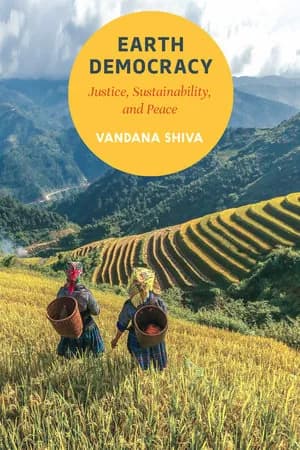
Whenever we engage in consumption or production patterns which take more than we need, we are engaging in violence. (p116)
They said it was a sitting-room, but I don’t know why they’d decided to confine its purpose just to sitting. Obviously, sitting was one of the things you could do in a room this size; but you could also stage operas, hold cycling races, and have an absolutely cracking game of frisbee, all at the same time, without having to move any of the furniture.
It could rain in a room this big.
We share this planet, our home, with millions of species. Justice and sustainability both demand that we do not use more resources than we need. Restraint in resource use and living within nature's limits are preconditions for social justice. The commons are where justice and sustainability converge, where ecology and equity meet. The survival of pastures and forests as community property, or of a common good like a stable ecosystem, is only possible with social organizations with checks and controls on the use of resources built into their principles. The breakdown of a community, with the associated erosion of concepts of joint ownership and responsibility, can trigger the degradation of common resources. (p.50)
It is the indignity of being treated as disposable that pushes people towards religious fundamentalism in order to retrieve a sense of self, of meaning, of significance. This is why globalization breeds religious fundamentalism and free markets create terrorism and extremism, not democracy. (p80)