

Vandana Shiva
Quotes
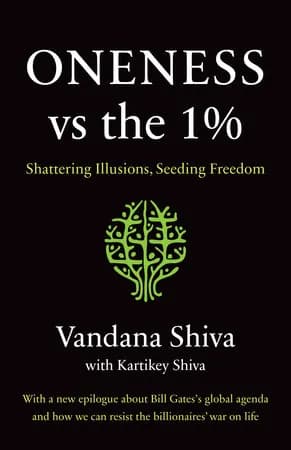
Owning our seeds through seed freedom, our own food through food freedom, our own minds and intelligence through intellectual freedom, our own economies through freedom to produce and consume ecologically and locally, is the ‘barbarianism’ that the 1% would like to extinguish.
Simplicity and nonviolence are the basis of an economy of wellbeing, and such an economy must be localised.
What J.P. Morgan and John D. Rockefeller were to the Age of Robber Barons, Microsoft's Bill Gates and Berkshire Hathaway's Warren Buffett, as well as digital moguls like Mark Zuckerberg and Jeff Bezos are to the contemporary age of the rule of the 1%. Then as now, the super-rich used governments to write laws and rules to allow them to accumulate unlimited wealth; then as now, creating monopolies by enclosing the commons and killing competition is the strategy for becoming the 1%.
Being a planetary citizen does not need space travel. It means being conscious that we are part of the universe and of the earth. The most fundamental law is to recognise that we share the planet with other beings, and that we have a duty to care for our common home.
The business of grabbing and money-making, through a violent extractive economy that the 1% have built, is burdening the earth and humanity with unbearable and non-sustainable costs, and has brought us to the brink of extinction. We do not have to escape from the earth; we have to escape from the illusions that enslave our minds and make extinction look inevitable.
As Gandhi taught, freedom can be reclaimed only by refusing to cooperate with unjust, immoral laws. The fight for truth—employing the principles of civil disobedience, nonviolence, and noncooperation—is not just our right as free citizens of free societies. It is our duty as citizens of the earth. (p184)
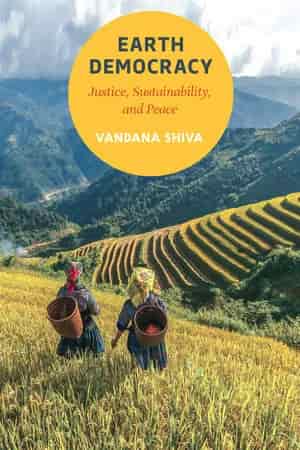
Principles of Earth Democracy, #10: Earth Democracy connects people in circles of care, cooperation, and compassion instead of dividing them through competition and conflict, fear and hatred. In the face of a world of greed, inequality, and overconsumption, Earth Democracy globalizes compassion, justice, and sustainability. (p. 11)
Whenever we engage in consumption or production patterns which take more than we need, we are engaging in violence. (p116)
We share this planet, our home, with millions of species. Justice and sustainability both demand that we do not use more resources than we need. Restraint in resource use and living within nature's limits are preconditions for social justice. The commons are where justice and sustainability converge, where ecology and equity meet. The survival of pastures and forests as community property, or of a common good like a stable ecosystem, is only possible with social organizations with checks and controls on the use of resources built into their principles. The breakdown of a community, with the associated erosion of concepts of joint ownership and responsibility, can trigger the degradation of common resources. (p.50)
It is the indignity of being treated as disposable that pushes people towards religious fundamentalism in order to retrieve a sense of self, of meaning, of significance. This is why globalization breeds religious fundamentalism and free markets create terrorism and extremism, not democracy. (p80)
That’s all the quotes.
10 quotes in the collection · come back when we add more