Quotes about consumerism
98 quotes · 65 authors
Quotes
Six billion of you wake up every morning and start devouring the world.
p. 185
It is a terrible punishment to be banished from the web of reciprocity, with no one to share with you and no one for you to care for. I remember walking a street in Manhattan, where the warm light of a lavish home spilled out over the sidewalk on a man picking through the garbage for his dinner. Maybe we've all been banished to lonely corners by our obsession with private property. We've accepted banishment even from ourselves when we spend our beautiful, utterly singular lives on making more money, to buy more things that feed but never satisfy.
p. 307
We are all complicit. We've allowed the "market" to define what we value so that the redefined common good seems to depend on profligate lifestyles that enrich the sellers while impoverishing the soul and the earth.
p. 307
The fear for me is that the world has been turned inside out, the dark side made to seem light. Indulgent self-interest that our people once held to be monstrous is now celebrated as success. We are asked to admire what our people viewed as unforgivable. The consumption-driven mind-set masquerades as "quality of life" but eats us from within. It is as if we've been invited to a feast, but the table is laid with food that nourishes only emptiness, the black hole of the stomach that never fills. We have unleashed a monster.
p. 308
We have constructed an artifice, a Potemkin village of an ecosystem where we perpetrate the illusion that the things we consume have just fallen off the back of Santa's sleigh, not been ripped from the earth. The illusion enables us to imagine that the only choices we have are between brands.
p. 199
The exchange relationships we choose determine whether we share them as a common gift or sell them as a private commodity. A great deal rests on that choice. For the greater part of human history, and in places in the world today, common resources were the rule. But some invented a different story, a social construct in which everything is a commodity to be bought and sold. The market economy story has spread like wildfire, with uneven results for human well-being and devastation for the natural world. But it is just a story we have told ourselves and we are free to tell another, to reclaim the old one. One of these stories sustains the living systems on which we depend. One of these stories opens the way to living in gratitude and amazement at the richness and generosity of the world. One of these stories asks us to bestow our own gifts in kind, to celebrate our kinship with the world. We can choose. If all the world is a commodity, how poor we grow. When all the world is a gift in motion, how wealthy we become.
p. 31
Gratitude doesn’t send you out shopping to find satisfaction; it comes as a gift rather than a commodity, subverting the foundation of the whole economy. That's good medicine for land and people alike.
p. 111
While expressing gratitude seems innocent enough, it is a revolutionary idea. In a consumer society, contentment is a radical proposition. Recognizing abundance rather than scarcity undermines an economy that thrives by creating unmet desires. Gratitude cultivates an ethic of fullness, but the economy needs emptiness.
p. 111
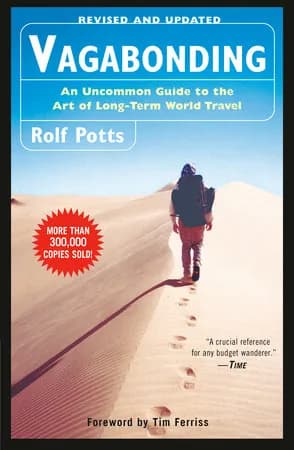
For some reason, we see long-term travel to faraway lands as a recurring dream or an exotic tempation, but not something that applies to the here and now. Instead --- out of our insane duty to fear, fashion, and monthly payments on things we don't really need -- we quarantine our travels to short, frenzied bursts. In this way, as we throw our wealth at an abstract notion called "lifestyle," travel becomes just another accessory --- a smooth-edged, encapsulated experience that we purchase the same way we buy clothing and furniture.
Under the Enrichment Laws, consumers have to spend a fixed quota of dollars each month, depending on their strata. Hoarding is an anti-corpocratic crime.
p. 227
The Walmart was like a starship that had landed in the soybean fields. … They went inside. The young ones shuffled to a stop as their ironic sensibilities, which served them in lieu of souls, were jammed by a signal of overwhelming power.
"It's what we do now instead of bohemias," Harwood says.
"Instead of what?"
"Bohemias. Alternative subcultures. They were a crucial aspect of industrial civilization in the two previous centuries. They were where industrial civilization went to dream. A sort of unconscious R&D, exploring alternate societal strategies…And they did, frequently, have locales with which they became associated. But they became extinct."
"Extinct?"
"We started picking them before they could ripen…as marketing evolved and the mechanisms of recommodification became quicker, more rapacious. Authentic subcultures required backwaters, and time, and there are no more backwaters."