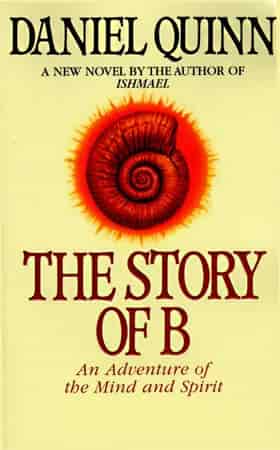
Daniel Quinn
Quotes
People seldom look very hard for things they don’t want to find.
p. 63
“The question is, can you do would B did?”
“What exactly do you have in mind?”
“You took in their insights, but do you have any of your own? Are you a thinker and a teacher or just a reciter of Holy Writ? If all you can do is chant the Scriptures, then you’re no more B than I am. You’re just an altar boy who has all the responses down pat.”
p. 213
What was forgotten in the Great Forgetting was the fact that, before the advent of agriculture and village life, humans had lived in a profoundly different way.…Paleontology made untenable the idea that humanity, agriculture, and civilization all began at roughly the same time.
p. 244
In 1950 there wasn’t the slightest whisper of a doubt about this anywhere in our culture, East or West, capitalist or communist. In 1950 this was something everyone could agree on: Exploiting the world was our God-given right. The world was created for us to exploit. Exploiting the world actually improved it! There was no limit to what we could do. Cut as much down as you like, dig up as much as you like. Scrape away the forests, fill in the wetlands, dam the rivers, dump poisons anywhere you want, as much as you want. None of this was regarded as wicked or dangerous. Good heavens, why would it be? The earth was created specifically to be used in this way. It was a limitless, indestructible playroom for humans. You simply didn’t have to consider the possibility of running out of something or of damaging something. The earth was designed to take any punishment, to absorb and sweeten any toxin, in any quantity. Explode nuclear weapons? Good heavens, yes—as many as you want! Thousands, if you like. Radioactive material generated while trying to achieve our God-given destiny can’t harm us.
Wipe out whole species? Absolutely! Why ever not? If people don’t need these creatures, then obviously they’re superfluous! To exercise such control over the world is to humanize it, to take us a step closer to our destiny.
p. 278
It means I’ve been changed, fundamentally and permanently. It means I cannot be put back to what I was.
That’s why I am B: I cannot be put back to what I was.
p. 235
It can’t possibly be said too often that there is no one right way for people to live; that’s only the delusion of the most murderous and destructive culture that history has ever produced.
p. 318
History—and not just thirty years of history but ten thousand years of history—offers no support whatever for the idea that we can simultaneously increase food production and end population growth. On the contrary, history resoundingly confirms what ecology teaches: If you make more food available, there will be more people to consume it.
p. 302
By the simple act of being locked up, food was transformed into a product—the fundamental product of your economy.
p. 174
You’re not surprised that natural selection has organized geese in a way that works well for geese. You’re not surprised that natural selection has organized elephants in a way that works well for elephants. You’re not surprised that natural selection has organized dolphins in a way that works well for dolphins. Why should you be surprised that natural selection organized people in a way that worked well for people?
p. 321
They’re sure that there must be all sorts of things wrong with ever tribal way of life, and of course they’re correct—if you mean by “wrong” something you don’t like.
p. 95
And conversely, why should you be surprised if the founders of our culture, having obliterated a lifestyle tested over a period of three million years, were unable to instantly slap together a replacement that was just as good? Really, the task was a formidable one. We’ve been working at it for ten thousand years, and where are we?
The very first thing to go was the very thing that made tribal life a success: its social, economic, and political egalitarianism. As soon as our revolution began, the process of division began, between rulers and ruled, rich and poor, powerful and powerless, masters and slaves. The suffering class had arrived, and that class (as it would always be) was the masses. I won’t repeat a tale everyone knows. Just a few thousand years separates the bare beginning of our culture in rude farming villages from the age of the god-kings, when the royal classes lived in mind-boggling splendor and all the rest—the suffering masses—lived like cattle.
p. 322
Those who wish to imagine that God called every species to life in a final, changeless form are welcome to do so, but I’m incapable of embracing such a primitive scenario.
p. 68