


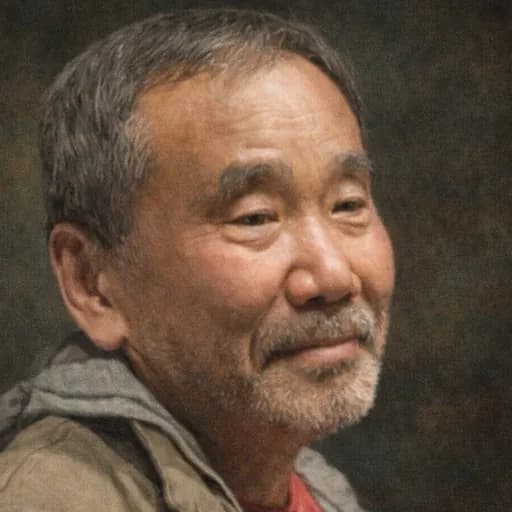
Haruki Murakami
Quotes
"The world of the grotesque is the darkness within us. Well before Freud and Jung shined a light on the workings of the subconscious, this correlation between darkness and our subconscious, these two forms of darkness, was obvious to people. It wasn't a metaphor, even. If you trace it back further, it wasn't even a correlation. Until Edison invented the electric light, most of the world was totally covered in darkness. The physical darkness outside and the inner darkness of the soul were mixed together, with no boundary separating the two. They were directly linked. Like this."
When a war starts people are forced to become soldiers. They carry guns and go to the front lines and have to kill soldiers on the other side. As many as they possibly can. Nobody cares whether you like killing other people or not. It's just something you have to do. Otherwise you're the one who gets killed." Johnnie Walker pointed his index finger at Nakata's chest. "Bang!" he said. "Human history in a nutshell."
After a simple dinner I go out on the porch and gaze up at the stars twinkling above, the random scattering of millions of stars. Even in a planetarium you wouldn't find this many. Some of them look really big and distinct, like if you reached your hand out intently you could touch them. The whole thing is breathtaking. Not just beautiful, though -the stars are like the trees in the forest, alive and breathing. And they're watching me. What I've done up till now, what I'm going to do-they know it all. Nothing gets past their watchful eyes. As I sit there under the shining night sky, again a violent fear takes hold of me. My heart's pounding a mile a minute, and I can barely breathe. All these millions of stars looking down on me, and I've never given them more than a passing thought before. Not just stars-how many other things haven't I I10ticecl in the world, things I know nothing about? I suddenly feel helpless, completely powerless. And 1 know I'll never outrun that awful feeling.
Closing your eyes isn't going to change anything. Nothing's going to disappear just because you can't see what's going on. In fact, things will even be worse the next time you open your eyes. That's the kind of world we live in. Keep your eyes wide open. Only a coward closes his eyes. Closing your eyes and plugging up your ears won't make time stand still.
I stood there for a while, holding Nakata tight in my arms, feeling like I wanted to die or disappear. Just over the horizon the violence of war went on, with countless people dying. I no longer had any idea what was right and what was wrong. Was I really seeing the real world? Was the sound of birds I was hearing? I found myself alone in the woods, totally confused, blood flowing from freely from my womb. I was angry, afraid , embarrassed-all of these rolled into one. I cried quietly, without making a sound.
"According to Aristophanes in Plato's The Banquet, in the ancient world of legend there were three types of people.
In ancient times people weren't simply male or female, but one of three types: male/male, male/female or female/female. In other words, each person was made out of the components of two people. Everyone was happy with this arrangement and never really gave it much thought. But then God took a knife and cut everyone in half, right down the middle. So after that the world was divided just into male and female, the upshot being that people spend their time running around trying to locate their missing half."
People soon get tired of things that aren't boring, but not of what is boring.
Nakata let his body relax, switched off his mind, allowing things to flow through him. This was natural for him, something he'd done ever since he was a child, without a second thought. Before long the borders of his consciousness fluttered around, just like the butterflies. Beyond these borders lay a dark abyss. Occasionally his consciousness would fly over the border and hover over that dizzying, black crevass. But Nakata wasn't afraid of the darkness or how deep it was. And why should he be? That bottomless world of darkness, that weighty silence and chaos, was an old friend, a part of him already. Nakata understood this well. In that world there was no writing, no days of the week, no scary Governor, no opera, no BMWs. No scissors, no tall hats. On the other hand, there was also no delicious eel, no tasty bean-jam buns. Everything is there, but there are no parts. Since there are no parts, there's no need to replace one thing with another. No need to remove anything, or add anything. You don't have to think about difficult things, just let yourself soak it all in. For Nakata, nothing could be better.
Sometimes fate is like a small sandstorm that keeps changing directions. You change direction but the sandstorm chases you. You turn again, but the storm adjusts. Over and over you play this out, like some ominous dance with death just before dawn. Why? Because this storm isn't something that blew in from far away, something that has nothing to do with you. This storm is you. Something inside of you. So all you can do is give in to it, step right inside the storm, closing your eyes and plugging up your ears so the sand doesn't get in, and walk through it, step by step. There's no sun there, no moon, no direction, no sense of time. Just fine white sand swirling up into the sky like pulverized bones. That's the kind of sandstorm you need to imagine.
Adults constantly raise the bar on smart children, precisely because they're able to handle it. The children get overwhelmed by the tasks in front of them and gradually lose the sort of openness and sense of accomplishment they innately have. When they're treated like that, children start to crawl inside a shell and keep everything inside. It takes a lot of time and effort to get them to open up again. Kid's hearts are malleable , but once they gel it's hard to get them back the way they were. Next to impossible, in most cases.
"I think what Kafka does is give a purely mechanical explanation of that complex machine in the story, as sort of a substitute for explaining the situation we're in. What I mean is ... " I have to give it some more thought. "What I mean is, that's his own device for explaining the kind of lives we lead. Not by talking about our situation, but by talking about the details of the machine."
“Perhaps,” Oshima says, as if fed up. “Perhaps most people in the world aren’t trying to be free, Kafka. They just think they are. It’s all an illusion. If they really were set free, most people would be in a real bind. You’d better remember that. People actually prefer not being free.” “Including you?” “Yeah. I prefer being unfree, too. Up to a point. Jean-Jacques Rousseau defined civilization as when people build fences. A very perceptive observation. And it’s true—all civilization is the product of a fenced-in lack of freedom.

