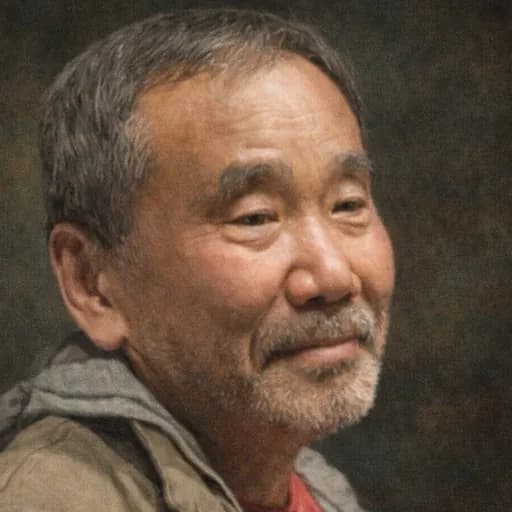
Haruki Murakami
Quotes
We can, if we so choose, wander aimlessly over the continent of the arbitrary. Rootless as some winged seed blown about on a serendipitous spring breeze. Nonetheless, we can in the same breath deny that there is any such thing as coincidence. What's done is done, what's yet to be is clearly yet to be. In other words, sandwiched as we are between the "everything" that is behind us and the "zero" beyond us, ours is an ephemeral existence in which there is neither coincidence nor possibility. In actual practice, however, distinctions between the two interpretations amount to precious little. A state of affairs (as with most face-offs between interpretations) not unlike calling the same food by two different names. So much for metaphors.
Mediocrity is a constant, as one Russian writer put it. Russians have a way with aphorisms. They probably spend all winter thinking them up.
The song is over. But the melody lingers on.
You have an interesting history. Now people can generally be classified in to two groups: the mediocre realists and the mediocre dreamers. You clearly belong to the latter. Your fate is and will always be the fate of dreamers.
It's all a question of imagination. Our responsibility begins with the power to imagine. It's just as Yeats said: In dreams begin responsibility. Turn this on its head and you could say that where there's no power to imagine, no responsibility can arise.
Where does your responsibility begin here? Wiping away the nebula from your sight, you struggle to find where you really are. You're trying to find the direction of the flow, struggling to hold on to the axis of time. But you can't locate the borderline separating dream and reality. Or even the boundary between what's real and what's possible. All you're sure of is that you're in a delicate position. Delicate-and dangerous. You're pulled along, a part of it, unable to pin down the principles of prophecy, or of logic. Like when a river overflows, washing over a town, all road signs have sunk beneath the waves. And all you can see are the anonymous roofs of the sunken houses.
And you really will have to make it through that violent, metaphysical, symbolic storm. No matter how metaphysical or symbolic it might be, make no mistake about it: it will cut through flesh like a thousand razor blades. People will bleed there, and you will bleed too. Hot, red blood. You'll catch that blood in your hands, your own blood and the blood of others. And once the storm is over you won't remember how you made it through, how you managed to survive. You won't even be sure, in fact, whether the storm is really over. But one thing is certain. When you come out of the storm you won't be the same person who walked in. That's what this storm's all about.
I pay the entrance fee at the desk, no questions asked, and get a key to a locker. After changing into shorts and a T-shirt in he locker room, I do some stretching exercises. As my muscles relax so do I. I'm safe inside this container called me. With a little click, the outlines of this being - me - fit right inside and are locked nearly away. Just the way I like it. I'm where I belong.
Narrow minds devoid of imagination. Intolerance, theories cut off from reality, empty terminology, usurped ideals, inflexible systems. Those are the things that really frighten me. What I absolutely fear and loathe.
As I already explaned, I don't have any form. I'm a conceptual metaphysical object.
I've experienced all kinds of discrimination," Oshima says. "Only people who've been discriminated against can really know how much it hurts. Each person feels the pain in his own way, each has his own scars. So I think I'm as concerned about fairness and justice as anybody. But what disgusts me even more are people who have no imagination. The kind T. S. Eliot calls hollow men. People who fill up that lack of imagination with heartless bits of straw, not even aware of what they're doing. Callous people who throw a lot of empty words at you, trying to force you to do what you don't want to. Like that lovely pair we just met." He sighs and twirls the long slender pencil in his hand. "Gays, lesbians, straights, feminists, fascist pigs, communists, Hare Krishnas-none of them bother me. I don't care what banner they raise. But what I can't stand are hollow people. When I'm with them I just can't bear it, and wind up saying things I shouldn't. With those women I should've just let it slide, or else called Miss Saeki and let her handle it. She would have given them a smile and smoothed things over. But I just can't do that. I say things I shouldn't, do things I shouldn't do. I can't control myself. That's one of my weak points.
“Lost opportunities, lost possibilities, feelings we can never get back. That's part of what it means to be alive. But inside our heads - at least that's where I imagine it - there's a little room where we store those memories. A room like the stacks in this library. And to understand the workings of our own heart we have to keep on making new reference cards. We have to dust things off every once in awhile, let in fresh air, change the water in the flower vases. In other words, you'll live forever in your own private library."