
Quotes
[T]he very existence of such powers argues a counterforce. We call powers of the first kind dark, though they may use a species of deadly light... and we call those of the second kind bright, though I think that they may at times employ darkness, as a good man nevertheless draws the curtains of his bed to sleep. Yet there is truth to the talk of darkness and light, because it shows plainly that one implies the other. The tale I read to little Severian said that the universe was but a long word of the Increate's. We, then, are syllables of that word. But the speaking of any word is futile unless there are other words, words that are not spoken. If a beast has but one cry, the cry tells nothing; and even the wind has a multitude of voices, so that those who sit indoors may hear it and know if the weather is tumultuous or mild. The powers we call dark seem to me to be the words the Increate did not speak... and these words must be maintained in a quasi-existence, if the other word, the word spoken is to be distinguished. What is not said can be important - but what is said is more important... And if the seekers after dark things find them, may not the seekers after bright find them as well? And are they not more apt to hand their wisdom on?
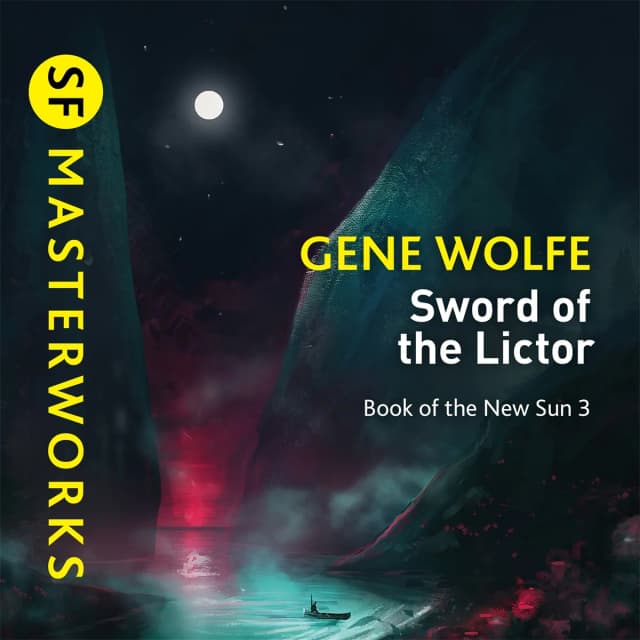
 The Sword of the Lictor
Time itself is a thing, so it seems to me, that stands solidly like a fence of iron palings with its endless row of years; and we flow past like Gyoll, on our way to a sea from which we shall return only as rain.
I knew then, on the arm of that giant figure, the ambition to conquer time, an ambition beside which the desire of the distant suns is only the lust of some petty, feathered chieftain to subjugate some other tribe.
The Sword of the LictorAn angel is often only a demon who stands between us and our enemy.
The Sword of the LictorI found I could not say what it was I understood; that it was in fact on the level of meaning above language, a level we like to believe scarcely exists, though if it were not for the constant discipline we have learned to exercise upon our thoughts, they would always be climbing to it unaware.
The Sword of the LictorDr. Talos whispered, "Look about you—don't you recognize this? It is just as he says!"
"What do you mean?" I whispered in return.
"The castle? The monster? The man of learning? I only just thought of it. Surely you know that just as the momentous events of the past cast their shadows down the ages, so now, when the sun is drawing toward the dark, our own shadows race into the past to trouble mankind's dreams."
The Sword of the LictorWhen I was alone I felt I had in some fashion lost my individuality; to the thrush and the rabbit I had not been Severian, but Man. The many people who like to be utterly alone, and particularly to be utterly alone in a wilderness, do so, I believe, because they enjoy playing that part. But I wanted to be a particular person again, and so I sought the mirror of other persons, which would show me that I was not as they were.
The Sword of the LictorJust as the room of the Inquisitor in Dr. Talos's play, with its high judicial bench, lurked somewhere at the lowest level of the House Absolute, so we have each of us in the dustiest cellars of our minds a counter at which we strive to repay the debts of the past with the debased currency of the present.
The Sword of the LictorI had not thought, when I began this record of my life, to reveal any of the secrets of our guild [...] But I will tell one now, because what I did that night on Lake Diuturna cannot be understood without understanding it. And the secret is only that we torturers obey. [...] No one truly obeys unless he will do the unthinkable in obedience; no one will do the unthinkable save we.
The Sword of the LictorNot dead. Why had he thought that every life must end in death, and never in anything else? Not dead, but vanished as a single note vanishes, never to reappear, when it becomes an indistinguishable and inseparable part of some extemporized melody.
The Sword of the LictorThe best way to describe silence is to say nothing—but what grace!
The Sword of the LictorOne of the easiest ways to dominate a man is to demand something he cannot supply.
The Sword of the LictorThe progress of science depends much less upon theoretical considerations or systematic investigation than is commonly believed, but rather on the transmittal of reliable information, gained by chance or insight from one set of men to their successors. The nature of those who hunt after dark knowledge is to hoard it even unto death, or to transmit it so wrapped in disguise and beclouded with self-serving lies that it is of little value.
The Sword of the LictorHe waited for me to speak. I had the feeling, which I have often had when talking with old people, that the words he said and the words I heard were quite different, that there was in his speech a hoard of hints, clues, and implications as invisible to me as his breath, as though Time were a species of white spirit who stood between us and with his trailing sleeves wiped away before I had heard it the greater part of all that was said.
The Sword of the LictorI realized that what disturbed me was the memory of the lies I had told the magicians, pretending, as they did, to command great powers and be privy to vast secrets. Those lies had been wholly justifiable—they had helped to save my life and little Severian’s. Nevertheless, I felt myself somewhat less of a man because I had resorted to them. Master Gurloes, whom I had come to hate before I left the guild, had lied frequently; and now I was not sure whether I had hated him because he lied, or hated lying because he did it.
The Sword of the LictorThat was the brightest day I've ever seen. The sun had new life in him, the way a man will when he was sick yesterday and will be sick tomorrow, but today he walks around and laughs so that if a stranger was to come he'd think there was nothing wrong, no sickness at all, that the medicines and the bed were for somebody else.
The Sword of the LictorIf I had seen one miracle fail, I had witnessed another; and even a seemingly purposeless miracle is an inexhaustible source of hope, because it proves to us that since we do not understand everything, our defeats—so much more numerous than our few and empty victories—may be equally specious.
The Sword of the LictorThe brown book I carry says there is nothing stranger than to explore a city wholly different from all those one knows, since to do so is to explore a second and unsuspected self. I have found a thing stranger: to explore such a city only after one has lived in it for some time without learning anything of it.
The Sword of the LictorLlibio had worn a fish carved from a tooth about his neck; and when I asked him what it was he had said it was Oannes, and covered it with his hand so that I my eyes could not profane it, for he knew that I did not believe in Oannes, who must surely be the fish-god of these people. I did not, yet I felt I knew everything about Oannes that mattered. I knew that he must live in the darkest deeps of the lake, but that he was seen leaping among the waves in storms. I knew he was the shepherd of the deep, who filled nets of the islanders, and that murderers could not go on the water without fear, lest Oannes appear alongside, with his eyes as big as moons, and overturn the boat. I did not believe in Oannes or fear him. But I knew, I thought, whence he came - I knew that there is an all-pervasive power in the universe of which every other is the shadow. I knew that in the last analysis my conception of that power was as laughable (and as serious) as Oannes.
The Sword of the LictorHow strange it is that the sky, which by day is a stationary ground on which the clouds are seen to move, by night becomes the backdrop for Urth's own motion, so that we feel her rolling beneath us as a sailor feels the running of the tide.
The Sword of the LictorI am not clever—I am too strong for cleverness, as you well understand.
The Sword of the LictorAt sixteen or so, Thecla was attracted, as I think young women often are, to their lectures on theogony, theodicy, and the like, and I recall one particularly in which a phoebad put forward as an ultimate truth the ancient sophistry of the existence of three Adonai, that of the city (or of the people), that of the poets, and that of the philosophers. Her reasoning was that since the beginning of human consciousness (if such a beginning ever was) there have been vast numbers of persons in the three categories who have endeavored to pierce the secret of the divine. If it does not exist, they should have discovered that long before; if it does, it is not possible that Truth itself should mislead them. Yet the beliefs of the populace, the insights of the rhapsodists, and the theories of the metaphysicians have so far diverged that few of them can so much as comprehend what the others say, and someone who knew nothing of any of their ideas might well believe there was no connection at all between them.
May it not be, she asked (and even now I am not certain I can answer), that instead of traveling, as has always been supposed, down three roads to the same destination, they are actually traveling toward three quite different ones? After all, when in common life we behold three roads issuing from the same crossing, we do not assume they all proceed toward the same goal.
I found (and find) this suggestion as rational as it is repellent, and it represents for me all that monomaniacal fabric of arguments, so tightly woven that not even the tiniest objection or spark of light can escape its net, in which human minds become enmeshed whenever the subject is one in which no appeal to fact is possible.
The Sword of the Lictor

That’s all the quotes.
21 quotes in the collection · come back when we add more