
Quotes
Anyone who loves nature, as I do, cries out at the havoc being spread by humans, all over the globe. The pressures of city life can be appalling, as are the moral ambiguities that plague us, both at home and via yammering media. The temptation to seek uncomplicated certainty sends some rushing off to ashrams and crystal therapy, while many dive into the shelter of fundamentalism, and other folk yearn for better, “simpler” times. Certain popular writers urgently prescribe returning to ancient, nobler ways.
Ancient, nobler ways. It is a lovely image . . . and pretty much a lie. John Perlin, in his book A Forest Journey, tells how each prior culture, from tribal to pastoral to urban, wreaked calamities upon its own people and environment. I have been to Easter Island and seen the desert its native peoples wrought there. The greater harm we do today is due to our vast power and numbers, not something intrinsically vile about modern humankind.
Technology produces more food and comfort and lets fewer babies die. “Returning to older ways” would restore some balance all right, but entail a holocaust of untold proportion, followed by resumption of a kind of grinding misery never experienced by those who now wistfully toss off medieval fantasies and neolithic romances. A way of life that was nasty, brutish, and nearly always catastrophic for women.
That is not to say the pastoral image doesn’t offer hope. By extolling nature and a lifestyle closer to the Earth, some writers may be helping to create the very sort of wisdom they imagine to have existed in the past. Someday, truly idyllic pastoral cultures may be deliberately designed with the goal of providing placid and just happiness for all, while retaining enough technology to keep existence decent.
But to get there the path lies forward, not by diving into a dark, dank, miserable past. There is but one path to the gracious, ecologically sound, serene pastoralism sought by so many. That route passes, ironically, through successful consummation of this, our first and last chance, our scientific age.
p. 563
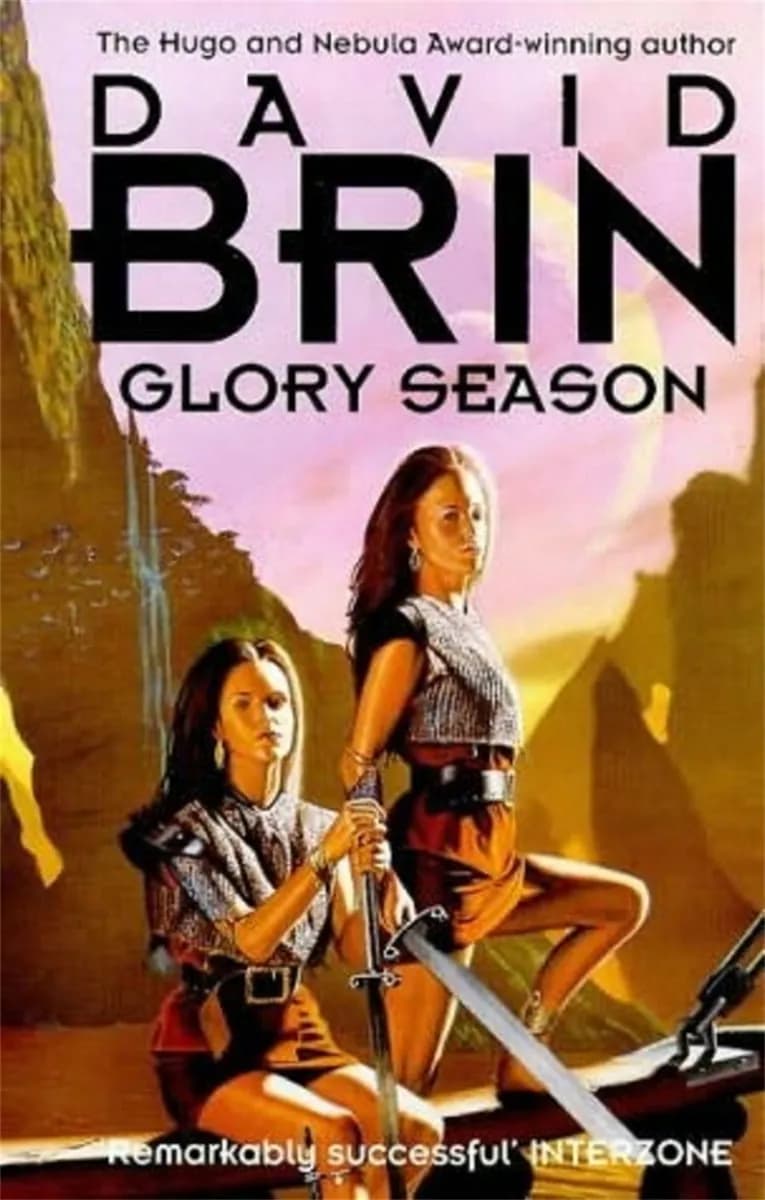 Glory Season
As in elections, the law pretended universal rights, while securing the interests of powerful houses.
p. 553
Glory SeasonOne great mystery is why sexual reproduction became dominant for higher life-forms. Optimization theory says it should be otherwise.
Take a fish or lizard, ideally suited to her environment, with just the right internal chemistry, agility, camouflage—whatever it takes to be healthy, fecund, and successful in her world. Despite all this, she cannot pass on her perfect characteristics. After sex, her offspring will be jumbles, getting only half of their program from her and half their re-sorted genes somewhere else.
Sex inevitably ruins perfection. Parthenogenesis would seem to work better—at least theoretically. In simple, static environments, well-adapted lizards who produce duplicate daughters are known to have advantages over those using sex.
Yet, few complex animals are known to perform self-cloning. And those species exist in ancient, stable deserts, always in close company with a related sexual species.
Sex has flourished because environments are seldom static. Climate, competition, parasites—all make for shifting conditions. What was ideal in one generation may be fatal the next. With variability, your offspring get a fighting chance. Even in desperate times, one or more of them may have what it takes to meet new challenges and thrive.
Each style has its advantages, then. Cloning offers stability and preservation of excellence. Sex gives adaptability to changing times. In nature it is usually one or the other. Only lowly creatures such as aphids have the option of switching back and forth.
p. 123
Glory SeasonIt is senseless to proclaim that it’s evil to make generalizations about groups. Generalization is a natural human mental process, and many generalizations are true—in average. What often does promote evil behavior is the lazy, nasty habit of believing that generalizations have anything at all to do with individuals. We have no right to pre-judge that a specific man can’t nurture, or a particular woman cannot fight.
p. 562
Glory Season“All right,” she said. “You’ve convinced me. Men are good for something, after all.”
p. 429
Glory SeasonThey say survival is Nature’s only form of flattery.
p. 512
Glory SeasonA dragon’s inertia is not shifted by yanking its tail.
p. 551
Glory SeasonThe notions she fought with needed more than the simple algebra she’d been grudgingly taught at Lamai Hold. More and more she resented how they had robbed her of this, arguably her one talent, driving her from math and other abstractions by the simple expedient of making them seem boring.
p. 337
Glory SeasonIt is dangerous these days for a male to write even glancingly on feminist themes. Did anyone attack Margaret Atwood’s right to extrapolate religio-machismo in The Handmaid’s Tale? Women writers appear vouchsafed insight into the souls of men—credit that seldom flows the other way. It is a sexist and offensive assumption, which does not advance understanding.
p. 561
Glory SeasonWisdom. No match for the troublemaker Curiosity.
p. 265
Glory SeasonPiss on the world, or it’ll piss on you.
p. 155
Glory Season“I thought they were very good at what they did.”
”Of course they were good!” Brill glanced sharply. “The issue is what one chooses to be good at. The arts are fine, for hobbies. I play six instruments, myself. But they pose no great challenge to a mature mind.”
p. 545
Glory SeasonIs there an inverse relation between knowledge and wisdom? At times it seems the more we know, the less we understand.
I am not the first to note this quandary. One scholar recently wrote, “Lysos and her followers chase the siren call of pastoralism, like countless romantics before them, idealizing a past Golden Age that never was, pursuing a serenity possible only in the imagination.”
p. 502
Glory SeasonLoneliness, her arch enemy, never seemed content.
p. 150
Glory SeasonIn the end, both extremes had more in common with each other than either did with the middle.
p. 470
Glory SeasonMaia recognized a look of true religion in the other woman’s eyes. A version and interpretation that conveniently justified what had already been decided.
p. 240
Glory Season“It’s magic,” the chief cook concluded, in awe.
”No, not magic,” the ship’s doctor replied. “It’s much more. It’s mathematics.”
p. 466
Glory SeasonThe heritage we give our children, and the myths we leave to sustain them, must work with the tug and press of life, or they will fail. Adaptability has to be enshrined alongside stability, or the ghost of Darwin will surely come back to haunt us, whispering in our ears the penalty of conceit.
We wish our descendants happiness. But over time one criterion alone will judge our efforts.
Survival.
p. 192
Glory SeasonNaroin stopped, shook her head. “Take it from an experienced hand, child. It’s no good blamin’ yourself for what you couldn’t prevent. Not so long as you tried.”
Maia’s lips pressed together. That was exactly what she had been telling herself. From the look in Naroin’s eyes, it didn’t get much more believable as you got older.
p. 514
Glory SeasonI’d rather be dead than so suspicious I can’t trust anybody.
p. 525
Glory SeasonCultural contamination that is directed outward is always seen as “enlightenment.”
p. 364
Glory Season“Life is the continuation of existence, yet no thing endures. We are all patterns, seeking to propagate. Patterns which bring other patterns into being, then vanish, as if we’ve never been.”
p. 281
Glory SeasonWhat hope has any endeavor which is based on hate and fear?
p. 191
Glory SeasonBut it’s not so hard, learning to picture yourself as part of a great chain. One that began long before you, and will go on long after.
p. 387
Glory SeasonHow far do we owe loyalty to our creators’ dream? When have we earned the right to dream for ourselves?
p. 442
Glory SeasonI’m learning, Maia thought. They keep making mistakes and I keep getting stronger.
At this rate, someday I may actually gain control over my life.
p. 531
Glory SeasonAt her station in life, wisdom dictated keeping a low profile.
And yet...
p. 61
Glory SeasonIt could be worse. I can’t think how right now, but I’m sure it could be worse.
p. 74
Glory SeasonThere was that word quaint again. It seemed to refer patronizingly to anything simple or backward, from the viewpoint of a city-bred tourist.
p. 90
Glory SeasonMaia lifted her gaze to watch low clouds briefly occult a brightly speckled, placid sea, its green shoals aflicker with silver schools of fish and the flapping shadows of hovering swoop-birds. The variegated colors were lush, voluptuous. Mixing with scents carried by the moist, heavy wind, they made a stew for the senses, spiced with fecund exudates of life.
The beauty was heavy-handed, adamantly consoling. She got the point—that life goes on.
p. 80
Glory SeasonWe are programmed to find sex pleasurable for one simple reason—because animals who mate have offspring. Those who do not mate have none. Traits that result in successful reproduction get reinforced and passed on. Evolution is that simple.
It is therefore useless to bemoan as evil the fact that men tend toward aggression. Among our ancestors, aggression often helped males have more offspring than their competitors. “Good” and “evil” had little to do with it.
That is, until we reached consciousness, at which point, good and evil became pertinent indeed! Behaviors which might be excusable in dumb beasts can seem perverted, criminal, when performed by thinking beings. Just because a trait is “natural” does not oblige us to keep it.
p. 105
Glory SeasonIntelligence is loose in the galaxy. Power is in our hands, for better or worse. We can modify Nature’s rules, if we dare, but we cannot ignore her lessons.
p. 32
Glory SeasonSome smart moves were little more than nicely padded traps.
p. 19
Glory SeasonYou can’t fight biology. Only push at the rules, here and there.
p. 90
Glory Season

That’s all the quotes.
34 quotes in the collection · come back when we add more