


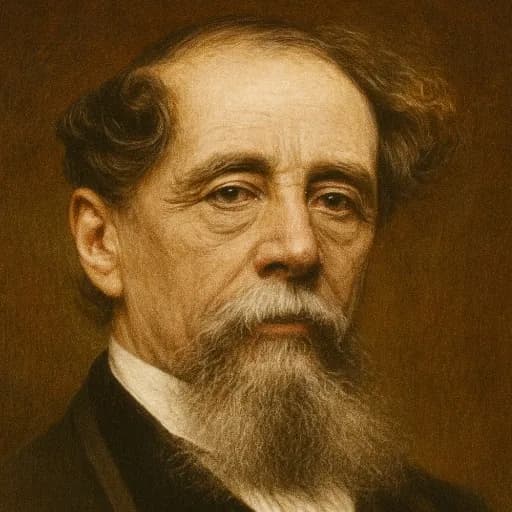
Charles Dickens
Quotes
‘Bless you,’ cried Barnaby, stepping lightly towards him, ‘I’m not frightened, Hugh. I’m quite happy. I wouldn’t desire to live now, if they’d let me. Look at me! Am I afraid to die? Will they see me tremble?’ ...He was the only one of the three who had washed or trimmed himself that morning. Neither of the others had done so, since their doom was pronounced. He still wore the broken peacock’s feathers in his hat; and all his usual scraps of finery were carefully disposed about his person. His kindling eye, his firm step, his proud and resolute bearing, might have graced some lofty act of heroism; some voluntary sacrifice, born of a noble cause and pure enthusiasm; rather than that felon’s death.
The symbol of its dignity,—stamped upon every page of the criminal statute-book,—was the gallows; and Barnaby was to die.
They walked out into the courtyard, clinging to each other, but not speaking. Barnaby knew that the jail was a dull, sad, miserable place, and looked forward to tomorrow, as to a passage from it to something bright and beautiful. He had a vague impression too, that he was expected to be brave—that he was a man of great consequence, and that the prison people would be glad to make him weep. He trod the ground more firmly as he thought of this, and bade her take heart and cry no more, and feel how steady his hand was. ‘They call me silly, mother. They shall see to-morrow!’
"Good night, captain!" he cried. "I am yours to the death, remember!"
"These smalls," said Dennis, rubbing his legs; "these very smalls—they belonged to a friend of mine that’s left off sich incumbrances for ever: this coat too—I’ve often walked behind this coat, in the street, and wondered whether it would ever come to me: this pair of shoes have danced a hornpipe for another man, afore my eyes, full half-a-dozen times at least: and as to my hat," he said, taking it off, and whirling it round upon his fist—"Lord! I’ve seen this hat go up Holborn on the box of a hackney-coach—ah, many and many a day!" "You don’t mean to say their old wearers are all dead, I hope?" said Mr Tappertit, falling a little distance from him as he spoke. "Every one of ’em," replied Dennis. "Every man Jack!"
"Make anything you like of me!" cried Hugh, flourishing the can he had emptied more than once. "Put me on any duty you please. I’m your man. I’ll do it. Here’s my captain—here’s my leader. Ha ha ha! Let him give me the word of command, and I’ll fight the whole Parliament House single-handed, or set a lighted torch to the King’s Throne itself!"
Whenever the chimes of the neighboring church were heard—and that was every quarter of an hour—a strange sensation, instantaneous and indescribable, but perfectly obvious, seemed to pervade them all.
Indeed this gentleman’s stoicism was of that not uncommon kind, which enables a man to bear with exemplary fortitude the afflictions of his friends, but renders him, by way of counterpoise, rather selfish and sensitive in respect of any that happen to befall himself.
It was a part of John's character. He made a point of going to sleep at the coach's time. He despised gadding about; he looked upon coaches as things that ought to be indicted; as disturbers of the peace of mankind; as restless, bustling, busy, horn-blowing contrivances, quite beneath the dignity of men, and only suited to giddy girls that did nothing but chatter and go a-shopping. "...If you like to wait for 'em you can; but we don't know anything about 'em; they may call and they may not--there's a carrier--he was looked upon as quite good enough for us, when I was a boy."
‘Why then, I tell you what, brother,’ Dennis began. ‘You must look up your friends—’ ‘My friends!’ cried Hugh, starting up and resting on his hands. ‘Where are my friends?’ ‘Your relations then,’ said Dennis. ‘Ha ha ha!’ laughed Hugh, waving one arm above his head. ‘He talks of friends to me—talks of relations to a man whose mother died the death in store for her son, and left him, a hungry brat, without a face he knew in all the world! He talks of this to me!’ ‘Brother,’ cried the hangman, whose features underwent a sudden change, ‘you don’t mean to say—’ ‘I mean to say,’ Hugh interposed, ‘that they hung her up at Tyburn. What was good enough for her, is good enough for me. Let them do the like by me as soon as they please—the sooner the better. Say no more to me. I’m going to sleep.’ ‘But I want to speak to you; I want to hear more about that,’ said Dennis, changing color.
It is something to look upon enjoyment, so that it be free and wild and in the face of nature, though it is but the enjoyment of an idiot. It is something to know that Heaven has left the capacity of gladness in such a creature's breast; it is something to be assured that, however lightly men may crush that faculty in their fellows, the Great Creator of mankind imparts it even to his despised and slighted work. Who would not rather see a poor idiot happy in the sunlight, than a wise man pining in a darkened jail!
Into the street outside the jail’s main wall, workmen came straggling at this solemn hour, in groups of two or three, and meeting in the center, cast their tools upon the ground and spoke in whispers. Others soon issued from the jail itself, bearing on their shoulders planks and beams: these materials being all brought forth, the rest bestirred themselves, and the dull sound of hammers began to echo through the stillness. Here and there among this knot of laborers, one, with a lantern or a smoky link, stood by to light his fellows at their work; and by its doubtful aid, some might be dimly seen taking up the pavement of the road, while others held great upright posts, or fixed them in the holes thus made for their reception. Some dragged slowly on, towards the rest, an empty cart, which they brought rumbling from the prison-yard; while others erected strong barriers across the street. All were busily engaged. Their dusky figures moving to and fro, at that unusual hour, so active and so silent, might have been taken for those of shadowy creatures toiling at midnight on some ghostly unsubstantial work, which, like themselves, would vanish with the first gleam of day, and leave but morning mist and vapor.

