


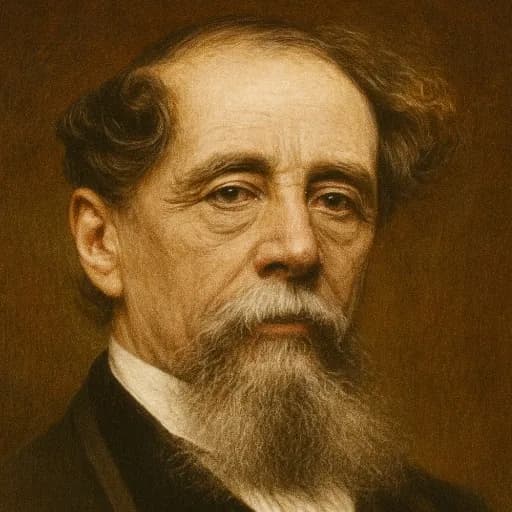
Charles Dickens
Quotes
To be shelterless and alone in the open country, hearing the wind moan and watching for day through the whole long weary night; to listen to the falling rain, and crouch for warmth beneath the lee of some old barn or rick, or in the hollow of a tree; are dismal things—but not so dismal as the wandering up and down where shelter is, and beds and sleepers are by thousands; a houseless rejected creature.
I’d do anything to have some revenge on him—anything. And when you told me that he and all the Catholics would suffer from those who joined together under that handbill, I said I’d make one of ’em, if their master was the devil himself. I am one of ’em. See whether I am as good as my word and turn out to be among the foremost, or no. I mayn’t have much head, master, but I’ve head enough to remember those that use me ill. You shall see, and so shall he, and so shall hundreds more, how my spirit backs me when the time comes. My bark is nothing to my bite. Some that I know had better have a wild lion among ’em than me, when I am fairly loose—they had!
It is curious to imagine these people of the world, busy in thought, turning their eyes towards the countless spheres that shine above us, and making them reflect the only images their minds contain. The man who lives but in the breath of princes, has nothing his sight but stars for courtiers' breasts. The envious man beholds his neighbours' honours even in the sky; to the money-hoarder, and the mass of worldly folk, the whole great universe above glitters with sterling coin—fresh from the mint—stamped with the sovereign's head—coming always between them and heaven, turn where they may. So do the shadows of our own desires stand between us and our better angels, and thus their brightness is eclipsed.
Oh gracious, why wasn't I born old and ugly!
With them who stood upon the brink of the great gulf which none can see beyond, Time, so soon to lose itself in vast Eternity, rolled on like a mighty river, swollen and rapid as it nears the sea. It was morning but now; they had sat and talked together in a dream; and here was evening. The dreadful hour of separation, which even yesterday had seemed so distant, was at hand.
‘I thank you very much,’ returned the knight, kissing his delicate hand to the locksmith, ‘for your guileless advice; and I only wish, my good soul, although your simplicity is quite captivating, that you had a little more worldly wisdom. I never so much regretted the arrival of my hairdresser as I do at this moment.
By and by, the feeble light grew stronger, and the houses with their signboards and inscriptions, stood plainly out, in the dull grey morning. Heavy stage wagons crawled from the inn-yard opposite; and travelers peeped out; and as they rolled sluggishly away, cast many a backward look towards the jail. And now, the sun’s first beams came glancing into the street; and the night’s work, which, in its various stages and in the varied fancies of the lookers-on had taken a hundred shapes, wore its own proper form-—a scaffold, and a gibbet.
‘Sir John, Sir John,’ returned the locksmith, ‘at twelve tomorrow, these men die. Hear the few words I have to add, and do not hope to deceive me; for though I am a plain man of humble station, and you are a gentleman of rank and learning, the truth raises me to your level, and I know that you anticipate the disclosure with which I am about to end, and that you believe this doomed man, Hugh, to be your son.’
‘I take you for a man, Sir John, and I suppose it tends to some pleading of natural affection in your breast,’ returned the locksmith. ‘I suppose to the straining of every nerve, and the exertion of all the influence you have, or can make, in behalf of your miserable son, and the man who has disclosed his existence to you. At the worst, I suppose to your seeing your son, and awakening him to a sense of his crime and danger. He has no such sense now. Think what his life must have been, when he said in my hearing, that if I moved you to anything, it would be to hastening his death, and ensuring his silence, if you had it in your power!’
Although one of these men displayed, in his speech and bearing, the most reckless hardihood; and the other, in his every word and action, testified such an extreme of abject cowardice that it was humiliating to see him; it would be difficult to say which of them would most have repelled and shocked an observer. Hugh’s was the dogged desperation of a savage at the stake; the hangman was reduced to a condition little better, if any, than that of a hound with the halter round his neck. Yet, as Mr Dennis knew and could have told them, these were the two commonest states of mind in persons brought to their pass. Such was the wholesome growth of the seed sown by the law, that this kind of harvest was usually looked for, as a matter of course.
But, as the hour approached, a buzz and hum arose, which, deepening every moment, soon swelled into a roar, and seemed to fill the air. No words or even voices could be distinguished in this clamor, nor did they speak much to each other; though such as were better informed upon the topic than the rest, would tell their neighbors, perhaps, that they might know the hangman when he came out, by his being the shorter one: and that the man who was to suffer with him was named Hugh: and that it was Barnaby Rudge who would be hanged in Bloomsbury Square.
‘No reprieve, no reprieve! Nobody comes near us. There’s only the night left now!’ moaned Dennis faintly, as he wrung his hands. ‘Do you think they’ll reprieve me in the night, brother? I’ve known reprieves come in the night, afore now. I’ve known ’em come as late as five, six, and seven o’clock in the morning. '''Don’t you think there’s a good chance yet,—don’t you? Say you do. Say you do, young man,’ whined the miserable creature, with an imploring gesture towards Barnaby, ‘or I shall go mad!’

