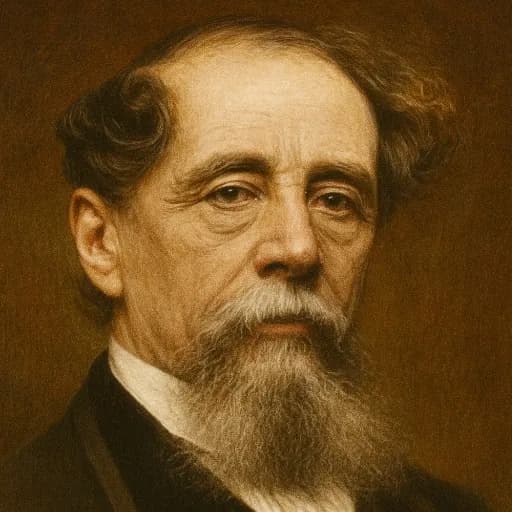
Charles Dickens
Quotes
Mrs Varden was a lady of what is commonly called an uncertain temper — a phrase which being interpreted signifies a temper tolerably certain to make everybody more or less uncomfortable.
"A mere fortune-hunter!" cried the son, indignantly. "What in the devil’s name, Ned, would you be!" returned the father. "All men are fortune-hunters, are they not? The law, the church, the court, the camp—see how they are all crowded with fortune-hunters, jostling each other in the pursuit. The stock-exchange, the pulpit, the counting-house, the royal drawing-room, the senate,—what but fortune-hunters are they filled with? A fortune-hunter! Yes. You are one; and you would be nothing else, my dear Ned, if you were the greatest courtier, lawyer, legislator, prelate, or merchant, in existence. If you are squeamish and moral, Ned, console yourself with the reflection that at the very worst your fortune-hunting can make but one person miserable or unhappy. How many people do you suppose these other kinds of huntsmen crush in following their sport—hundreds at a step? Or thousands?"
Whether they were right or wrong in this conjecture, certain it is that minds, like bodies, will often fall into a pimpled ill-conditioned state from mere excess of comfort, and like them, are often successfully cured by remedies in themselves very nauseous and unpalatable.
It was no longer a home; children were never born and bred there; the fireside had become mercenary—a something to be bought and sold—a very courtesan: let who would die, or sit beside, or leave it, it was still the same—it missed nobody, cared for nobody, had equal warmth and smiles for all. God help the man whose heart ever changes with the world, as an old mansion when it becomes an inn!
I have been taught to look upon those means, by which men raise themselves to riches and distinction, as being beyond my heeding, and beneath my care. I have been, as the phrase is, liberally educated, and am fit for nothing.
Father Time is not always a hard parent, and, though he tarries for none of his children, often lays his hand lightly upon those who have used him well; making them old men and women inexorably enough, but leaving their hearts and spirits young and in full vigour.
When the people found that they were none the better for the blessings of the Druids, and none the worse for the curses of the Druids, but, that the sun shone and the rain fell without consulting the Druids at all, they just began to think that the Druids were mere men, and that it signified very little whether they cursed or blessed. After which, the pupils of the Druids fell greatly off in numbers, and the Druids took to other trades.
In the year of our Lord one thousand one hundred and eighty-nine, Richard of the Lion Heart succeeded to the throne of King Henry the Second, whose paternal heart he had done so much to break. He had been, as we have seen, a rebel from his boyhood; but, the moment he became a king against whom others might rebel, he found out that rebellion was a great wickedness. In the heat of this pious discovery, he punished all the leading people who had befriended him against his father. He could scarcely have done anything that would have been a better instance of his real nature, or a better warning to fawners and parasites not to trust in lion-hearted princes.
When men unnaturally fight against their own countrymen, they are always observed to be more unnaturally cruel and filled with rage than they are against any other enemy.
War is a dreadful thing; and it is appalling to know how the English were obliged, next morning, to kill those prisoners mortally wounded, who yet writhed in agony upon the ground; how the dead upon the French side were stripped by their own countrymen and countrywomen, and afterwards buried in great pits; how the dead upon the English side were piled up in a great barn, and how their bodies and the barn were all burned together. It is in such things, and in many more much too horrible to relate, that the real desolation and wickedness of war consist. Nothing can make war otherwise than horrible. But the dark side of it was little thought of and soon forgotten; and it cast no shade of trouble on the English people, except on those who had lost friends or relations in the fight. They welcomed their King home with shouts of rejoicing, and plunged into the water to bear him ashore on their shoulders, and flocked out in crowds to welcome him in every town through which he passed, and hung rich carpets and tapestries out of the windows, and strewed the streets with flowers, and made the fountains run with wine, as the great field of Agincourt had run with blood.
Some became Crusaders for the love of change; some, in the hope of plunder; some, because they had nothing to do at home; some, because they did what the priests told them; some, because they liked to see foreign countries; some, because they were fond of knocking men about, and would as soon knock a Turk about as a Christian.
Courtiers are not only eager to laugh when the King laughs, but they really do enjoy a laugh against a Favourite.