


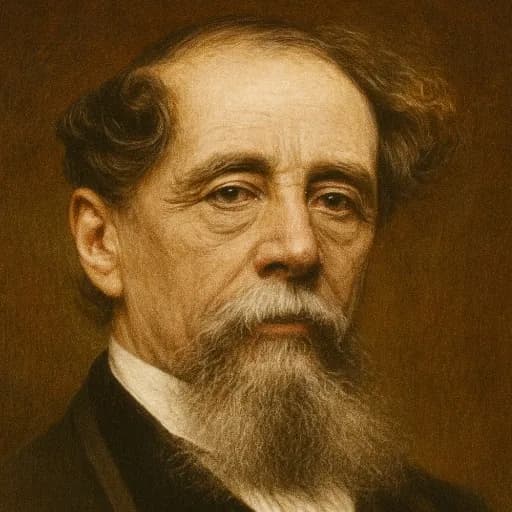
Charles Dickens
Quotes
The sergeant was describing a military life. It was all drinking, he said, except that there were frequent intervals of eating and love-making.
He spoke no more, but moved onward in his place, with a careless air, though listening at the same time to the Service for the Dead, with something between sullen attention, and quickened curiosity. As soon as he had passed the door, his miserable associate was carried out; and the crowd beheld the rest.
It took so much time to drag Dennis in, that this ceremony was over with Hugh, and nearly over with Barnaby, before he appeared. He no sooner came into the place he knew so well, however, and among faces with which he was so familiar, than he recovered strength and sense enough to clasp his hands and make a last appeal. ...‘All I ask, sir,—all I want and beg, is time, to make it sure,’ cried the trembling wretch, looking wildly round for sympathy. ‘The King and Government can’t know it’s me; I’m sure they can’t know it’s me; or they never would bring me to this dreadful slaughterhouse. They know my name, but they don’t know it’s the same man. Stop my execution—for charity’s sake stop my execution, gentlemen—till they can be told that I’ve been hangman here, nigh thirty year. Will no one go and tell them?’ he implored, clenching his hands and glaring round, and round, and round again—‘will no charitable person go and tell them!’
Ye men of gloom and austerity, who paint the face of Infinite Benevolence with an eternal frown; read in the Everlasting Book, wide open to your view, the lesson it would teach. Its pictures are not in black and sombre hues, but bright and glowing tints; its music—save when ye drown it—is not in sighs and groans, but songs and cheerful sounds. Listen to the million voices in the summer air, and find one dismal as your own. Remember, if ye can, the sense of hope and pleasure which every glad return of day awakens in the breast of all your kind who have not changed their nature; and learn some wisdom even from the witless, when their hearts are lifted up they know not why, by all the mirth and happiness it brings.
I am guilty, and yet innocent; wrong, yet right; good in intention, though constrained to shield and aid the bad. Ask me no more questions, sir; but believe that I am rather to be pitied than condemned.
‘Better be mad than sane, here,’ said Hugh. ‘GO mad.’
Everything was fresh and gay, as though the world were but that morning made, when Mr Chester rode at a tranquil pace along the Forest road. Though early in the season, it was warm and genial weather; the trees were budding into leaf, the hedges and the grass were green, the air was musical with songs of birds, and high above them all the lark poured out her richest melody. In shady spots, the morning dew sparkled on each young leaf and blade of grass; and where the sun was shining, some diamond drops yet glistened brightly, as in unwillingness to leave so fair a world, and have such brief existence. Even the light wind, whose rustling was as gentle to the ear as softly-falling water, had its hope and promise; and, leaving a pleasant fragrance in its track as it went fluttering by, whispered of its intercourse with Summer, and of his happy coming.
Hugh looked about him, nodded gloomily to some person in authority, who indicated with his hand in what direction he was to proceed; and clapping Barnaby on the shoulder, passed out with the gait of a lion.
There was something so very ghastly in this circumstance, and it appeared to account, in such a very strange and dismal manner, for his faded dress—which, in this new aspect, seemed discolored by the earth from graves—that Mr. Tappertit abruptly found he was going another way, and, stopping short, bade him good night with the utmost heartiness.
‘Not through you,’ said the idiot, mildly. ‘Don’t say that. You were not to blame. You have always been very good to me.—Hugh, we shall know what makes the stars shine, now!’
‘If this was not faith, and strong belief!’ cried Hugh, raising his right arm aloft, and looking upward like a savage prophet whom the near approach of Death had filled with inspiration, ‘where are they! What else should teach me—me, born as I was born, and reared as I have been reared—to hope for any mercy in this hardened, cruel, unrelenting place! Upon these human shambles, I, who never raised this hand in prayer till now, call down the wrath of God! On that black tree, of which I am the ripened fruit, I do invoke the curse of all its victims, past, and present, and to come. On the head of that man, who, in his conscience, owns me for his son, I leave the wish that he may never sicken on his bed of down, but die a violent death as I do now, and have the night-wind for his only mourner. To this I say, Amen, amen!’ His arm fell downward by his side; he turned; and moved towards them with a steady step, the man he had been before.
They took him to the anvil: but even then he could be heard above the clinking of the smiths’ hammers, and the hoarse raging of the crowd, crying that he knew of Hugh’s birth—that his father was living, and was a gentleman of influence and rank—that he had family secrets in his possession—that he could tell nothing unless they gave him time, but must die with them on his mind; and he continued to rave in this sort until his voice failed him, and he sank down a mere heap of clothes between the two attendants.

