


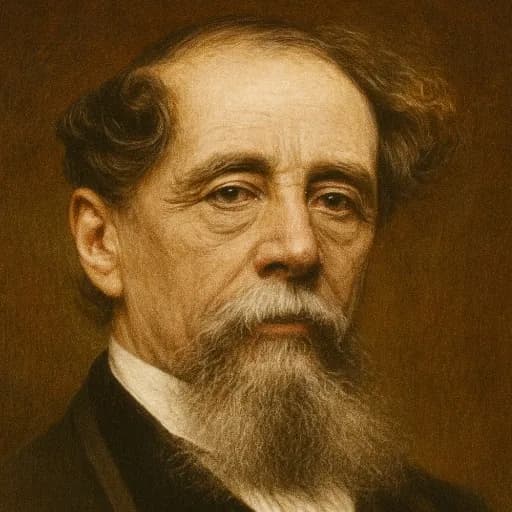
Charles Dickens
Quotes
Barnaby glanced once more through the grate into the empty yard; and then watched Hugh as he strode to the steps leading to his sleeping-cell. He heard him shout, and burst into a roar of laughter, and saw him flourish his hat. Then he turned away himself, like one who walked in his sleep; and, without any sense of fear or sorrow, lay down on his pallet, listening for the clock to strike again.
It was at this moment that the clock struck the first stroke of twelve, and the bell began to toll. The various officers, with the two sheriffs at their head, moved towards the door. All was ready when the last chime came upon the ear. They told Hugh this, and asked if he had anything to say. ...‘I’ll say this,’ he cried, looking firmly round, ‘that if I had ten lives to lose, and the loss of each would give me ten times the agony of the hardest death, I’d lay them all down—ay, I would, though you gentlemen may not believe it—to save this one. This one,’ he added, wringing his hand again, ‘that will be lost through me.’
Gradually, a faint brightness appeared in the east, and the air, which had been very warm all through the night, felt cool and chilly. Though there was no daylight yet, the darkness was diminished, and the stars looked pale. The prison, which had been a mere black mass with little shape or form, put on its usual aspect; and ever and anon a solitary watchman could be seen upon its roof, stopping to look down upon the preparations in the street. This man, from forming, as it were, a part of the jail, and knowing or being supposed to know all that was passing within, became an object of as much interest, and was as eagerly looked for, and as awfully pointed out, as if he had been a spirit.
‘I took him from her in a reckless mood, and didn’t think what harm would come of it,’ said Hugh, laying his hand upon his head, and speaking in a lower voice. ‘I ask her pardon; and his.—Look here,’ he added roughly, in his former tone. ‘You see this lad?’ ...‘That gentleman yonder—’ pointing to the clergyman—‘has often in the last few days spoken to me of faith, and strong belief. You see what I am—more brute than man, as I have been often told—but I had faith enough to believe, and did believe as strongly as any of you gentlemen can believe anything, that this one life would be spared. See what he is!—Look at him!’
His intimacy with Mr Dennis is very ominous. But I have no doubt he must have come to that end any way. If I lend him a helping hand, the only difference is, that he may, upon the whole, possibly drink a few gallons, or puncheons, or hogsheads, less in this life than he otherwise would. It’s no business of mine. It’s a matter of very small importance!
This is the sort of chap for my division, Muster Gashford. Down with him, sir. Put him on the roll. I’d stand godfather to him, if he was to be christened in a bonfire, made of the ruins of the Bank of England.
In one respect they all agreed. The wandering and uncontrollable train of thought, suggesting sudden recollections of things distant and long forgotten and remote from each other—the vague restless craving for something undefined, which nothing could satisfy—the swift flight of the minutes, fusing themselves into hours, as if by enchantment—the rapid coming of the solemn night—the shadow of death always upon them, and yet so dim and faint, that objects the meanest and most trivial started from the gloom beyond, and forced themselves upon the view—the impossibility of holding the mind, even if they had been so disposed, to penitence and preparation, or of keeping it to any point while one hideous fascination tempted it away—these things were common to them all, and varied only in their outward tokens.
‘There is nothing more.’ ...‘—Unless,’ said Hugh, glancing hurriedly back,—‘unless any person here has a fancy for a dog; and not then, unless he means to use him well. There’s one, belongs to me, at the house I came from, and it wouldn’t be easy to find a better. He’ll whine at first, but he’ll soon get over that.—You wonder that I think about a dog just now, he added, with a kind of laugh. ‘If any man deserved it of me half as well, I’d think of him.’
"There are strings," said Mr Tappertit, flourishing his bread-and-cheese knife in the air, "in the human heart that had better not be wibrated. That's what's the matter."
"You have made a pretty evening’s work. I told you not to do this. You may get into trouble. You’ll have an opportunity of revenging yourself on your proud friend Haredale, though, and for that, you’d hazard anything, I suppose?" "I would," retorted Hugh, stopping in his passage out and looking back; "but what do I risk! What do I stand a chance of losing, master? Friends, home? A fig for ’em all; I have none; they are nothing to me. Give me a good scuffle; let me pay off old scores in a bold riot where there are men to stand by me; and then use me as you like—it don’t matter much to me what the end is!"
The thoughts of worldly men are for ever regulated by a moral law of gravitation, which, like the physical one, holds them down to earth. The bright glory of day, and the silent wonders of a starlit night, appeal to their minds in vain. There are no signs in the sun, or in the moon, or in the stars, for their reading. They are like some wise men, who, learning to know each planet by its Latin name, have quite forgotten such small heavenly constellations as Charity, Forbearance, Universal Love, and Mercy, although they shine by night and day so brightly that the blind may see them; and who, looking upward at the spangled sky, see nothing there but the reflection of their own great wisdom and book-learning.
‘You ought to be the best, instead of the worst,’ said Hugh, stopping before him. ‘Ha, ha, ha! See the hangman, when it comes home to him!’

