

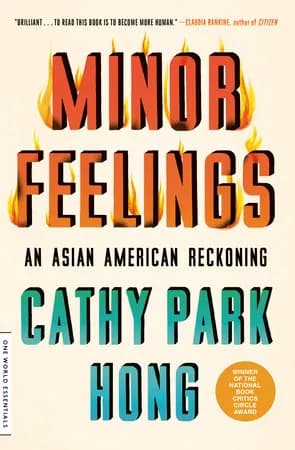
Quotes
I’d rather be indebted than be the kind of white man who thinks the world owes him, because to live an ethical life is to be held accountable to history.
Because I didn't learn the language until I started school, I associated English with everything hard: the chalkboard with diagrammed sentences, the syllables in my mouth like hard slippery marbles. English was not an expression of me but a language that was out to get me, threaded with invisible trip wires that could expose me at the slightest misstep.
When I hear the phrase “Asians are next in line to be white,” I replace the word “white” with “disappear.” Asians are next in line to disappear.
Two thousand and sixteen was the year of white tears...And white tears are why 63 percent of white men and 53 percent of white women elected a malignant man-child as their leader. For to be aware of history, they would be forced to be held accountable, and rather than face that shame, they'd rather, by any means necessary, maintain their innocence.
Whether our families come from Guatemala, Afghanistan, or South Korea, the immigrants since 1965 have shared histories that extend beyond this nation, to our countries of origin, where our lineage has been decimated by Western imperialism, war, and dictatorships orchestrated or supported by the United States. In our efforts to belong in America, we act grateful, as if we've been given a second chance at life. But our shared root is not the opportunity this nation has given us but how the capitalist accumulation of white supremacy has enriched itself off the blood of our countries. We cannot forget this.
The indignity of being Asian in this country has been underreported. We have been cowed by the lie that we have it good. We keep our heads down and work hard, believing that our diligence will reward us with our dignity, but our diligence will only make us disappear. By not speaking up, we perpetuate the myth that our shame is caused by our repressive culture and the country we fled, whereas America has given us nothing but opportunity. The lie that Asians have it good is so insidious that even now as I write, I'm shadowed by doubt that I didn't have it bad compared to others. But racial trauma is not a competitive sport. The problem is not that my childhood was exceptionally traumatic but that it was in fact rather typical.
One characteristic of racism is that children are treated like adults and adults are treated like children. Watching a parent being debased like a child is the deepest shame. I cannot count the number of times I have seen my parents condescended to or mocked by white adults. This was so customary that when my mother had any encounter with a white adult, I was always hypervigilant, ready to mediate or pull her away. To grow up Asian in America is to witness the humiliation of authority figures like your parents and to learn not to depend on them: they cannot protect you.
My term “minor feelings” is deeply indebted to theorist Sianne Ngai, who wrote extensively on the affective qualities of ugly feelings, negative emotions—like envy, irritation, and boredom—symptomatic of today’s late-capitalist gig economy.
Nothing gets dated faster than a joke.
The flip side of innocence is shame.
Racial self-hatred is seeing yourself the way the whites see you, which turns you into your own worst
The most damaging legacy of the West has been its power to decide who our enemies are, turning us not only against our own people, like North and South Korea, but turning me against myself.
As a poet, I have always treated English as a weapon in a power struggle, wielding it against those who are more powerful than me. But I falter when using English as an expression of love.
In many Asian American novels, writers set trauma in a distant mother country or within an insular Asian family to ensure that their pain is not a reproof against American imperial geopolitics or domestic racism; the outlying forces that cause their pain—Asian Patriarchal Fathers, White People Back Then—are remote enough to allow everyone, including the reader, off the hook.
Most white Americans can only understand racial trauma as a spectacle.
Innocence is both a privilege and a cognitive handicap, a sheltered unknowingness that, once protracted into adulthood, hardens into entitlement.
Asian Americans inhabit a purgatorial status: neither white enough nor black enough, unmentioned in most conversations about racial identity. In the popular imagination, Asian Americans are all high-achieving professionals. But in reality, this is the most economically divided group in the country, a tenuous alliance of people with roots from South Asia to East Asia to the Pacific Islands, from tech millionaires to service industry laborers. How do we speak honestly about the Asian American condition—if such a thing exists?
minor feelings: the racialized range of emotions that are negative, dysphoric, and therefore untelegenic, built from the sediments of everyday racial experience and the irritant of having one’s perception of reality constantly questioned or dismissed.
Patiently educating a clueless white person about race is draining. It takes all your powers of persuasion. Because it’s more than a chat about race. It’s ontological. It’s like explaining to a person why you exist, or why you feel pain, or why your reality is distinct from their reality. Except it’s even trickier than that. Because the person has all of Western history, politics, literature, and mass culture on their side, proving that you don’t exist.
Ever since I started writing poetry seriously, I have used English inappropriately.
I have to address whiteness because Asian Americans have yet to truly reckon with where we stand in the capitalist white supremacist hierarchy of this country.
Childhood is a state of mind, whether it's a nostalgic return to innocence or a sudden flashback to unease and dread. If the innocence of childhood is being protected and comforted, the precarity of childhood is when one feels the least protected and comfortable.
To other English is to make audible the imperial power sewn into the language, to slit English open so its dark histories slide out.
The problem with silence is that it can’t speak up and say why it’s silent. And so silence collects, becomes amplified, takes on a life outside our intentions, in that silence can get misread as indifference, or avoidance, or even shame, and eventually this silence passes over into forgetting.
That’s all the quotes.
24 quotes in the collection · come back when we add more