Quotes about ecology
222 quotes · 87 authors
Quotes
No one before the twenty-first century had ever loved flowers and fruiting trees and little birds and the simple beauty of green leaves as did those who lived after the Famine, for whom they were precious and rare and always endangered. (four: THROUGH THE BURNING LABYRINTH)
our incestuous fixation on combat with our own kind has left us ill prepared to face many of the larger perils of the situation in which we find ourselves: the possibility of drastic climatic changes, the depletion of natural resources, the relentless predations of the microbial world. The wealth that flows ceaselessly to the project of war is wealth lost, for the most part, to the battle against these threats. In the United States, military spending no longer requires a credible enemy to justify it, while funding for sanitation, nutrition, medical care, and environmental reclamation declines even as the need mounts. In the third world and much of the postcommunist world, the preparedness for war far surpasses the readiness to combat disease-witness Zaire's fumbling efforts to contain the Ebola outbreak of 1995, or the swiftly declining life expectancy of the former Soviets.
They had jerrybuilt the beaches from San Diego to the Golden Gate, bulldozed super-highways through mountains, cut down a thousand year of redwood growth, and built an urban wilderness in the desert. They couldn't touch the ocean. They poured their sewage into it, but it couldn't be tainted.
The sole religious orthodoxy permitted in our public schools is the separation of paper from plastic. Not so many miles from this beach, great-grandchildren of westering pioneers chain themselves to redwoods, martyrs of the new animism.
Being a planetary citizen does not need space travel. It means being conscious that we are part of the universe and of the earth. The most fundamental law is to recognise that we share the planet with other beings, and that we have a duty to care for our common home.
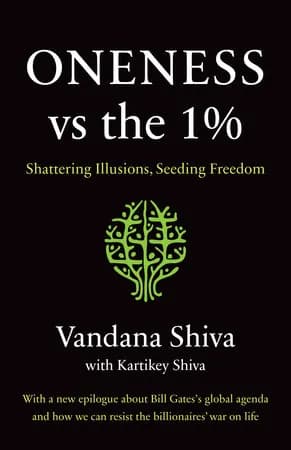
The business of grabbing and money-making, through a violent extractive economy that the 1% have built, is burdening the earth and humanity with unbearable and non-sustainable costs, and has brought us to the brink of extinction. We do not have to escape from the earth; we have to escape from the illusions that enslave our minds and make extinction look inevitable.
Principles of Earth Democracy, #10: Earth Democracy connects people in circles of care, cooperation, and compassion instead of dividing them through competition and conflict, fear and hatred. In the face of a world of greed, inequality, and overconsumption, Earth Democracy globalizes compassion, justice, and sustainability. (p. 11)
Birds' songs express joy, beauty, and purity, and evoke in us vitality and love. So many beings in the universe love us unconditionally. The trees, the water, and the air don't ask anything of us; they just love us. Even though we need this kind of love, we continue to destroy them. By destroying the animals, the air, and the trees, we are destroying ourselves. We must learn to practice unconditional love for all beings so that the animals, the air, the trees, and the minerals can continue to be themselves.
Our ecology should be a deep ecology—not only deep, but universal. There is pollution in our consciousness. Television, films, and newspapers are forms of pollution for us and our children. They sow seeds of violence and anxiety in us and pollute our consciousness, just as we destroy our environment by farming with chemicals, clear-cutting the trees, and polluting the water. We need to protect the ecology of the Earth and the ecology of the mind, or this kind of violence and recklessness will spill over into even more areas of life.
Our Earth, our green beautiful Earth is in danger, and all of us know it. Yet we act as if our daily lives have nothing to do with the situation of the world. If the Earth were your body, you would be able to feel many areas where she is suffering. Many people are aware of the world's suffering, and their hearts are filled with compassion. They know what needs to be done, and they engage in political, social, and environmental work to try to change things. But after a period of intense involvement, they become discouraged, because they lack the strength needed to sustain a life of action. Real strength is not in power, money, or weapons, but in deep, inner peace. If we change our daily lives—the way we think, speak, and act—we change the world. The best way to take care of the environment is to take care of the environmentalist.
We share this planet, our home, with millions of species. Justice and sustainability both demand that we do not use more resources than we need. Restraint in resource use and living within nature's limits are preconditions for social justice. The commons are where justice and sustainability converge, where ecology and equity meet. The survival of pastures and forests as community property, or of a common good like a stable ecosystem, is only possible with social organizations with checks and controls on the use of resources built into their principles. The breakdown of a community, with the associated erosion of concepts of joint ownership and responsibility, can trigger the degradation of common resources. (p.50)
We have to remember that our body is not limited to what lies within the boundary of our skin. Our body is much more immense. We know that if our heart stops beating, the flow of our life will stop, but we do not take the time to notice the many things outside of our bodies that are equally essential for our survival. If the ozone layer around our Earth were to disappear for even an instant, we would die. If the sun were to stop shining, the flow of our life would stop. The sun is our second heart, our heart outside of our body. It gives all life on Earth the warmth necessary for existence. Plants live thanks to the sun. Their leaves absorb the sun's energy, along with carbon dioxide from the air, to produce food for the tree, the flower, the plankton. And thanks to plants, we and other animals can live. All of us—people, animals, plants, and minerals—"consume" the sun, directly and indirectly. We cannot begin to describe all the effects of the sun, that great heart outside of our body.
When we look at green vegetables, we should know that it is the sun that is green and not just the vegetables. The green color in the leaves of the vegetables is due to the presence of the sun. Without the sun, no living being could survive. Without sun, water, air, and soil, there would be no vegetables. The vegetables are the coming-together of many conditions near and far.
If you are a mountain climber or someone who enjoys the countryside or the forest, you know that forests are our lungs outside of our bodies. Yet we have been acting in a way that has allowed millions of square miles of land to be deforested, and we have also destroyed the air, the rivers, and parts of the ozone layer. We are imprisoned in our small selves, thinking only of some comfortable conditions for this small self, while we destroy our large self. If we want to change the situation, we must begin by being our true selves. To be our true selves means we have to be the forest, the river, and the ozone layer. If we visualize ourselves as the forest, we will experience the hopes and fears of the trees. If we don't do this, the forests will die, and we will lose our chance for peace. When we understand that we inter-are with the trees, we will know that it is up to us to make an effort to keep the trees alive.