Quotes
Our culture peculiarly honors the act of blaming, which it takes as the sign of virtue and intellect.
We don't have a great war in our generation, or a great depression, but we do, we have a war of the spirit. We have a great revolution against the culture. The great depression is our lives. We have a spiritual depression.
Our culture has made us all the same. No one is truly white or black or rich, anymore. We all want the same. Individually, we are nothing.
Once efficiency is universally accepted as a rule, it becomes an inner compulsion and weighs like a sense of sin, simply because no one can ever be efficient enough, just as no one can ever be virtuous enough. And this new sense of sin only contributes further to the enervation of leisure, for the rich as well as the poor.The difficulty of carrying on a leisure-oriented tradition of culture in a work-oriented society is enough in itself to keep the present crisis in our culture unresolved.
p. 31
We are in Transylvania, and Transylvania is not England. Our ways are not your ways, and there shall be to you many strange things.
Does the vacuousness of Western universalism and the reality of global cultural diversity lead inevitably and irrevocably to moral and cultural relativism? If universalism legitimates imperialism, does relativism legitimate repression? Once again, the answer to these questions is yes and no. Cultures are relative; morality is absolute. Cultures, as Michael Walzer has argued, are “thick”; they prescribe institutions and behavior patterns to guide humans in the paths which are right in a particular society. Above, beyond, and growing out of this maximalist morality, however, is a “thin” minimalist morality that embodies “reiterated features of particular thick or maximal moralities.” Minimal moral concepts of truth and justice are found in all thick moralities and cannot be divorced from them. There are also minimal moral “negative injunctions, most likely, rules against murder, deceit, torture, oppression, and tyranny.” What people have in common is “more the sense of a common enemy [or evil] than the commitment to a common culture.” Human society is “universal because it is human, particular because it is a society.” At times we march with others; mostly we march alone. Yet a “thin” minimal morality does derive from the common human condition, and “universal dispositions” are found in all cultures. Instead of promoting the supposedly universal features of one civilization, the requisites for cultural coexistence demand a search for what is common to most civilizations. In a multicivilizational world, the constructive course is to renounce universalism, accept diversity, and seek commonalities.
p. 319
Nothing else Chavez wrote during his life had such haunting power for me as that public prayer for a life of suffering; no utterance sounded so Mexican. Other cultures in the world assume the reality of suffering as something to be overcome. Mexico assumes the inevitability of suffering. That knowledge informs the folk music of Mexico, the bitter humor of Mexican proverb. To be a man is to suffer for others—you’re going to suffer anyway.
The Nazis hated culture itself, because it is essentially international and therefore subversive of nationalism. What they called Nazi culture was a local, perverted, nationalistic cult, by which a few major artists and many minor ones were honored for their Germanness, not their talent.
p. 65
Technology has become our culture, our culture technology.
"Art is not like other culture because its success is not made by its audience. The public fill concert halls and cinemas everyday, we read novels by the millions, and buy records by the billions. 'We the people' affect the making and quality of most of our culture, but not our art."
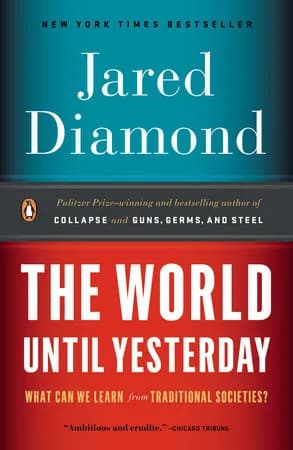
As we shall see in this book's chapters, traditional societies are far more diverse in many of their cultural practices than are modern industrial societies. [...] Yet psychologists base most of their generalizations about human nature on studies of our own narrow and atypical slice of human diversity. [...] That is, as social scientists Joseph Henrich, Steven Heine, and Ara Norenzayan express it, most of our understanding of human psychology is based on subjects who may be described by the acronym WEIRD: from Western, educated, industrialized, rich, and democratic societies. [...] Hence if we wish to generalize about human nature, we need to broaden greatly our study sample from the usual WEIRD subjects [...] to the whole range of traditional societies.
The societies to which most readers of this book belong represent a narrow slice of human cultural diversity. Societies from that slice achieved world dominance not because of a general superiority, but for specific reasons: their technological, political, and military advantages derived from their early origins of agriculture, due in turn to their productive local wild domesticable plant and animal species. Despite those particular advantages, modern industrial societies didn’t also develop superior approaches to raising children, treating the elderly, settling disputes, avoiding non-communicable diseases, and other societal problems. Thousands of traditional societies developed a wide array of different approaches to those problems.