Quotes
The weakness of the Sapir-Whorf Hypothesis... the impossibility of generalizing about entire cultures and then attributing these generalizations to the language spoken ...is to leave numerous facts about culture unexplained. The great religions of the world... have flourished among diverse peoples who speak languages with sharply different grammars. ...Cultures as diverse as the Aztec Empire of Mexico and the Ute hunting bands of the Great Basin spoke very closely related tongues.
Whorf asked... Do the Hopi and European cultures... conceptualize reality in different ways? And his answer was that they do. Whereas European cultures are organized in terms of space and time, the Hopi culture, Whorf believed, emphasizes events. To speakers of European languages, time is a commodity that occurs between fixed points and can be measured. Time is said to be wasted or saved... their economic systems emphasize wages paid for the amount of time worked, rent for the time a dwelling is occupied, interest for the time money is loaned. Hopi culture... instead thinks... The span of time the growing takes is not the important thing, but rather the way in which the event of growth follows the event of planting. The Hopi is concerned that the sequence of events in the construction of a building be in the correct order, not that it takes a certain amount of time to complete the job.
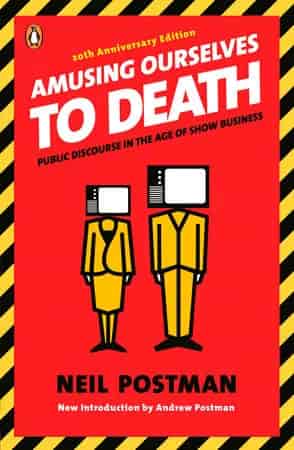
Everything in our background has prepared us to know and resist a prison when the gates begin to close around us . . . But what if there are no cries of anguish to be heard? Who is prepared to take arms against a sea of amusements? To whom do we complain, and when, and in what tone of voice, when serious discourse dissolves into giggles? What is the antidote to a culture's being drained by laughter?
p. 156
What ideas are convenient to express inevitably becomes the important content of a culture.
p. 6
In a technocracy, tools play a central role in the thought-world of the culture. Everything must give way, in some degree, to their development. The social and symbolic worlds become increasingly subject to the requirements of that development. Tools are not integrated into the culture; they attack the culture. They bid to become the culture. As a consequence, tradition, social mores, myth, politics, ritual, and religion have to fight for their lives...
The clearest way to see through a culture is to attend to its tools for conversation.
p. 8
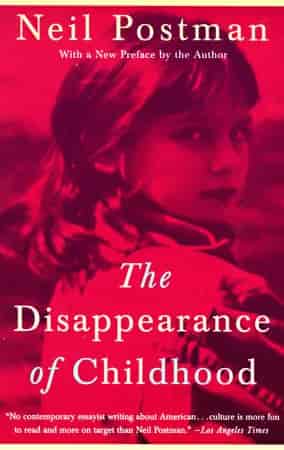
Childhood is analogous to language learning. It has a biological basis but cannot be realized unless a social environment triggers and nurtures it, that is, has need of it. If a culture is dominated by a medium that requires the segregation of the young in order that they learn unnatural, specialized, and complex skills and attitudes, then childhood, in one form or another, will emerge, articulate and indispensable.
Children are the living messages we send to a time we will not see. From a biological point of view it is inconceivable that any culture will forget that it needs to reproduce itself. But it is quite possible for a culture to exist without a social idea of children. Unlike infancy, childhood is a social artifact, not a biological category.
If America is a melting pot, then to me India is a thali -- a collection of sumptuous dishes in different bowls. Each may not mix with the next, but they combine on your palate to produce a satisfying repast.
Mr. Weathereye had always said that civility could not possibly be resented by any civilized person; that if resentment were offered, it was a sure sign of loutdom.
p. 132
It did not take long to find out that Earth was no different from Phobos. People on Earth engaged in ritual repetition; most of them thought as little as possible; most of them occupied themselves with things and events that were not very important. Amusement stage dramas were the same as the ones I had seen on Phobos. All music had been so extensively filtered, corrected, and augmented by technology that it all sounded alike. Singing voices were improved by electronic means, as were the faces, the bodies, and the dramatic ability of actors and actresses. No one was plain; no one was allowed to be ugly; no one was very different from anyone else. In school, the stupid students got the same grades as the smart ones except for the tiny secret marks the educational archivists made in their records – in case a VIP needed a truthful reference.
p. 86
It is far more important to establish a civil and orderly society than it is to pander to abusive cultural and religious artifacts.
p. 293