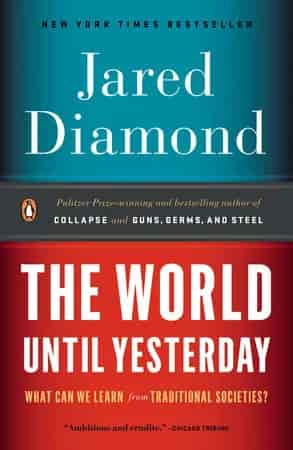
Jared Diamond
Quotes
My hope in writing this book has been that enough people will choose to profit from that opportunity to make a difference.
p. 525
Remember that impact is the product of two factors: population multiplied times impact per person.
p. 524
What are the choices that we must make if we are now to succeed, and not to fail? [...] Two types of choices seem to me to have been crucial to tipping their outcomes towards success or failure: long-term planning, and willingness to reconsider core values. On reflection, we can also recognize the crucial role of these same two choices for the outcomes of our individual lives. One of those choices has depended on the courage to practice long-term thinking, and to make bold, courageous, anticipatory decisions at a time when problems have become perceptible but before they have reached crisis proportions. [...] The other crucial choice illuminated by the past involves the courage to make painful decisions about values. Which of the values that formerly served a society well can continue to be maintained under new changed circumstances? Which of these treasured values must instead be jettisoned and replaced with different approaches?
As we shall see in this book's chapters, traditional societies are far more diverse in many of their cultural practices than are modern industrial societies. [...] Yet psychologists base most of their generalizations about human nature on studies of our own narrow and atypical slice of human diversity. [...] That is, as social scientists Joseph Henrich, Steven Heine, and Ara Norenzayan express it, most of our understanding of human psychology is based on subjects who may be described by the acronym WEIRD: from Western, educated, industrialized, rich, and democratic societies. [...] Hence if we wish to generalize about human nature, we need to broaden greatly our study sample from the usual WEIRD subjects [...] to the whole range of traditional societies.
Two types of choices seem to me to have been crucial in tipping their outcomes towards success or failure: long-term planning, and willingness to reconsider core values. On reflection, we can also recognize the crucial role of these same two choices for the outcomes of our individual lives.
p. 522
Religious values tend to be especially deeply held and hence frequent cause of disastrous behaviour. [...] The modern world provides us with abundant secular examples of admirable values to which we cling under conditions where those values no longer make sense [...] It appears to me that much of the rigid opposition to environmental concerns in the First World nowadays involves values acquired early in life and never again reexamined [...].
The central principle of Fritz Bauer's career was that Germans should hold judgement upon themselves. That meant prosecuting ordinary Germans, not just the leaders whom the Allies had prosecuted. [...] The Nazi defendants being prosecuted by Bauer all tended to offer the same set of excuses [...]. Bauer's response, which he formulated again and again at the trials and in public, was as follows. Those Germans whom he was prosecuting were committing crimes against humanity. The laws of the Nazi state were illegitimate. One cannot defend one's actions by saying that one was obeying those laws. There is no law that can justify a crime against humanity. Everybody must have his own sense of right and wrong and must obey it, independently of what a state government says. Anyone who takes part in what Bauer called a murder machine [...] thereby becomes guilty of a crime.
p. 226
Businesses have changed when the public came to expect and require different behavior, to reward businesses for behavior that the public wanted, and to make things difficult for businesses practising behaviors that the public didn't want. I predict that in the future, just as in the past, changes in public attitudes will be essential for changes in businesses' environmental practices.
p. 485
History, as well as life itself, is complicated; neither life nor history is an enterprise for those who seek simplicity and consistency.
p. 349
"The environment has to be balanced against the economy." This quote portrays environmental concerns as a luxury, views measures to solve environmental problems as incurring a net cost, and considers leaving environmental problems unsolved to be a money-saving device. This one-liner puts the truth exactly backwards. Environmental messes cost us huge sums of money both in the short run and in the long run; cleaning up or preventing those messes saves us huge sums in the long run, and often in the short run as well. In caring for the health of our surroundings, just as of our bodies, it is cheaper and preferable to avoid getting sick than to try to cure illnesses after they have developed.
p. 503
Because we are the cause of our environmental problems, we are the ones in control of them, and we can choose or not choose to stop causing them and start solving them. The future is up for grabs, lying in our own hands. We don’t need new technologies to solve our problems; while new technologies can make some contribution, for the most part we "just" need the political will to apply solutions already available.
My views may seem to ignore a moral imperative that businesses should follow virtuous principles, whether or not it is most profitable for them to do so. Instead I prefer to recognize that, throughout human history, [...] government regulation has arisen precisely because it was found to be necessary for the enforcement of moral principles. Invocation of moral principles is a necessary first step for eliciting virtuous behavior, but that alone is not a sufficient step.