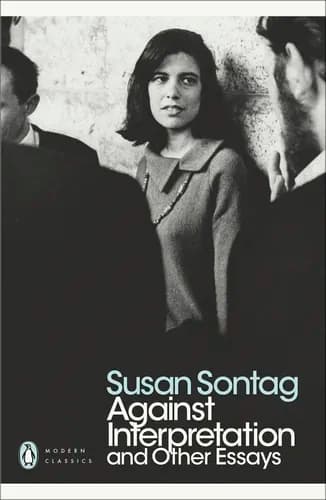
Quotes
Beauty expressed by the artist cannot awaken in us an emotion which is kinetic or a sensation which is purely physical. It awakens, or ought to awaken, or induces, or ought to induce, an esthetic stasis, an ideal pity or an ideal terror, a stasis called forth, prolonged, and at last dissolved by what I call the rhythm of beauty.
The artist, like the God of the creation, remains within or behind or beyond or above his handiwork, invisible, refined out of existence, indifferent, paring his fingernails.
In place of a hermeneutics we need an erotics of art.
p. 14
Interpretation is the revenge of the intellect upon art.
p. 7
None of us can ever retrieve that innocence before all theory when art knew no need to justify itself, when one did not ask of a work of art what it said because one knew (or thought one knew) what it did. From now to the end of consciousness, we are stuck with the task of defending art. We can only quarrel with one or another means of defense. Indeed, we have an obligation to overthrow any means of defending and justifying art which becomes particularly obtuse or onerous or insensitive to contemporary needs and practices.
This is the case, today, with the very idea of content itself. Whatever it may have been in the past, the idea of content is today mainly a hindrance, a nuisance, a subtle or not so subtle philistinism.
p. 5
Transparence is the highest, most liberating value in art—and in criticism—today. Transparence means experiencing the luminousness of the thing in itself, of things being what they are.
What the overemphasis on the idea of content entails is the perennial, never consummated project of interpretation. And, conversely, it is the habit of approaching works of art in order to interpret them that sustains the fancy that there really is such a thing as the content of a work of art.
p. 5
I will tell you what I will do and what I will not do. I will not serve that in which I no longer believe, whether it call itself my home, my fatherland, or my church: and I will try to express myself in some mode of life or art as freely as I can and as wholly as I can, using for my defence the only arms I allow myself to use — silence, exile and cunning.
Real art has the capacity to make us nervous. By reducing the work of art to its content and then interpreting that, one tames the work of art. Interpretation makes art manageable, comformable.
p. 8
Interpretation is not (as most people assume) an absolute value, a gesture of mind situated in some timeless realm of capabilities. Interpretation must itself be evaluated, within a historical view of human consciousness.''' In some cultural contexts, interpretation is a liberating act. It is a means of revising, of transvaluing, of escaping the dead past. In other cultural contexts, it is reactionary, impertinent, cowardly, stifling.
p. 6
Let me formulate the artistic disposition as follows: it is reacting with one’s ideal to the flaw in oneself and in the world, and somehow making that reaction formation solid enough in the medium so that it indeed becomes an improved bit of real world for others.
p. 176
When we choose a man to beautify our towns, we do not automatically call on the major artists of the world. … We now lavishly praise Frank Lloyd Wright, but we never made any community use of him, though he longed for the chance.
p. 153