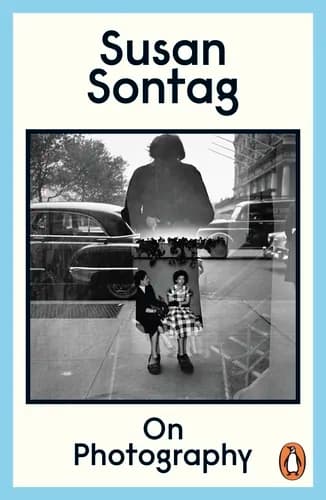
Susan Sontag
Quotes
Photography has become almost as widely practiced an amusement as sex and dancing.
p. 8
Whitman thought he was not abolishing beauty but generalizing it. So, for generations, did the most gifted American photographers, in their polemical pursuit of the trivial and the vulgar. But among American photographers who have matured since World War II, the Whitmanesque mandate to record in its entirety the extravagant candors of actual American experience has gone sour. In photographing dwarfs, you don't get majesty & beauty. You get dwarfs.
p. 29
The flâneur is not attracted to the city's official realities but to its dark seamy corners, the neglected populations—an unofficial reality behind the façade of bourgeois life that the photographer 'apprehends,' as a detective apprehends a criminal."
p. 55
The particular qualities and intentions of photographs tend to be swallowed up in the generalized pathos of time past.
p. 21
So successful has been the camera's role in beautifying the world that photographs, rather than the world, have become the standard of the beautiful.'''
p. 85
Even when photographers are most concerned with mirroring reality, they are still haunted by tacit imperatives of taste and conscience.
p. 6
The destiny of photography has taken it far beyond the role to which it was originally thought to be limited: to give more accurate reports on reality (including works of art). Photography is the reality; the real object is often experienced as a letdown.
p. 147
Between two fantasy alternatives, that Holbein the Younger had lived long enough to have painted Shakespeare or that a prototype of the camera had been invented early enough to have photographed him, most Bardolators would choose the photograph. This is not just because it would presumably show what Shakespeare really looked like, for even if the photograph were faded, barely legible, a brownish shadow, we would probably still prefer it to another glorious Holbein. Having a photograph of Shakespeare would be like having a nail from the True Cross.
p. 154
The camera makes everyone a tourist in other people's reality, and eventually in one's own.
p. 57
Photographed images do not seem to be statements about the world so much as pieces of it, miniatures of reality that anyone can make or acquire.
p. 4
Reality has come to seem more and more like what we are shown by cameras. It is common now for people to insist upon their experience of a violent event in which they were caught up — a plane crash, a shoot-out, a terrorist bombing — that "it seemed like a movie." This is said, other descriptions seeming insufficient, in order to explain how real it was. While many people in non-industrialized countries still feel apprehensive when being photographed, divining it to be some kind of trespass, an act of disrespect, a sublimated looting of the personality or the culture, people in industrialized countries seek to have their photographs taken — feel that they are images, and are made real by photographs.
p. 161
The tradition of portrait painting, to embellish or idealize the subject, remains the aim of everyday and of commercial photography, but it has had a much more limited career in photography considered as art. Generally speaking, the honors have gone to the Cordelias.
p. 105