Leafy Quotes
Recently added
The newest book quotes in the Leafy Quotes collection — passages readers have just added, each with its author, book and the page it came from.
It is an old rule, only not sufficiently obeyed, but a good rule: If you do not wish to be lied to, do not ask questions! The only real defense civilized man has against anybody who bothers him is to lie. There would be no lies if there were no questions.
p. 150
If all people had a decent job to occupy their minds, and regular meals to satisfy their hunger, most crimes would not be committed.
p. 159
Anyone who is willing to work and is serious about it will certainly find a job. Only you must not go to the man who tells you this, for he has no job to offer and doesn't know anyone who knows of a vacancy. This is exactly the reason why he gives you such generous advice, out of brotherly love, and to demonstrate how little he knows the world.
The treasure which you think not worth taking trouble and pains to find, this alone is the real treasure you are longing for all your life. The glittering treasure you are hunting for day and night lies buried on the other side of that hill yonder.
If you wish to survive, you have to win the battle.
Morals are taught and preached not for the sake of heaven, but to assist those people on earth who have everything they need and more to retain their possessions and to help them to accumulate still more. Morals is the butter for those who have no bread.
p. 143
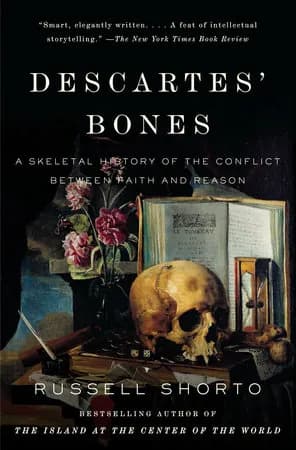
The irony is that in shifting the focus onto the individual human mind, which everyone agrees can be a pretty flimsy and wayward organ, Descartes had arrived at the closest thing to a certain basis for knowledge. If my own thoughts are the only indubitable ground I can stand on, apparently they aren’t so flimsy after all, at least not all the time. As an earlier follower of Descartes put it, “doubt is the beginning of an undoubtable philosophy.” Therefore the mind and its “good sense”—that is to say, human reason—are the only basis for judging whether a thing is true. With the “cogito,” as philosophers abbreviate it, and with the theory of knowledge that arises from it, which Descartes outlined in the Discourse on the Method and later works, human reason supplanted received wisdom. Once Descartes had established the base, he and others could rebuild the edifice of knowledge. But it would be different from what it had been. Everything would be different.
p. 20
The class I belong to always has to wait and wait, stand long nights and days in long files to get a cup of coffee and a slice of bread. Everybody in the world, official or boss, takes it for granted that our sort of people have ages, of time to waste. It is different with those who have money. They can arrange everything with money. Therefore they never have to wait. We who cannot pay with cold cash have to pay with our time instead. Suppose you get sore at the official who lets you wait and wait, and you say something about the citizen’s right it won’t help you a bit. He then lets you wait ten times longer, and you never do it again. He is the king. Do not forget that. Don’t ever believe that kings were done with when the fathers of the country made a revolution.
p. 41
“Death,” the philosopher Ludwig Wittgenstein once wrote, “is not an event in life.” He meant, maybe (for it’s hard to be sure—Wittgenstein was rather titanically cryptic), that being dead is not something we actually experience and that since we aren’t conscious of a nonliving state it is literally meaningless, so instead of spending our lives worrying about the future we should look at each instant as an eternity. We should live in the moment.
Perhaps this is true, and wise, but in an ordinary sense Wittgenstein was completely wrong. Death is the event in life. It is our chief organizing principle. It’s why we rush and why we dawdle, why we better up our bosses and fawn over our children, why we like both fast cars and fading flowers, why we write poetry, why sex thrills us. It’s why we wonder why we are here.
p. 43
Whatever a being may own is of no importance, of no concern at all. It is gone and useless. All we have is our breath. I shall fight for it with teeth and nails.
p. 222
Economists have a term for situations in which someone gets rewards but has little or no incentive to avoid risk: a . ...Those who occupy the executive suite and gamble millions of dollars on the lives of others are rarely seen as engaged in morally hazardous conduct. Yet reward without risk is a form of moral hazard that blinds us to the consequences of our acts.
Martin Luther King Jr. said he had a dream that one day his four children would be judged by the content of their character, not by the color of their skin. ...Today we often value people less by their character than by the contents of their wallet. ...The pursuit of ever more financial zeros... has... produced a moral breakdown... twisting our culture and our values in ways that tear at the fabric of our society.