Leafy Quotes
Recently added
The newest book quotes in the Leafy Quotes collection — passages readers have just added, each with its author, book and the page it came from.
And now I want to tell you about my late Uncle Alex. He was my father's kid brother, a childless graduate of Harvard who was an honest life insurance salesman in Indianapolis. He was well-read and wise. And his principal complaint about other human beings was that they so seldom noticed it when they were happy. So when we were drinking lemonade under an apple tree in the summer, say, and talking lazily about this and that, almost buzzing like honeybees, Uncle Alex would suddenly interrupt the agreeable blather to exclaim, If this isn't nice, I don't know what is. So I do the same now, and so do my kids and grandkids. And I urge you to please notice when you are happy, and exclaim or murmur or think at some point, If this isn't nice, I don't know what is.
Is it possible that seemingly incredible geniuses like Bach and Shakespeare and Einstein were not in fact superhuman, but simply plagiarists, copying great stuff from the future?
I am honorary president of the American Humanist Association, having succeeded the late, great, spectacularly prolific writer and scientist, Dr. Isaac Asimov in that essentially functionless capacity. At an A.H.A. memorial service for my predecessor I said, "Isaac is up in Heaven now." That was the funniest thing I could have said to an audience of humanists. It rolled them in the aisles. Mirth! Several minutes had to pass before something resembling solemnity could be restored.
I made that joke, of course, before my first near-death experience — the accidental one.
So when my own time comes to join the choir invisible or whatever, God forbid, I hope someone will say, "He's up in Heaven now." Who really knows? I could have dreamed all this.
My epitaph in any case? "Everything was beautiful. Nothing hurt." I will have gotten off so light, whatever the heck it is that was going on.
Here is a lesson in creative writing. First rule: Do not use semicolons. They are transvestite hermaphrodites representing absolutely nothing. All they do is show you've been to college.
Many people need desperately to receive this message: "I feel and think much as you do, care about many of the things you care about, although most people don't care about them. You are not alone."
Adam and Eve, more in love than they have ever been before, tell Him that they like life all right, but that they would like it even better if they could know that it was going to end sometime.
p. 238
If you really want to know whether your pictures are, as you say, "art or not," you must display them in a public place somewhere, and see if strangers like to look at them. That is the way the game is played. [...] The situation is social rather than scientific. Any work of art is half of a conversation between two human beings, and it helps a lot to know who is talking at you. [...] There are virtually no respected paintings made by persons about whom we know zilch. We can even surmise quite a bit about the lives of whoever did the paintings in the caverns underneath Lascaux, France. [...] If you are unwilling to claim credit for your pictures, and to say why you hoped others might find them worth examining, there goes the ball game. Pictures are famous for their humanness, and not their pictureness. [...]
There is also the matter of craftsmanship. Real picture-lovers like to play along, so to speak, to look closely at the surfaces, to see how the illusion was created. If you are unwilling to say how you made your pictures, there goes the ball game a second time.
p. 168
"We are here to help each other get through this thing, whatever it is."
p. 78
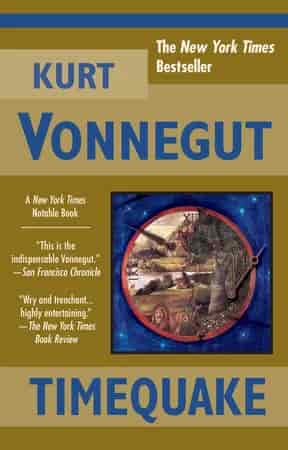
I always had trouble ending short stories in ways that would satisfy a general public. In real life, as during a rerun following a timequake, people don’t change, don’t learn anything from their mistakes, and don’t apologize. In a short story they have to do at least two out of three of those things, or you might as well throw it away in the lidless wire trash receptacle chained and padlocked to the fire hydrant in front of the American Academy of Arts and Letters.
p. 161
The self-respects of most middle-class American people my age or older, and still alive, are out to pasture now, not a bad place to be. They munch. They ruminate. If self-respect breaks a leg, the leg can never heal. Its owner has to shoot it.
p. 211
I will say, too, that lovemaking, if sincere, is one of the best ideas Satan put in the apple she gave to the serpent to give to Eve. The best idea in that apple, though, is making jazz.
p. 95
If this isn't nice, what is?
p. 22