
Quotes
Most of us would say, if asked, that we live in a capitalist society, but vast amounts of how we live our everyday lives - our interactions with and commitments to family lives, friendships, avocations, membership in social, spiritual and political organizations-are in essence noncapitalist or even anticapitalist, full of things we do for free, out of love, and on principle.
A better world, yes; a perfect world, never. (p82)
Violence is the power of the state; imagination and non-violence the power of civil society.
...as Freire points out, struggle generates hope as it goes along. Waiting until everything looks feasible is too long to wait. ("When We Lost" in 2016 edition)
Resistance is first of all a matter of principle and a way to live, to make yourself one small republic of unconquered spirit. You hope for results, but you don't depend on them. ("When We Lost" in 2016 edition)
Your opponents would love you to believe that it's hopeless, that you have no power, that there's no reason to act, that you can't win. Hope is a gift you don't have to surrender, a power you don't have to throw away.
A couple of years ago, a friend wrote to urge me to focus on the lyrical end of my writing rather than activism and I wrote back, “What is the purpose of resisting corporate globalization if not to protect the obscure, the ineffable, the unmarketable, the unmanageable, the local, the poetic, and the eccentric? So they need to be practiced, celebrated, and studied too, right now.” I could have added that they themselves become forms of resistance; the two are not necessarily separate practices. (p68)
I wonder sometimes what would happen if victory was imagined not just as the elimination of evil but the establishment of good (p61)
You row forward looking back, and telling this history is part of helping people navigate toward the future. We need a litany, a rosary, a sutra, a mantra, a war chant of our victories. The past is set in daylight, and it can become a torch we can carry into the night that is the future.
...hope is not a lottery ticket you can sit on the sofa and clutch, feeling lucky. It is an axe you break down doors with in an emergency. Hope should shove you out the door, because it will take everything you have to steer the future away from endless war, from the annihilation of the earth's treasures and the grinding down of the poor and marginal... To hope is to give yourself to the future - and that commitment to the future is what makes the present inhabitable. (p5)
We write history with our feet and with our presence and our collective voice and vision. And yet, of course, everything in the mainstream media suggests that popular resistance is ridiculous, pointless, or criminal, unless it is far away, was long ago, or, ideally, both. These are the forces that prefer the giant remain asleep.
You may be told that the legal decisions lead the changes, that judges and lawmakers lead the culture in those theaters called courtrooms, but they only ratify change. They are almost never where change begins, only where it ends up, for most changes travel from the edges to the center.
Since the Seattle surprise, it's become standard practice to erect a miniature police state around any globalization summit, and these rights free zones seem to prefigure what corporate globalization promises. (p46)
The revolution that counts is the one that takes place in the imagination; many kinds of change issue forth thereafter, some gradual and subtle, some dramatic and conflict-ridden—which is to say that revolution doesn't necessarily look like revolution.
when you face a politics that aspires to make you fearful, alienated and isolated, joy is a fine act of insurrection. ("False Hope and Easy Despair" in 2016 edition)
Joy doesn't betray but sustains activism. (p17)
People have always been good at imagining the end of the world, which is much easier to picture than the strange sidelong paths of change in a world without end. (p27)
I believe in hope as an act of defiance, or rather as the foundation for an ongoing series of acts of defiance, those acts necessary to bring about some of what we hope for while we live by principle in the meantime. There is no alternative, except surrender. And surrender not only abandons the future, it abandons the soul. (p137)
What lies ahead seems unlikely; when it becomes the past, it seems inevitable.
Writing is lonely, it’s an intimate talk with the dead, with the unborn, with the absent, with strangers, with the readers who may never come to be and who even if they read you will do so weeks, years, decades later. An essay, a book, is one statement in a long conversation you could call culture or history; you are answering something or questioning something that may have fallen silent long ago, and the response to your words may come long after you’re gone and never reach your ears, if anyone hears you in the first place. (p64)
Inside the word "emergency" is "emerge"; from an emergency new things come forth. The old certainties are crumbling fast, but danger and possibility are sisters. (p12)
Cause-and-effect assumes history marches forward, but history is not an army. It is a crab scuttling sideways, a drip of soft water wearing away stone, an earthquake breaking centuries of tension. Sometimes one person inspires a movement, or her words do decades later, sometimes a few passionate people change the world; sometimes they start a mass movement and millions do; sometimes those millions are stirred by the same outrage or the same ideal, and change comes upon us like a change of weather. All that these transformations have in common is that they begin in the imagination, in hope. To hope is to gamble. It's to bet on the future, on your desires, on the possibility that an open heart and uncertainty is better than gloom and safety. To hope is dangerous, and yet it is the opposite of fear, for to live is to risk. (p4)
The revolutionary days I have been outlining are days in which hope is no longer fixed on the future: it becomes an electrifying force in the present. (p108)
The assumption that whatever we now believe is just common sense, or what we always knew, is a way to save face. It's also a way to forget the power of a story and of a storyteller, the power in the margins, and the potential for change.
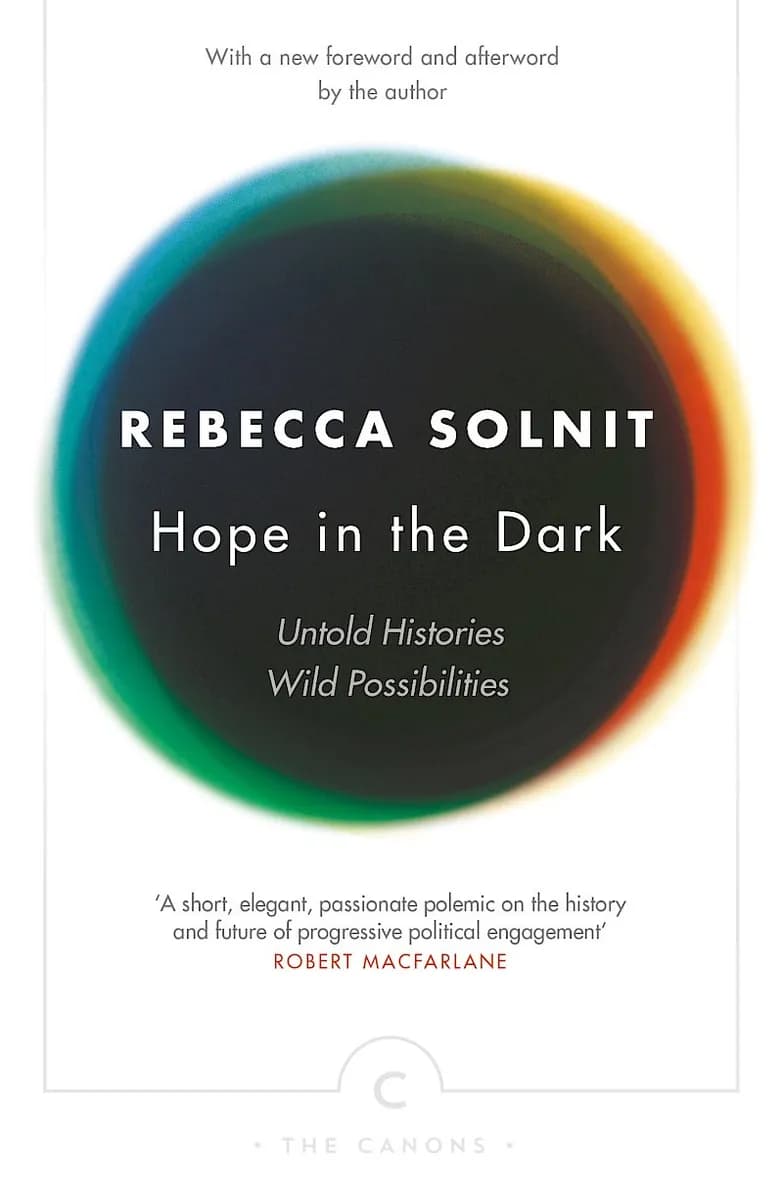
That’s all the quotes.
24 quotes in the collection · come back when we add more