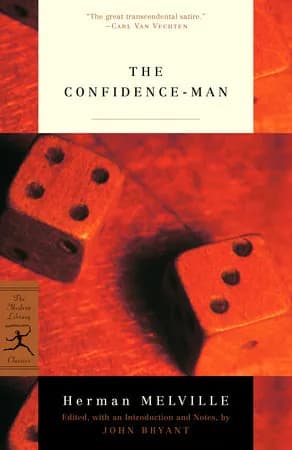
Herman Melville
Quotes
Where does any novelist pick up any character? For the most part, in town, to be sure. Every great town is a kind of man-show, where the novelist goes for his stock, just as the agriculturist goes to the cattle-show for his. But in the one fair, new species of quadrupeds are hardly more rare, than in the other are new species of characters — that is, original ones. Their rarity may still the more appear from this, that, while characters, merely singular, imply but singular forms so to speak, original ones, truly so, imply original instincts.
I do not think I have any uncharitable prejudice against the rattle-snake, still, I should not like to be one. If I were a rattle-snake now, there would be no such thing as being genial with men — men would be afraid of me, and then I should be a very lonesome and miserable rattle-snake.
Goneril held it flattery to hint praise even of the absent, and even if merited; but honesty, to fling people's imputed faults into their faces. This was thought malice, but it certainly was not passion. Passion is human.
You speak of a certain philosophy, and a more or less occult one it may be, and hint of its bearing upon practical life; pray, tell me, if the study of this philosophy tends to the same formation of character with the experiences of the world?"
"It does; and that is the test of its truth; for any philosophy that, being in operation contradictory to the ways of the world, tends to produce a character at odds with it, such a philosophy must necessarily be but a cheat and a dream."
If, then, something is to be pardoned to well-meant endeavor, surely a little is to be allowed to that writer who, in all his scenes, does but seek to minister to what, as he understands it, is the implied wish of the more indulgent lovers of entertainment, before whom harlequin can never appear in a coat too parti-colored, or cut capers too fantastic.
I cannot tell you how thankful I am for your reminding me about the apocrypha here. For the moment, its being such escaped me. Fact is, when all is bound up together, it's sometimes confusing. The uncanonical part should be bound distinct. And, now that I think of it, how well did those learned doctors who rejected for us this whole book of Sirach. I never read anything so calculated to destroy man's confidence in man. This son of Sirach even says — I saw it but just now: 'Take heed of thy friends'; not, observe, thy seeming friends, thy hypocritical friends, thy false friends, but thy friends, thy real friends — that is to say, not the truest friend in the world is to be implicitly trusted. Can Rochefoucault equal that? I should not wonder if his view of human nature, like Machiavelli's, was taken from this Son of Sirach. And to call it wisdom — the Wisdom of the Son of Sirach! Wisdom, indeed! What an ugly thing wisdom must be! Give me the folly that dimples the cheek, say I, rather than the wisdom that curdles the blood. But no, no; it ain't wisdom; it's apocrypha, as you say, sir. For how can that be trustworthy that teaches distrust?"
It is one of the imbecilities of the suspicious person to fancy that every stranger, however absent-minded, he sees so much as smiling or gesturing to himself in any odd sort of way, is secretly making him his butt.
Misanthropy, springing from the same root with disbelief of religion, is twin with that. It springs from the same root, I say; for, set aside materialism, and what is an atheist, but one who does not, or will not, see in the universe a ruling principle of love; and what a misanthrope, but one who does not, or will not, see in man a ruling principle of kindness? Don't you see? In either case the vice consists in a want of confidence.
"Ah!" cried the old man, brightening up, "now I know. Look," turning the leaves forward and back, till all the Old Testament lay flat on one side, and all the New Testament flat on the other, while in his fingers he supported vertically the portion between, "look, sir, all this to the right is certain truth, and all this to the left is certain truth, but all I hold in my hand here is apocrypha."
"Apocrypha?"
"Yes; and there's the word in black and white," pointing to it. "And what says the word? It says as much as 'not warranted;' for what do college men say of anything of that sort? They say it is apocryphal. The word itself, I've heard from the pulpit, implies something of uncertain credit. So if your disturbance be raised from aught in this apocrypha," again taking up the pages, "in that case, think no more of it, for it's apocrypha."
With these words and a grand scorn the cosmopolitan turned on his heel, leaving his companion at a loss to determine where exactly the fictitious character had been dropped, and the real one, if any, resumed.
At sunrise on a first of April there appeared, suddenly as Manco Capac at the lake Titicaca, a man in cream-colors, at the water-side in the city of St. Louis.
His cheek was fair, his chin downy, his hair flaxen, his hat a white fur one, with a long fleecy nap. He had neither trunk, valise, carpet-bag, nor parcel. No porter followed him. He was unaccompanied by friends. From the shrugged shoulders, titters, whispers, wonderings of the crowd, it was plain that he was, in the extremest sense of the word, a stranger.
"Help? to say nothing of the friend, there is something wrong about the man who wants help. There is somewhere a defect, a want, in brief, a need, a crying need, somewhere about that man."