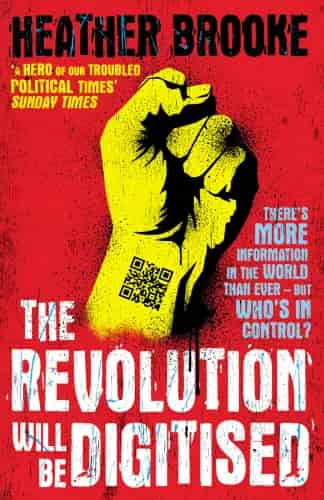
Heather Brooke
Quotes
At a time of information overload, good journalists are more important then ever. They serve as the public's hired guns to collect information from various sources and challenge it for the purpose of distilling down what is important and true. They-signpost issues that are worthy of our attention. In the past when we bought newspapers we were paying for that particular newspaper with its content- a bundle of news and entertainment. In the digital age we're buying the carriage (e.g. the Internet access) and readers decide later what information they want to view over that carrier.
p. 70
 The Revolution will be Digitised
We are at an extraordinary moment in human history: never before has the possibility of true democracy been so close to realisation. At the cost of publishing and duplication has dropped to near zero, a truly free press, and a truly informed public, becomes a reality. A new Information Enlightment is dawning where knowledge flows freely, beyond national boundaries. Technology is breaking down traditional social barriers of status, class, power, wealth and geography, replacing them with an ethos of collaboration and transparency. In this new Enlightenment it isn't just scientific truths that are the goal, but discovering truths about the way we live, about politics and power.
The Revolution will be DigitisedAuthoritarians offer citizens a deal: if we hand over our freedom, they will guarantee certainty and safety. This might have been possible in a closed society with little interaction between people, but it is a false promise in a knowledge economy where citizens are interconnected. If the best chaos theorists can't model the weather beyond a week, how does the National Security Agency think it can predict which of us will turn into a terrorist? If our intelligence agencies persist in monopolising knowledge we will see continued intelligence failures.
p. 236
The Revolution will be DigitisedWhy, then, are the world's governments intent on controlling and regulating the Internet? Free speech is most threatening to authoritarian systems such as autocracies, militaries, the police and security services. Security services in principle exist for our protection but that is so only when they are accountable to the public for their considerable power. We are seeing a push by these agencies to move beyond the rule of law, to be accountable to no one but themselves. National security is becoming the new word of God to which all must submit in blind obedience. The decisions made, the liberties eroded, the crimes committed in the name of national security cannot be challenged because the information on which they are based remains secret.
p. 236
The Revolution will be DigitisedLeaks have happened before. They are not new. But the industrial scale of leaking made possible through the digitisation of information and the ability to communicate instantly across the globe - that is new. If it is to be revolutionary, however, we need a model for a new type of politics.
p. 226
The Revolution will be DigitisedThe world may be more complex and uncertain than we would like, but giving away our freedom for the false promises of protection is not a sustainable solution. We are defined not just by what we preach, but by what we practice. We cannot claim to be an enlightened democratic society if we live in breach of these values, without the rule of law, without reason, or the rigorous commitment to truth.
p. 238
The Revolution will be DigitisedOver the past year I've thought a lot about censorship, surveillance and regulation of the Internet. Is it necessary? Is it really so dangerous to allow individuals an ability to associate and communicate freely? Certainly there exists a criminal minority who take advantage of the freedom of the Internet, but no one is arguing that crimes shouldn't be prosecuted. This is about allowing the vast majority of people to communicate without state intervention. Despite all the dire warnings, the prophesies of doom and destruction that were foretold by the Pentagon, the US State Department, Hosni Mubarak, even English High Court Judge Eady, I look at the fallout from all that was published in 2010, all the breaches to establishment power that occurred through a networked citizenry- and the good clearly outweighs the bad. From the uprising in Iceland to the ousting of dictators in the Middle East, free speech has fundamentally changed the world for the good.
p. 236
The Revolution will be DigitisedThe Internet is powerful because it allows people to organise around issues at unprecedented speed, broadcast their thoughts and challenge those in charge. A wave of such groups banded together in early 2011 to demand the removal of authoritarian leaders in the Middle East as one country after another rose up with varying degrees of success. But the Internet doesn't cause revolution. It is a communications network. What people choose to do with technology - that is where we can make moral judgements. Some people will use it for ill, others for good. Security forces tend to focus on the ills, while the majority use it for good. In the name of protecting us from 'bad things on the Internet' there are increasing moves to suppress communications networks in both repressive and democratic countries. Demands to shut down, censor, filter or in other ways oversee and control the way people communicate are on the rise.
The Revolution will be DigitisedIn secrecy, bureaucracies grow large, ungainly and unaccountable to those they are meant to serve. When there is no fierce spotlight of public accountability shining, there is no pressure to ensure systems are streamlined or even working. What you find throughout any bureaucracy protected by secrecy is a cesspit of illogic and waste. And because the state keeps rebranding, shifting responsibility from one set of bureaucrats to another, most of the work being done is for the purpose of keeping other bureaucrats in employment rather than satisfying the needs of the public.
p. 35
 The Silent State
Citizens around the world have long declared a desire to be trusted with the formation of their own opinions, and that can only come when they have access to the facts. This is the essence of the information war. Do we trust citizens to communicate freely and come to their own conclusions, or do we believe those in authority have a right to restrict and manipulate what we know? Do we hold to Enlightenment ideals of reason and the pursuit of truth no matter where that takes us, or put our faith in authority to make certain an uncertain world?
The Revolution will be DigitisedThe powerful have historically tried to impose their will through mechanisms of enforced ignorance such as censorship, secrecy, threats, physical intimidation and violence. This model is difficult to sustain in a networked world based on Enlightenment values. This is not to say that Western democracies have abandoned these heavy-handed tactics, but more often the methods have shifted to more sophisticated ways of maintaining power such as media management, public relations and legal intimidation. In the midst of all this information and misinformation how can we filter out what is important and true?
p. 72
The Revolution will be DigitisedWe now have a technology that unites individuals in such a way that we can create the first global democracy. Hundreds of millions of people are climbing out of poverty and the Internet gives them access to the sort of information that was previously accessible only to elite scholars. They can join a worldwide conversation and come together in infinite permutations to check power anywhere it concentrates. The greatest achievement isn't in producing technology, but using it to re-define the boundaries of what is possible.
p. 238
The Revolution will be Digitised