

Heather Brooke
Quotes
Free speech is not the great danger for humanity. Concentration of power is. We learn this lesson over and over again, and yet seem compelled eternally to repeat it. Communism, colonialism, monarchy, state socialism, tyranny- all become enemies of the people because they offer their citizens not too many opportunities to communicate or associate, but too few. Power is the dynamic force that fuels politics and it is this, not speech, which needs to be constantly monitored, controlled and checked. We view crimes against humanity as aberrations, individuals gone wild, when we should be seeing them through the prism of power. Abuse happens when a culture values some people more than others and those exercising power are not accountable for their actions.
p. 230
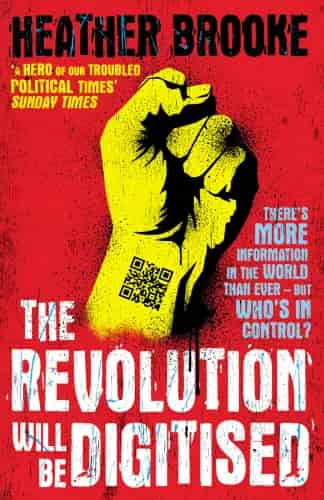
 The Revolution will be Digitised
Being a professional journalist is rather like training to be a lawyer. There's a certain amount you can learn in school but largely it is a vocation learned through practice, with scepticism being a primary attribute.
p. 70
The Revolution will be DigitisedWe seek a saviour, someone to rescue us from the problems of the world. A saviour is the simple story, the easy option and that is why it is so compelling. You don't have to do anything except believe. There's no need to negotiate with other people, or figure out how to create a robust system within the bizarre and contradictory parameters of human nature. I must admit I fell prey to this when I first met Julian Assange. He was going to lead the way to a bold new age. Instead I learned that power when concentrated is dangerous no matter who holds it or for whatever good intention. The real revolution happens in our own minds, when we stop believing there is someone or some agency who has all the answers, who is infallible and will save us, and instead come to realise we have that ability within ourselves. We may be susceptible to cults of personality, but we can build a check against this into our political systems.
p. 237
The Revolution will be DigitisedBureaucracy is the business of controlling other humans, making them do what you want them to do. That may be acceptable if what you are asking them to do is reasonable, rational and for the common good, but more likely what bureaucrats ask is treasonable, nonsensical and counterproductive to the public good. This is because the primary business of a bureaucrat, left unchecked, is creating more bureaucracy to further his or her own prestige and power. The result is that rules are in place serving no function but to keep bureaucrats in work and to expand their bureaucratic fiefdom. Before you know it you can't even hold a village fete without filling out more than fifteen different forms from various arms of the government.
p. 92
 The Silent State
There are three main things the public need to know about courts:
The Silent StateOnce the right of the people to see justice being done is eroded, it is not long before there is no justice at all.
p. 185
The Silent StateIn the public sphere, perception is reality: it's more important to be seen to do something than actually to do it. At least when private companies use PR and advertising they must spend their own money and there are other corporations vying for our business. If a company doesn't give us what we want they face bankruptcy. Public institutions, however, are monopolies. We have no choice but to buy, if not use, their services. If we don't like the way our particular police force operates it's not like we can choose another one or even withhold the money used to run the one we don't like. We're forced - under threat of imprisonment - to pay for a monopoly service and for it to tell us how great it is. This is the real danger of institutional PR. In the absence of competition it is only through a diversity of opinion and public scrutiny that some level of accountability can exist. PR stifles debate and suppresses opinion through the use of centralized press offices and communication protocols.
p. 45
The Silent StateWhen a politician claims for example that 'crime is down' since he implemented a certain policy, it is the professional investigative journalist who knows the raw data on which this statement is based (criminal incident reports) and who asks for verification. He or she can then go to other sources to question the veracity of the data. The reason I specialise in the intricate details of bureaucracy isn't because I have a passion for paper-pushers, but rather because I need to know all the types of information collected, by whom and where they are stored so I can get my hands on them. A statement isn't a fact. Even when the person making the statement is an authority he or she still needs to provide evidence or proof that what they say is the truth and a professional journalist should be asking for this proof and supplying it for public scrutiny. All this accumulating of statements, data and information which then has to be verified takes time. But this is the only thing a journalist does that marks him out as a professional. It's the only reason anyone would choose a well-known newspaper's website over an unknown blog. The newspaper as a brand has built up, over time, a reputation for challenging the powerful and giving people meaningful, true information. The press is not like any other business and what it sells shouldn't just be rehashed press releases or celebrity gossip, but the civic information necessary for people to understand their society and participate in it. It is a check on political and financial power, or at least it should be.
p. 72
The Revolution will be Digitised

That’s all the quotes.
8 quotes in the collection · come back when we add more