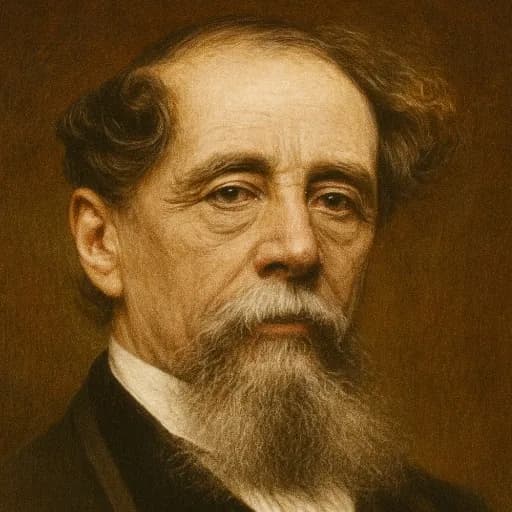
Charles Dickens
Quotes
"The boy’s eyes, which had been fixed on mine, slowly turned to the looker-on, and I saw in the two faces that all he said was true. The two opposing kinds of pride confronting one another, I can see, even in this Bastille; the gentleman’s, all negligent indifference; the peasants, all trodden-down sentiment, and passionate revenge."
So wicked do destruction and secrecy appear to honest minds, that Mr. Lorry and Miss Pross, while engaged in the commission of their deed [hiding Dr Manette's shoe-making bench] and in the removal of its traces, almost felt, and almost looked, like accomplices in a horrible crime.
A beautiful world we live in, when it IS possible, and when many other such things are possible, and not only possible, but done—done, see you!—under that sky there, every day. Long live the Devil. Let us go on.
Sadly, sadly, the sun rose; it rose upon no sadder sight than the man of good abilities and good emotions, incapable of their directed exercise, incapable of his own help and his own happiness, sensible of the blight on him, and resigning himself to let it eat him away.
It was remembered afterwards that when he bent down and touched her face with his lips, he murmured some words. The child, who was nearest to him, told them afterwards, and told her grandchildren when she was a handsome old lady, that she heard him say, "A life you love."
Before that unjust Tribunal, there was little or no order of procedure, ensuring to any accused person any reasonable hearing. There could have been no such Revolution, if all laws, forms, and ceremonies, had not first been so monstrously abused, that the suicidal vengeance of the Revolution was to scatter them all to the winds.
But indeed, at that time, putting to death was a recipe much in vogue with all trades and professions, and not least of all with Tellson's. Death is Nature's remedy for all things, and why not Legislation's?
Like the mariner in the old story, the winds and streams had driven him within the influence of the Loadstone Rock, and it was drawing him to itself, and he must go. Everything that arose before his mind drifted him on, faster and faster, more and more steadily, to the terrible attraction. His latent uneasiness had been, that bad aims were being worked out in his own unhappy land by bad instruments, and that he who could not fail to know that he was better than they, was not there, trying to do something to stay bloodshed, and assert the claims of mercy and humanity.
These are mere business relations, miss; there is no friendship in them, no particular interest, nothing like sentiment. I have passed from one to another, in the course of my business life, just as I pass from one of our customers to another in the course of my business day; in short, I have no feelings; I am a mere machine. To go on...
Samples of a people that had undergone a terrible grinding and regrinding in the mill, and certainly not in the fabulous mill which ground old people young, shivered at every corner, passed in and out at every doorway, looked from every window, fluttered in every vestige of a garment that the wind shook. The mill which had worked them down, was the mill that grinds young people old; the children had ancient faces and grave voices; and upon them, and upon the grown faces, and ploughed into every furrow of age and coming up afresh, was the sigh, Hunger. It was prevalent everywhere. Hunger was pushed out of the tall houses, in the wretched clothing that hung upon poles and lines; Hunger was patched into them with straw and rag and wood and paper; Hunger was repeated in every fragment of the small modicum of firewood that the man sawed off; Hunger stared down from the smokeless chimneys, and stared up from the filthy street that had no offal, among its refuse, of anything to eat. Hunger was the inscription on the baker's shelves, written in every small loaf of his scanty stock of bad bread; at the sausage-shop, in every dead-dog preparation that was offered for sale. Hunger rattled its dry bones among the roasting chestnuts in the turned cylinder; Hunger was shred into atomics in every farthing porringer of husky chips of potato, fried with some reluctant drops of oil.
Whatever might befall now, he must on to his journey’s end. Not a mean village closed upon him, not a common barrier dropped across the road behind him, but he knew it to be another iron door in the series that was barred between him and England. The universal watchfulness so encompassed him, that if he had been taken in a net, or were being forwarded to his destination in a cage, he could not have felt his freedom more completely gone.
"Repression is the only lasting philosophy. The dark deference of fear and slavery, my friend," observed the Marquis, "will keep the dogs obedient to the whip, as long as this roof," looking up to it, "shuts out the sky."