Quotes
Apocalypses, apparently, are subject to fashion like everything else. What terrifies one generation can seem obsolete and trivial to the next. Take our modern attitude toward war. Most anthropologists now think this activity was based originally on theft and rape—perhaps rewarding enterprises for some caveman or Viking, but no longer either sexy or profitable in the context of nuclear holocaust! Today, we look back on large-scale warfare as an essentially silly enterprise.
p. 48
The abbot snapped off the set. "Where’s the truth”? he asked quietly. “What’s to be believed? Or does it matter at all? When mass murder’s been answered with mass murder, rape with rape, hate with hate, there’s no longer much meaning in asking whose ax is the bloodier. Evil, on evil, piled on evil. Was there any justification in our ‘police action’ in space? How can we know? Certainly there was no justification for what they did — or was there? We only know what that thing says, and that thing is a captive. The Asian radio has to say what will least displease its government; ours has to say what will least displease our fine patriotic opinionated rabble, which is what, coincidentally, the government wants it to say anyhow, so where’s the difference?"
Why must I conquer you ask? War makes clear. Life or Death. Freedom or Bondage. War strikes the sediment from the water of life.
If the West has its military-industrial complex, we in the ex-Yugoslavia had a poetic-military complex: the post-Yugoslav was was triggered by a mixture of poetic and military components.
p. 31
When the sword is once drawn, the passions of men observe no bounds of moderation. The suggestions of wounded pride, the instigations of irritated resentment, would be apt to carry the States against which the arms of the Union were exerted, to any extremes necessary to avenge the affront or to avoid the disgrace of submission. The first war of this kind would probably terminate in a dissolution of the Union.
Let us recollect that peace or war will not always be left to our option; that however moderate or unambitious we may be, we cannot count upon the moderation, or hope to extinguish the ambition of others.
It was possibly the most circumspect advance in the history of military maneuvers, right down at the bottom end of the scale that things like the Charge of the Light Brigade are at the top of. (p. 70)
The famous Battle of Morpork, he strongly suspected had consisted of about two thousand men lost in a swamp on a cold, wet day, hacking one another into oblivion with rusty swords. What would the last King of Ankh have said to a pack of ragged men who knew they were outnumbered, outflanked and outgeneralled? Something with bite, something with edge, something like a drink of brandy to a dying man; no logic, no explanation, just words that would reach right down through a tired man's brain and pull him to his feet by his testicles.
I have told my sons that they are not under any circumstances to take part in massacres, and that the news of massacres of enemies is not to fill them with satisfaction or glee.
I have also told them not to work for companies which make massacre machinery, and to express contempt for people who think we need machinery like that. (p. 19)
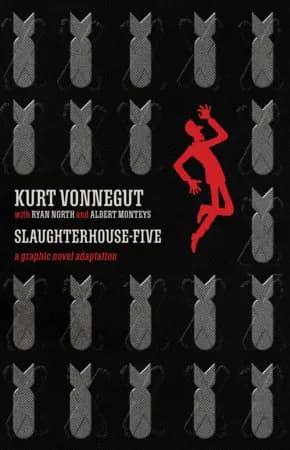
American planes, full of holes and wounded men and corpses, took off backwards from an airfield in England. Over France, a few German fighter planes flew at them backwards, sucked bullets and shell fragments from some of the planes and crewmen. They did the same for wrecked American bombers on the ground, and those planes flew up backwards to join the formation.
The formation flew backwards over a German city that was in flames. The bombers opened their bomb bay doors, exerted a miraculous magnetism which shrunk the fires, gathered them into cylindrical steel containers, and lifted the containers into the bellies of the planes. The Germans below had miraculous devices of their own, which were long steel tubes. They used them to suck more fragments from the crewmen and planes. But there were still a few wounded Americans, though, and some of the bombers were in bad repair. Over France, though, German fighters came up again, made everything and everybody as good as new.
When the bombers got back to their base, the steel cylinders were taken from the racks and shipped back to the United States of America, where factories were operating night and day, dismantling the cylinders, separating the dangerous contents into minerals. Touchingly, it was mainly women who did this work. The minerals were then shipped to specialists in remote areas. It was their business to put them into the ground, to hide them cleverly, so they would never hurt anybody ever again.
The American fliers turned in their uniforms, became high school kids. And Hitler turned into a baby, Billy Pilgrim supposed. That wasn't in the movie. Billy was extrapolating. Everybody turned into a baby, and all humanity, without exception, conspired biologically to produce two perfect people named Adam and Eve, he supposed. (pp. 74-75)
You know — we've had to imagine the war here, and we have imagined that it was being fought by aging men like ourselves. We had forgotten that wars were fought by babies. When I saw those freshly shaved faces, it was a shock. "'My God, my God — ' I said to myself, 'It's the Children's Crusade.'" (p. 106)
It is so short and jumbled and jangled, Sam, because there is nothing intelligent to say about a massacre. Everybody is supposed to be dead, to never say anything or want anything ever again. Everything is supposed to be very quiet after a massacre, and it always is, except for the birds.
And what do the birds say? All there is to say about a massacre, things like "Poo-tee-weet?"
p. 19