Quotes
"You know what I say to people when I hear they're writing anti-war books?"
"No. What do you say, Harrison Starr?"
"I say, 'Why don't you write an anti-glacier book instead?'"
What he meant, of course, was that there would always be wars, that they were as easy to stop as glaciers. I believe that too.
And even if wars didn't keep coming like glaciers, there would still be plain old death.
The nicest veterans in Schenectady, I thought, the kindest and funniest ones, the ones who hated war the most, were the ones who’d really fought. (p. 11)
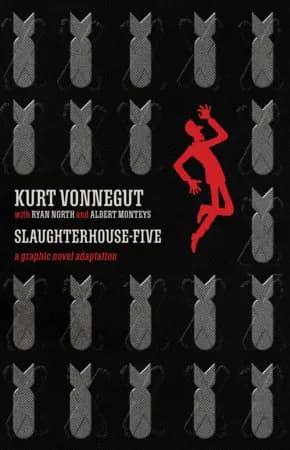
"I think the climax of the book will be the execution of poor old Edgar Derby," I said. "The irony is so great. A whole city gets burned down, and thousands of people are killed. And then this one American foot soldier is arrested in the ruins for taking a teapot. And he's given a regular trial, and then he's shot by a firing squad." (pp. 4-5)
"You were just babies then!" she said.
"What?" I said.
"You were just babies in the war — like the ones upstairs!"
I nodded that this was true. We had been foolish virgins in the war, right at the end of childhood.
"But you're not going to write it that way, are you." This wasn't a question. It was an accusation.
"I — I don't know," I said.
"Well I know," she said. "You'll pretend you were men instead of babies, and you'll be portrayed in the movies by Frank Sinatra and John Wayne or some of those other glamorous, war-loving, dirty old men. And war will look just wonderful, so we'll have a lot more of them. And they'll be fought by babies like the babies upstairs."
So then I understood. It was war that made her so angry. She didn't want her babies or anybody else's babies killed in wars. And she thought wars were partly encouraged by books and movies.
So I held up my right hand and I made her a promise: "Mary," I said, "I don't think this book of mine is ever going to be finished. I must have written five thousand pages by now, and thrown them all away. If I ever do finish it, though, I give you my word of honor: there won't be a part for Frank Sinatra or John Wayne.
"I tell you what," I said, "I'll call it The Children's Crusade."
She was my friend after that.
p. 14
Young men go to war. Sometimes because they are have to, sometimes because they want to. Always, they feel they are supposed to. This comes from the sad, layered stories of life, which over the centuries have seen courage confused with picking up arms, and cowardice confused with laying them down.
Try to remember this lesson. It might keep you alive a little longer. The most precious thing to a human being is a mind-set: more precious than one’s own life, even. Human history has taught us that lesson time and again, with its endless parade of wars—human sacrifices en masse—thousands of deaths over the most trivial of differences of religious interpretation.
p. 669
[T]here was never an army that did not accuse its enemies of barbarity.
That’s one thing about these religious boys—they reckon that if they are on God’s side, then the enemy must be on the devil’s, and so they have no qualms about giving it to ’em hot and strong.
p. 112
What were several fewer species of animals compared with a hundred-mile advance and another medal on another general?
p. 110
You are a fool to speak of last great battles, Sam, for the last great battle is always the next one.
p. 181
You do not understand what happens in war—a sort of sublime madness, an unholy hatred that is twisted into an unreasoning sense of righteousness…
p. 62
Someone must have known, but I never did. I have often wondered. It was the only way, you see, that a war could still be fought. No human could go to fight that kind of war. So man’s servants and companions, the machines, carried on the war. I don’t know why they kept on fighting. I have often asked myself. They’d destroyed all there’d ever been to fight for and there was not use of keeping on.
p. 40